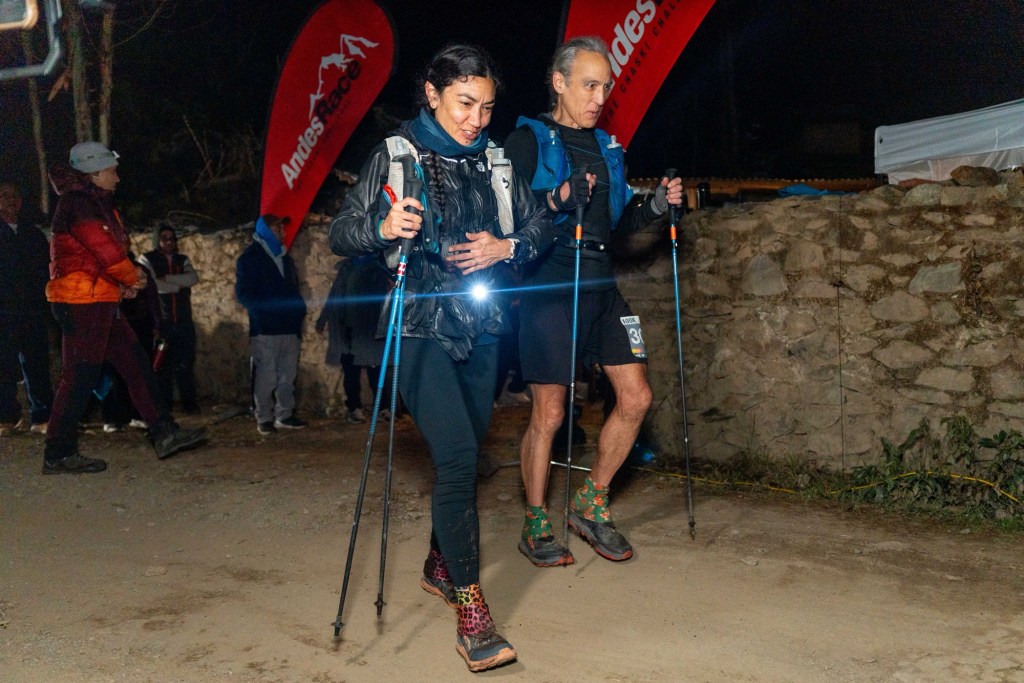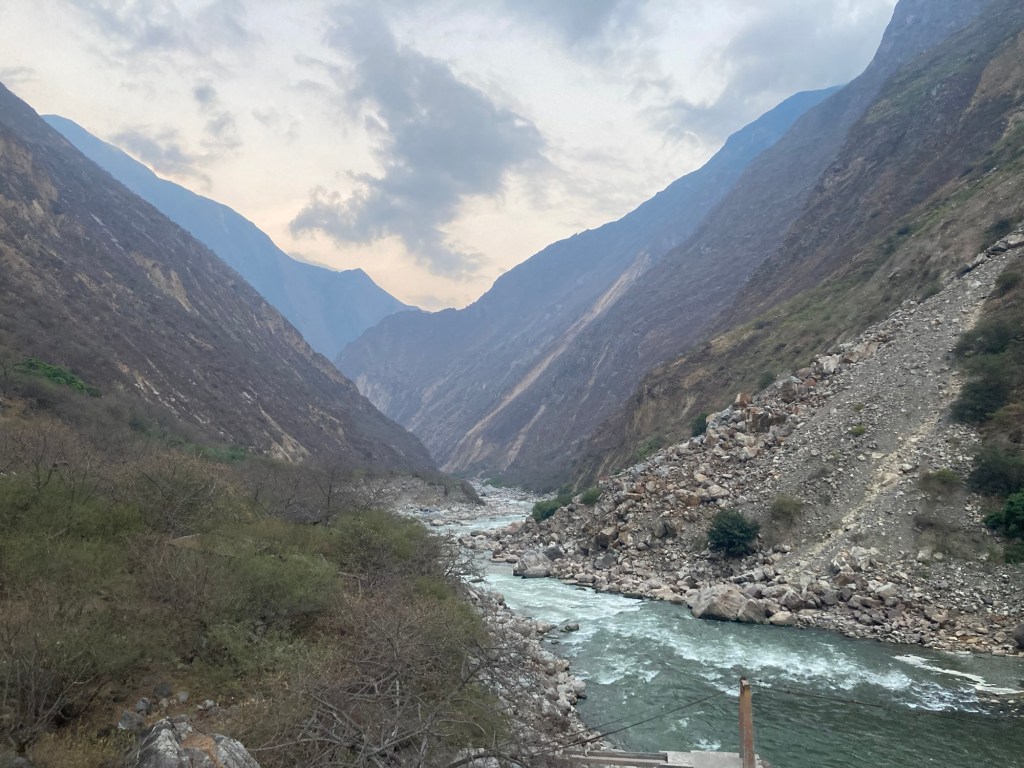
Andes 101k – 8.14.26

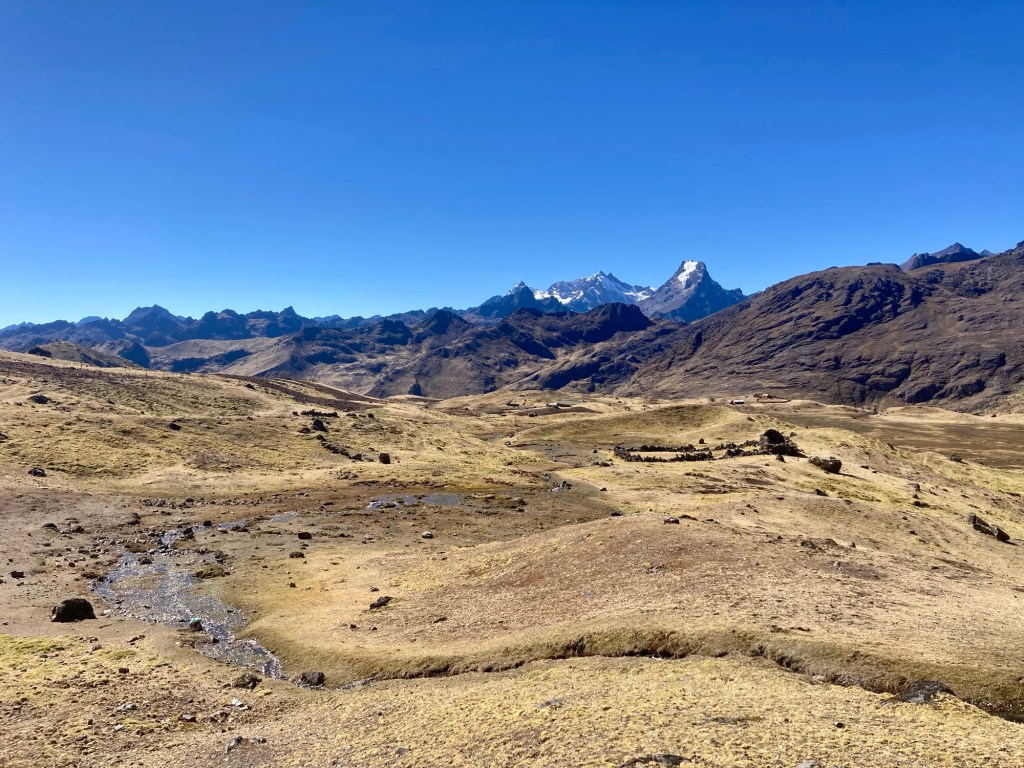
The Andes 101k is considered one of the toughest races in the world. It has approximately 18,600 ft of elevation gain in 63 miles, with the lowest point on course at approximately 10,000 ft and the highest point at 15,500 ft. It takes place in August during the Peruvian winter time aka the “dry season” which means intense sun during the day and very cold nights. The 3 pm start time means runners will only get 3 hours of daylight in before heading into the dark and cold for the next 12 hours. 

I first heard of the Andes 1001k from an article in Outside Online. The title read something like this: “This epic ultramarathon has more llamas than runners”. It talked about the inspiration behind the race; Incan messengers called chasquis who collectively traveled up to 200 kilometers on foot to deliver messages. With no written language, these messages were often in the form of tied knots. Each chasqui would cover 6-9 kilometers before passing their message on to the next chasqui. In this way, information could travel up to 200 kilometers in one day. Rich in Incan history and soaked in local tradition, this race immediately planted itself on my bucket list. 

After 3 years of heading to Italy for the Tor des Geants, a race that had taken a firm grasp of our hearts, Yuch and I decided it was time for something very different. We decided it was time to go to Peru! I had gone for the first time in 2018 with my sister, cousin, and aunt, but had always wanted to go back with Yuch. I especially wanted to spend more time in Cusco and the Sacred Valley. 

We arrived to Peru two weeks before the race. At this point I was pretty much in “taper mode” aside from a couple of long runs we had planned at altitude. An unusual taper, but in the end it all worked out! The first few days were spent in Arequipa at 7,660 ft. This is a great place to start acclimatizing if you are coming straight from sea level. We did a very short  sightseeing run in Arequipa to break the ice. Arequipa is a beautiful city and you really can’t go anywhere without seeing its 3 volcanoes – El Misti, Chachani, and Pichu Pichu.
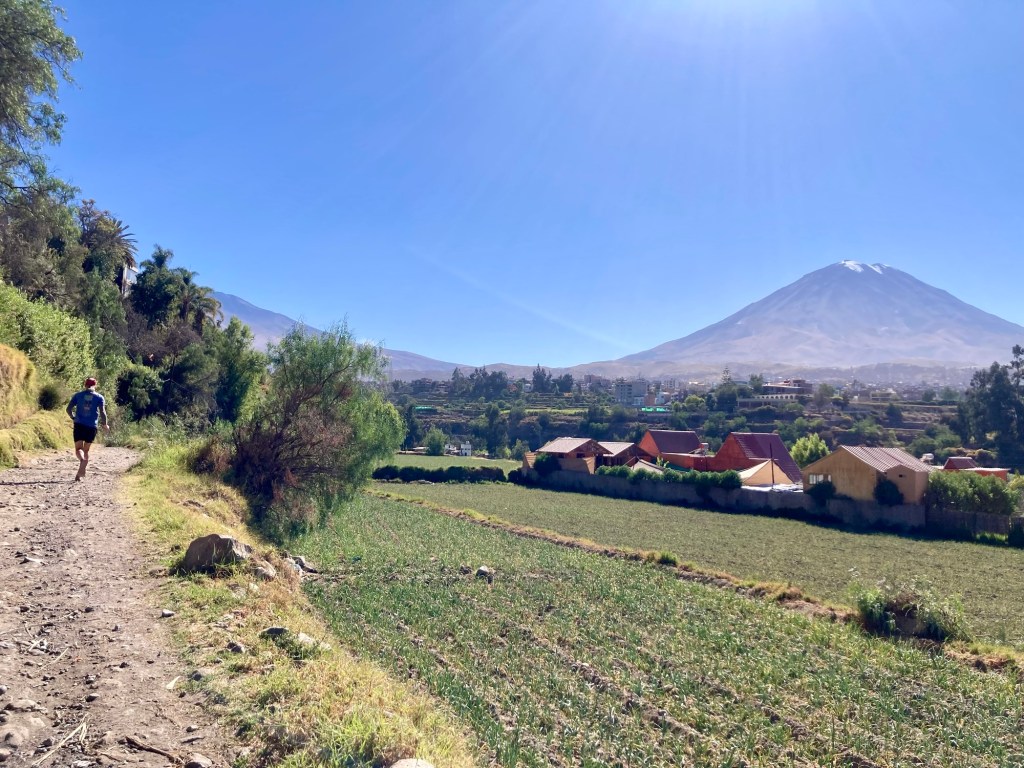
El Misti in the background

We then headed to Cabanaconde at 10,800 ft and ran an 18 mile loop in the Colca Canyon. This was a great first run at altitude to do. We took it fairly easy but got some good time on feet in. Afterwards, we headed to Cusco which sits at approximately 11,150 ft. We ran 31 miles to, from, and in Choquequirao, getting some more solid time on feet at higher altitude. Moving at altitude still felt hard, but I could tell it was getting easier. Outside of a ton of walking and sightseeing, these were the only 3 runs I did in the two weeks prior to race day. 

The Andes 100k is a point to point race. It starts in a town called Huaran and ends in Ollantaytambo. The race organizes busses to transport runners from Cusco to Huaran before the race as well as back to Cusco from Ollantaytambo afterwards. We decided to stay in Ollantaytambo and catch a ride to the start. That way we could stumble to our Airbnb after the race. I highly recommend this option! 

Ollantaytambo is a beautiful town in the Sacred Valley that is rich with Incan history. Aside from the ruins there that are commonly included in the Sacred Valley/Cusco ruins tour, the town itself is one big Incan ruin. The original grid work that the Incans built for the town still exists in addition to much of the foundational stonework and canals. It really is quite beautiful and special to stay in a neighborhood with so much history. Sadly, in 2018 our tour group only toured the main ruins in Ollantaytambo and the tourist market so my previous experience in Ollantaytambo had been reserved for the “tourist” attractions only. 
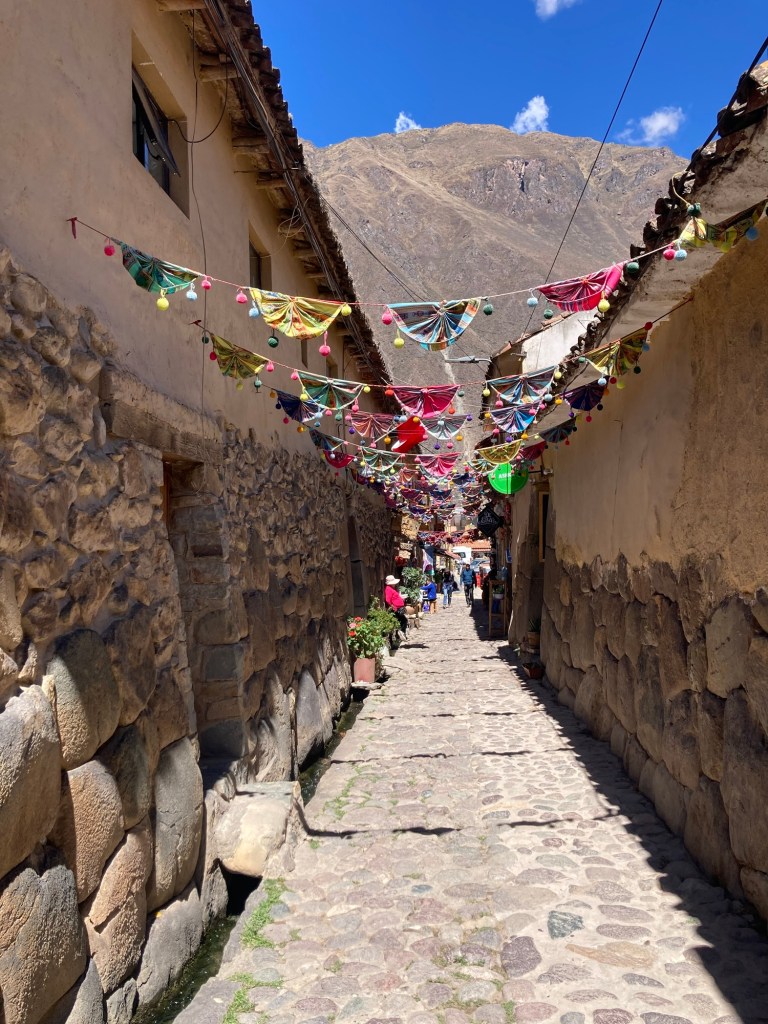
A typical street in Ollantaytambo with Incan stone foundation

We arrived to Ollantaytambo on the Wednesday before race day (Friday) via a bus from Cusco. That morning we had stopped by the “bib pickup” in Cusco although they called it “Kit delivery” so we nearly missed picking up our bibs. 

In Ollantaytambo, our Airbnb was just minutes from the main square, had some original Incan stones inside the premises, and had a great view of the mountains from the second floor. That night we ate at a vegan restaurant around the corner from our place. Did I mention that we have eaten 100% vegetarian and vegan this entire trip? Do not be afraid of Peru if you are either. The food and restaurants are excellent. 
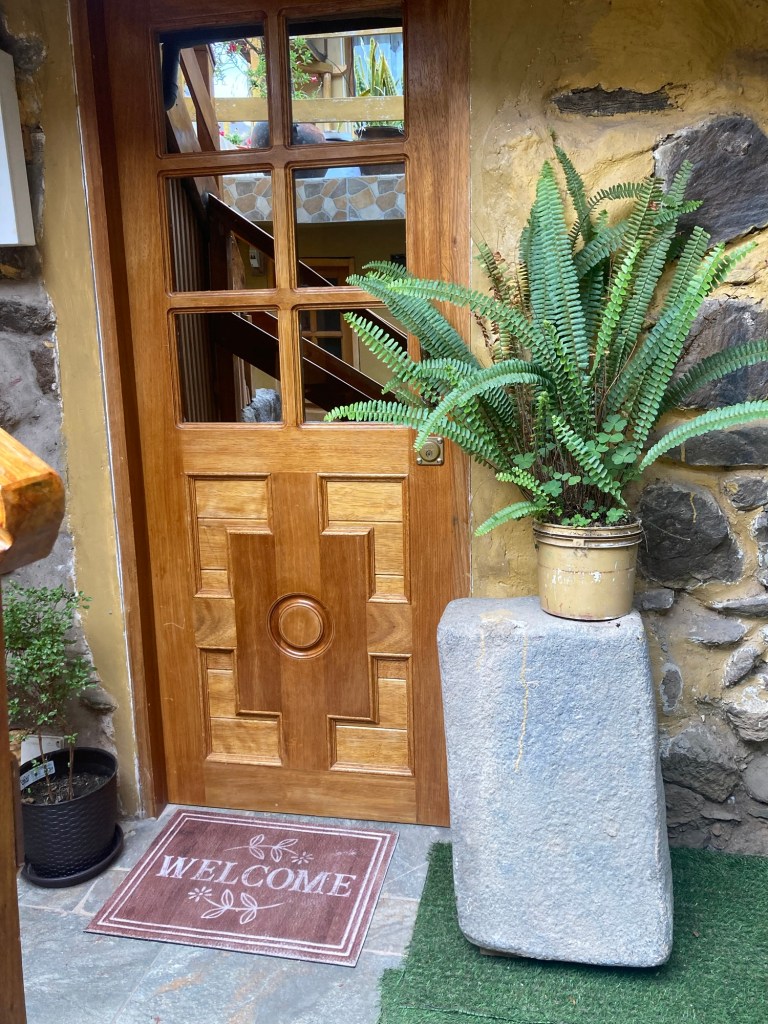
Airbnb front porch with Incan stone

The Thursday before the race we did very little other than organize our packs. Despite being at much higher altitude than the Tor and having much more extreme temperature ranges, I was surprised at how minimal the gear requirements were. That being said, my pack was still very similar to what it looked like at the Tor. The main difference was that the Andes 100k required the following items that I have never seen on a prior required gear list for a race: a mirror, a rear red blinky light, and a pocketknife. We had purchased the first two on Amazon prior to our trip, but unfortunately both of our pocket knives had been confiscated at various points on our trip (because knives are illegal to bring on planes, people). I vowed to not spend any more money on a pocket knife while Yuch was concerned that we wouldn’t be allowed to do the race without it. In the end we ended up spending 69 and 79 soles on two brand new Swiss Army knives from an outdoor store in Cusco. I loved my new shiny little pocketknife, but I knew I couldn’t get too attached as we would again be pulled apart after the race was over. 

Friday morning we walked over to the square around 11:30 am with the plan of finding a ride on the spot. There are so many drivers that are looking to make some extra money. We knew we wouldn’t have a problem finding a ride to Huaran, but we also wanted to make sure we left a sufficient buffer. As soon as we walked into the square, we were approached by someone. And just like that we had a ride. 
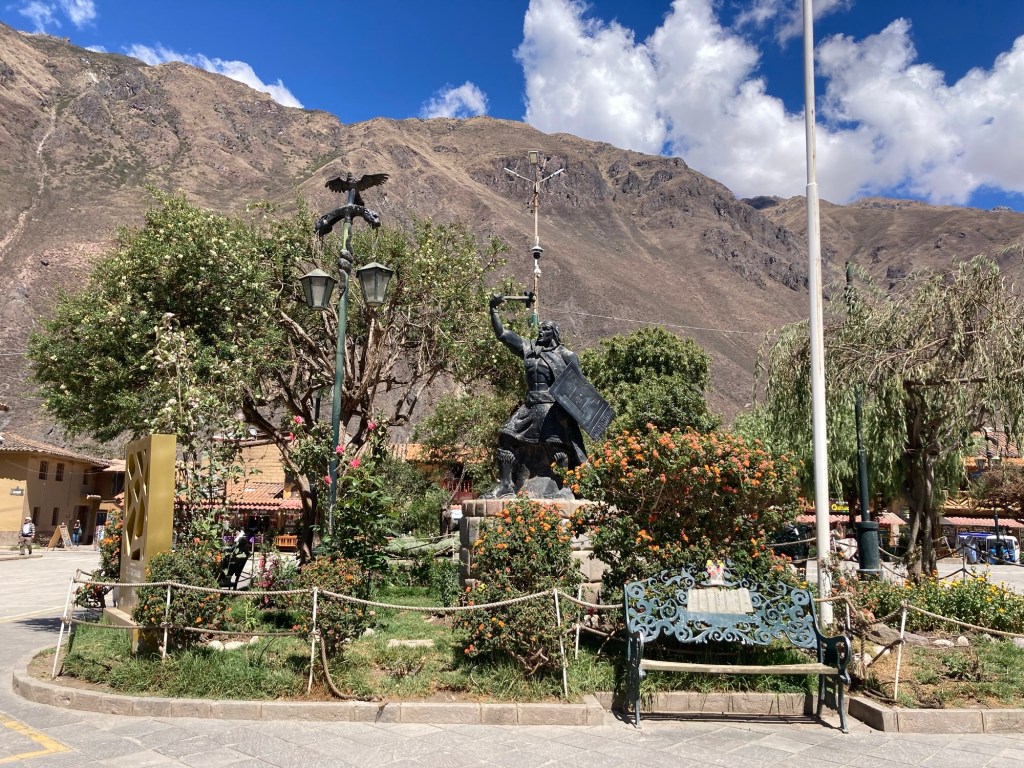
Ollantaytambo Plaza de Armas with Pachacuteq statue and lamp post with snake, puma, and condor

We arrived to the race start around 12:30, a whole 2.5 hours prior to race start. The “start” was essentially a house/villa with a bunch of runners hanging out, putting on sunblock, and organizing their packs. This is a tiny race and I would soon learn that there were only 4 women doing the 100k. I wasn’t sure if I should be excited or scared. I had a lot of fear going into this race that is now hard to explain after the fact. Probably it had to do with going into the “unknown”, a place that some people find exciting but for me; terrifying. I kept reminding myself that I’ve done the Tor, that this was nothing compared to that, but then I would remember that I’ve never been to anything higher than Mt. Whitney. What if I couldn’t handle the altitude and got HAPE (high altitude pulmonary edema) or what if it was so cold and my gear wasn’t enough to keep me warm? What if I was alone the whole race and got into a precarious situation? With such a small field I was surely going to end up alone. Yuch shared some of my concerns. While we hoped that at some point our paths would converge, we agreed that we should run our own races. There would be times when one of was stronger or weaker and it didn’t make sense to always be going the pace of the LCD (least common denominator). 
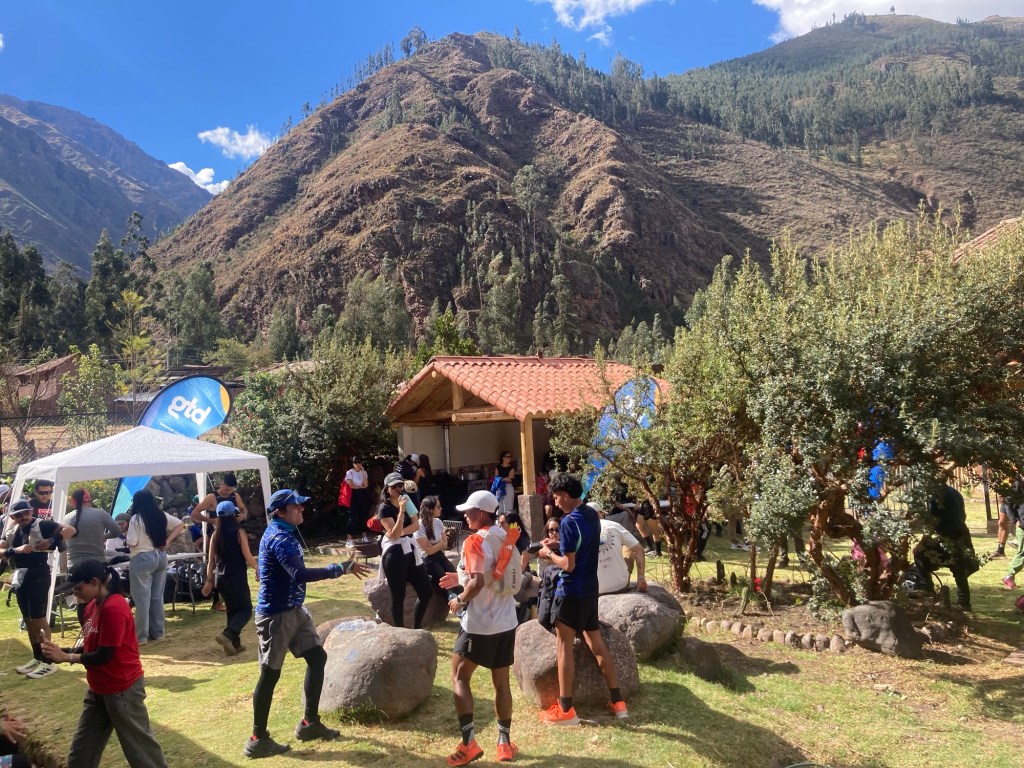
Race start area in Huaran

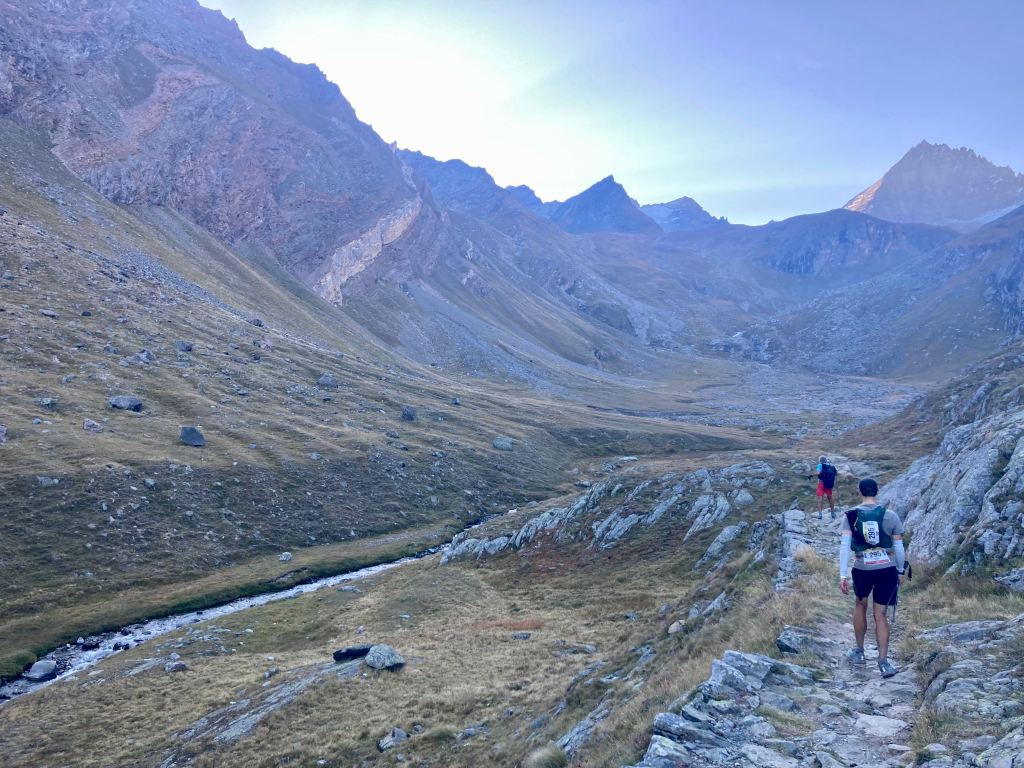
The race started at 3 pm and we were off. The course climbs 5,500 feet in the first ten miles with the first climb to Pachacutec at 15,500 ft. It started gradually on a wide fire road, yet running at altitude still felt difficult so I alternated between a jog and a hike; a jog when it was truly “runnable”, a hike with any increasing grade. I tried to keep up with Yuch but it was not possible. His jog/hike pace was clearly quicker than mine. I finally let go of the idea of hanging on to him. I would have to do this on my own. 
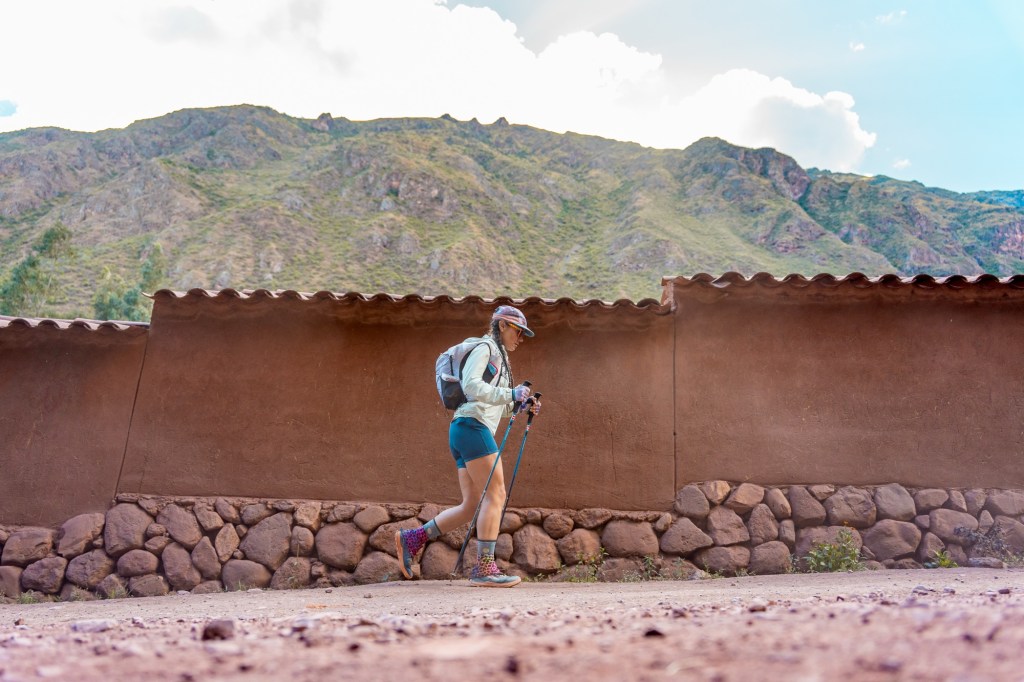
Leaving Huaran
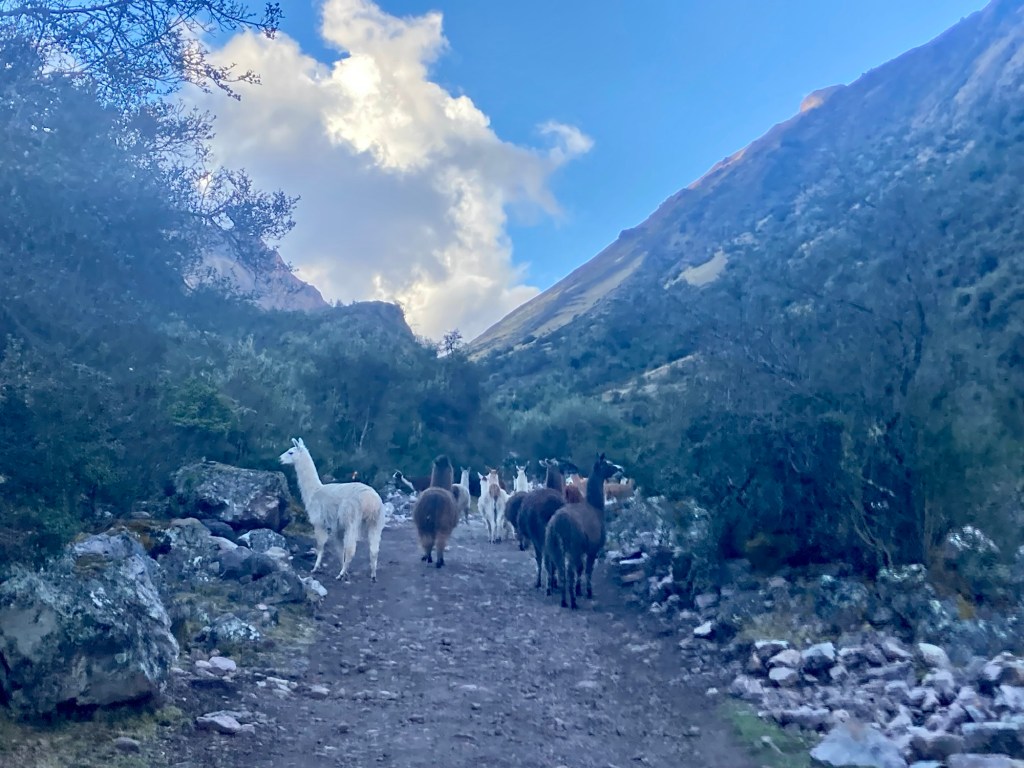
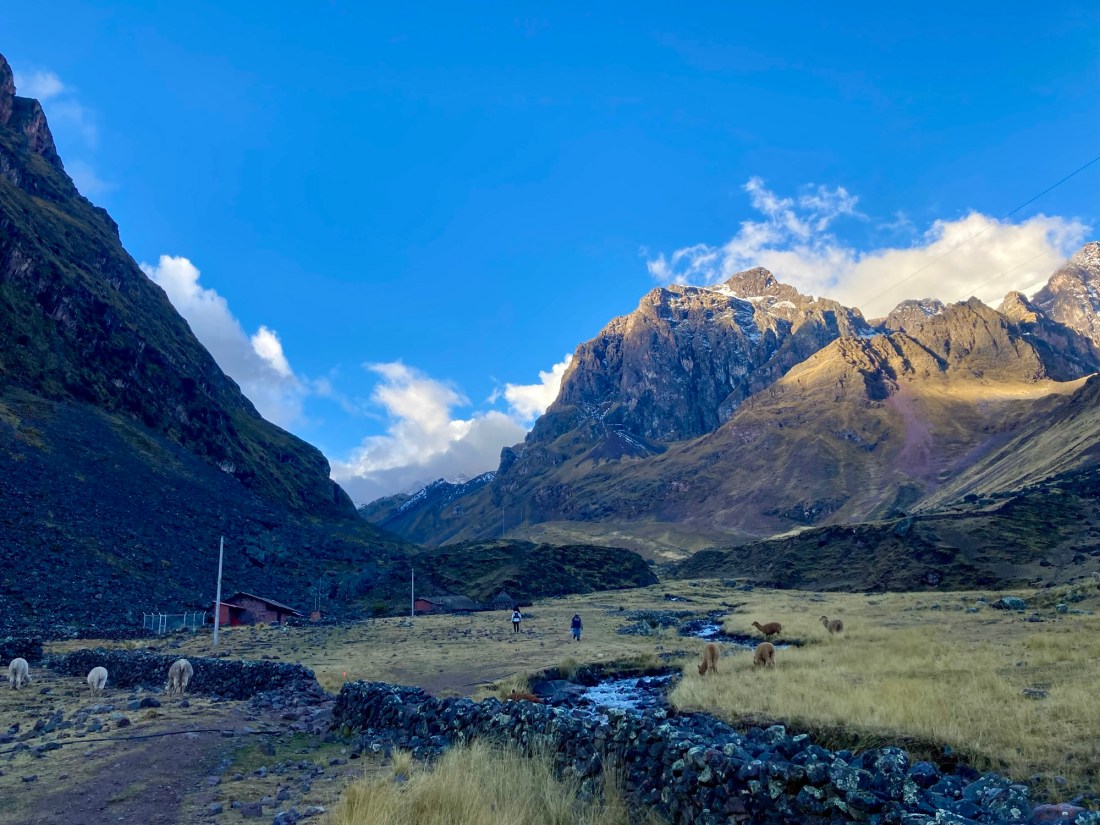
No Yuch to be seen, but muchas llamas

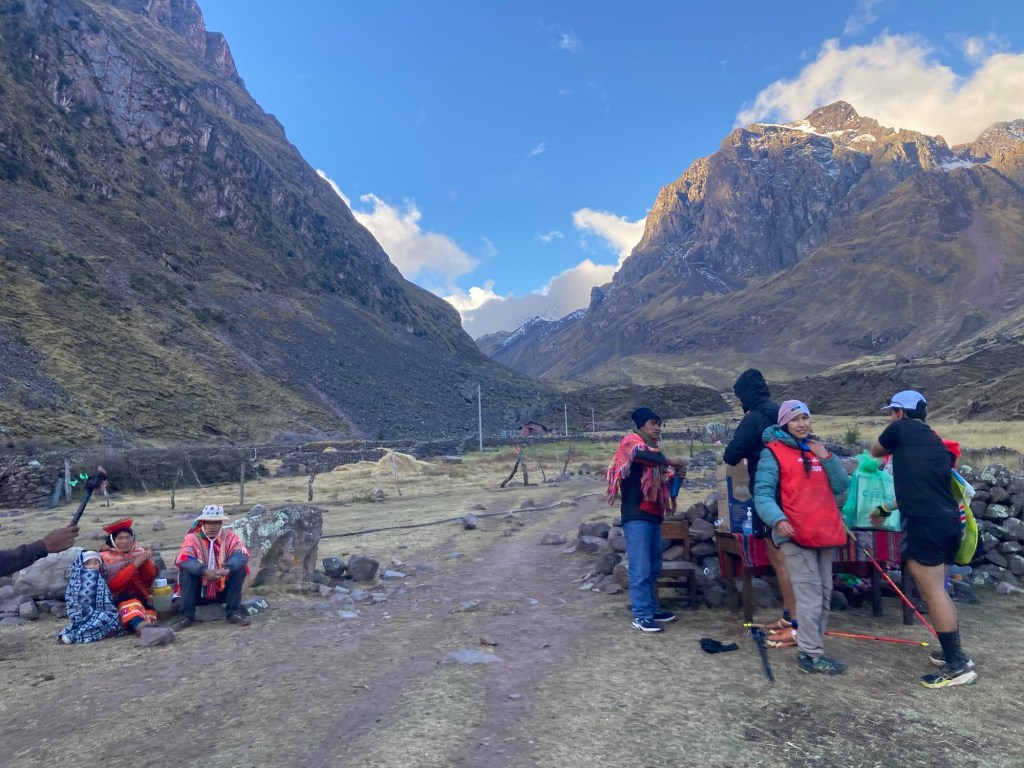
The first water station at Cancha Cancha surprised me. I had noted that there were aid stations every 20k until the 60k mark in which aid stations would be every 10k. However, I failed to note the water stations in between aid. Peruvians dressed in traditional Andean clothing were filling up runners water bottles, and families sat along the course spectating. I got my bottles topped off despite hardly drinking much for the last two hours. It had been slightly overcast to this point and now at 5 pm the sun was starting to get lower. It was starting to feel cold. 
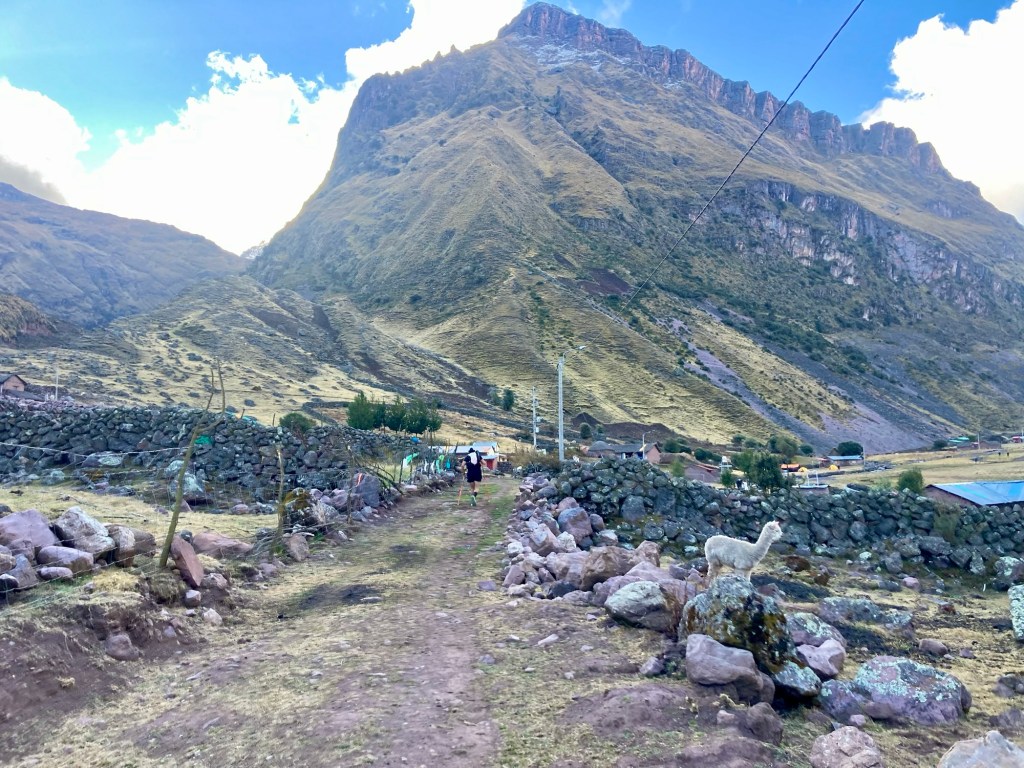
Arriving to Cancha Cancha
Water station #1 at Cancha Cancha

Shortly after leaving the water station I pulled aside to put on more layers. It would be one more hour until sunset and we were about to climb to the highest point on the course. I took my shoes and gaiters off and put my leggings on over my shorts. I put my smart wool base layer on followed by my down jacket, rain jacket, gloves, and buff. I basically had all my warm gear on. 
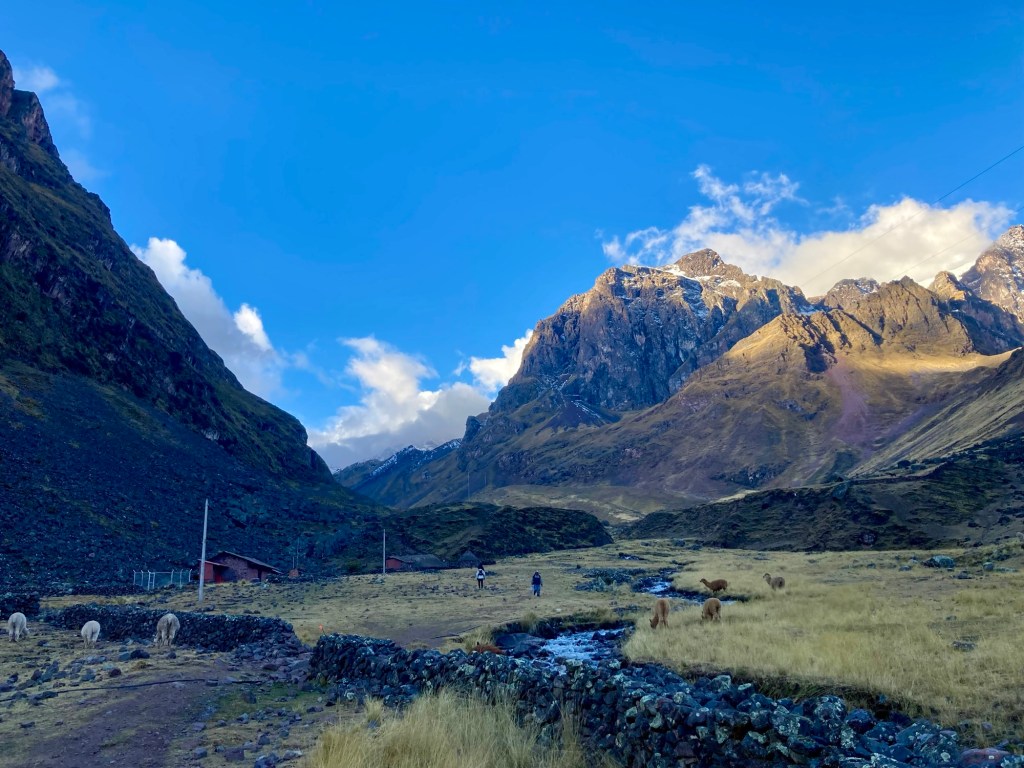
Leaving Cancha Cancha
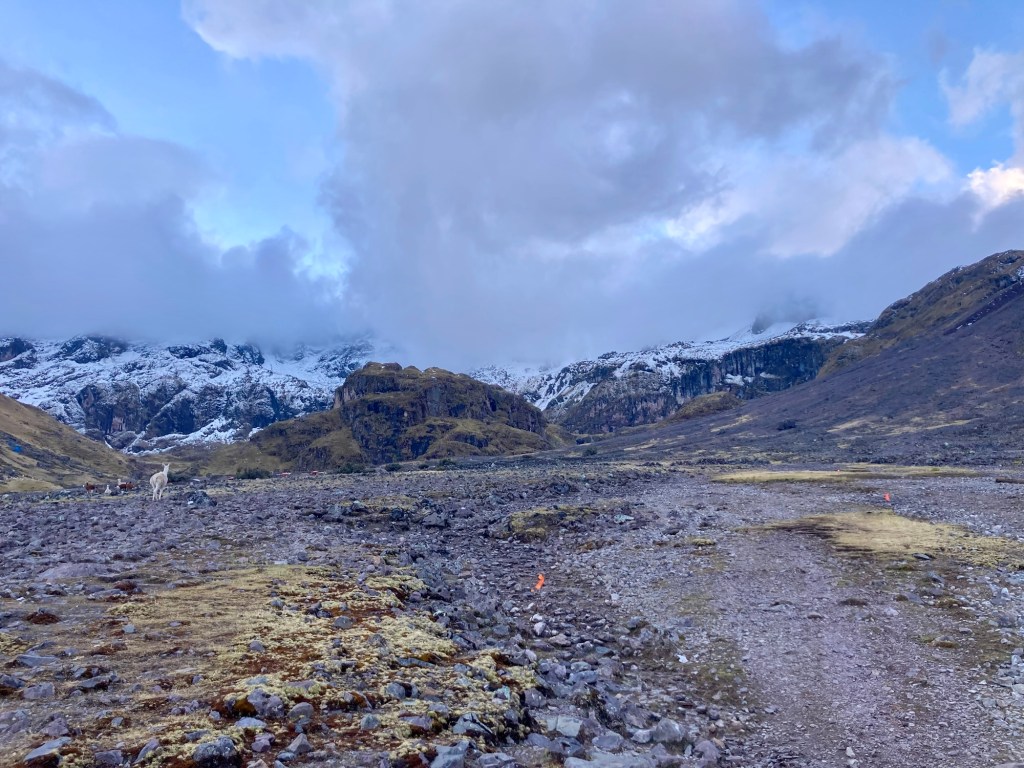
Snow up ahead as we ascend

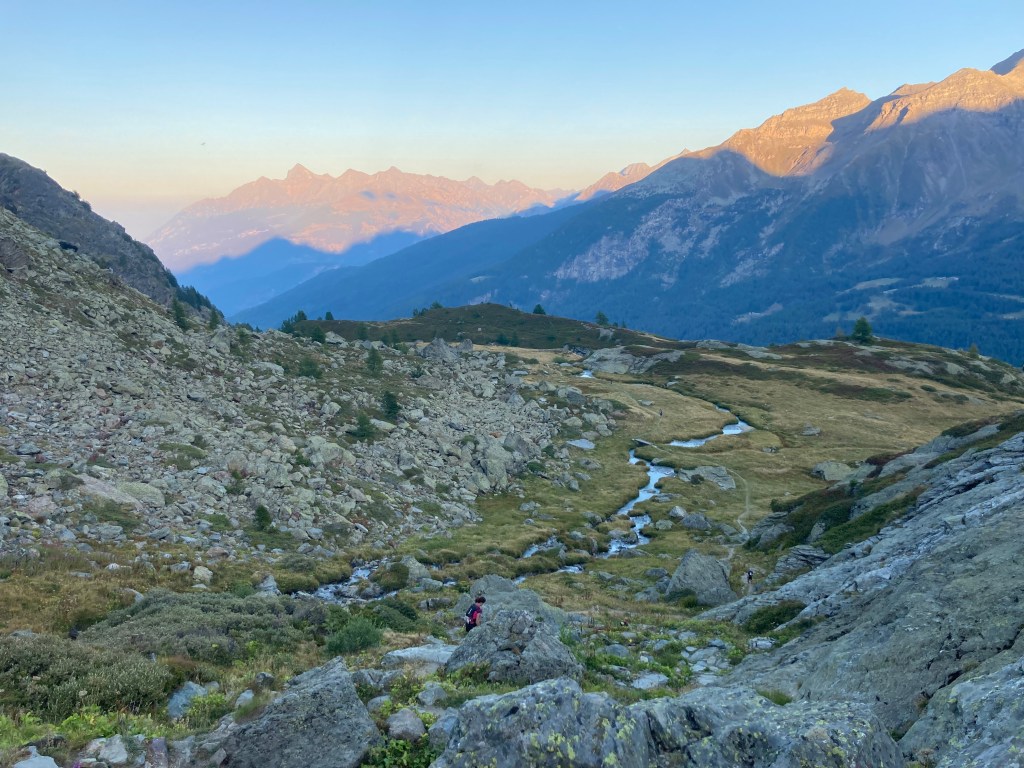
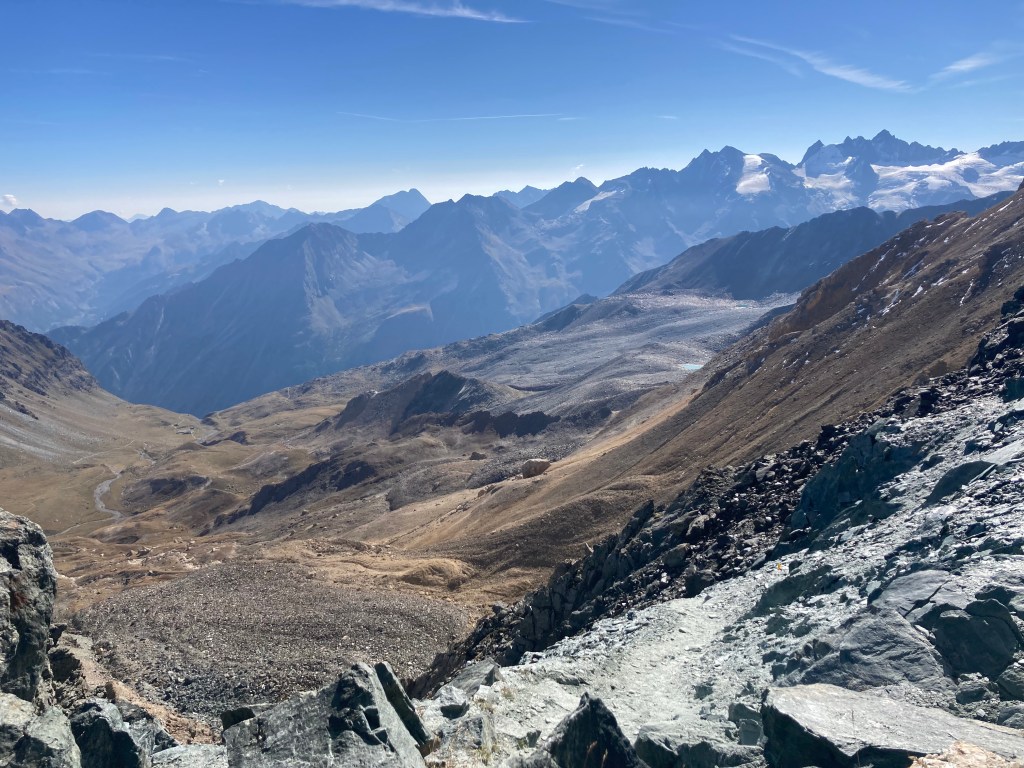
The ascent to 15,500 feet was beautiful. Snow surrounded the sides of trail but for the most part the trail was snow free – just muddy. As it got closer to 6 pm I took out my light belt. The summit was slightly anticlimactic as far as altitude goes. I didn’t notice a huge difference in my breathing, maybe because I was just going so slow in general. I lost sight of the race ribbons a few times and had to backtrack. At this time, I teamed up with two other Peruvians who had done the 60k the previous year. One of them, Jorge, spoke English but I still tried to practice my Spanish with him. A lot of our conversation was me speaking in Spanish and him speaking in English. Having been previously fearful of going into the race alone, it felt comforting to have a couple of newfound allies. 
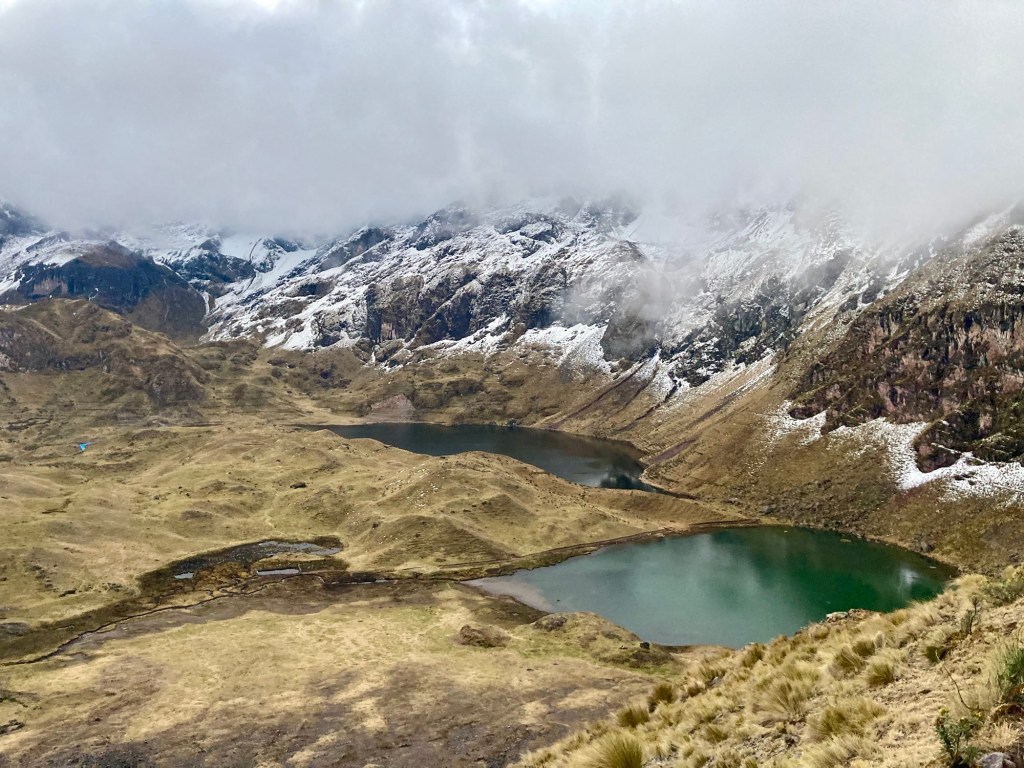
Last picture before sunset

On the descent down to the first aid station it felt noticeably good to come down in altitude. I noticed myself getting warmer and starting to sweat but couldn’t be bothered to take off any clothing. I wanted to keep the downhill momentum going. This attitude would also affect my fueling. I had been eating some but not nearly as much as I would normally in a race. I had planned on relying heavily on aid stations although I had my pack stocked with various bars, cookies, and sweet bread. I would wait until I got to the first aid station to eat some real food there. 

I reached the first aid station at Quishuarani, 22 kilometers in and now back down to 12,500 ft. I cursed myself for not stopping to take any layers off because everything was now sweaty and damp. I started to take everything off and the race organizers repeatedly asked me if I was okay and if I needed anything. Yuch and I would observe throughout the race how diligent the organizers were about checking in on runners safety. Despite having so much fear going into the race, I felt really safe the whole time and even safer knowing I was being looked after. As best as I could I tried to ensure them I was just “mojada” (wet), because I didn’t know how to say I was sweaty. In the end, I only ended up taking my undershirt off thinking it was the most damp, and putting everything else back on. I had some soup and instant coffee (although I really didn’t need the caffeine this early on) and continued on wondering how far ahead Yuch might be. I briefly paused at a fire pit with locals huddled around and warmed my hands for five seconds knowing I would be going back up into the cold, this time with sweaty clothes. 

The second ascent up to Hulliquisjasa was short and steep, about 3000 ft of gain in 3 kilometers. I caught up to my Arequipan friend, Jorge, just as he let out a loud “Fuuuuck!”To me, this was just a tiny snippet of the Tor, nothing more – power hiking under a beautiful night sky lit up by a thousand stars. I decided to practice my Spanish. I told him that when it got hard, I liked to remember why I do these things – to be in a beautiful place surrounded by beautiful things such as the night sky. 

The descent to the next aid station dropped us over 4,500 ft in about 15 kilometers. Hulliquisjasa had been at approximately 14,500 ft and the next aid at Lares would be just under 10,000 ft. On the descent I saw a light ahead of me and recognized the gait of the runner to which it belonged to. It was Yuch! I was beyond ecstatic and we ran into the 40k aid station together. 

At the Lares aid station I felt like a celebrity. People were photographing and filming us. A woman asked me what my name was so she could tag me on Instagram. I don’t have Instagram so I told her my name and she would end up referring to me as “Megan Konon” in a Facebook reel. Yuch told me he was feeling pretty wasted already 40k in and that his stomach was inhibiting him from eating. We took our time enjoying the hearty aid station soup and had 2 cups each. If I was not going to do a great job eating on the trail I wanted to make sure I took my time at the aid station. We agreed that this quinoa and veggie soup was the best aid station soup we had ever had. 
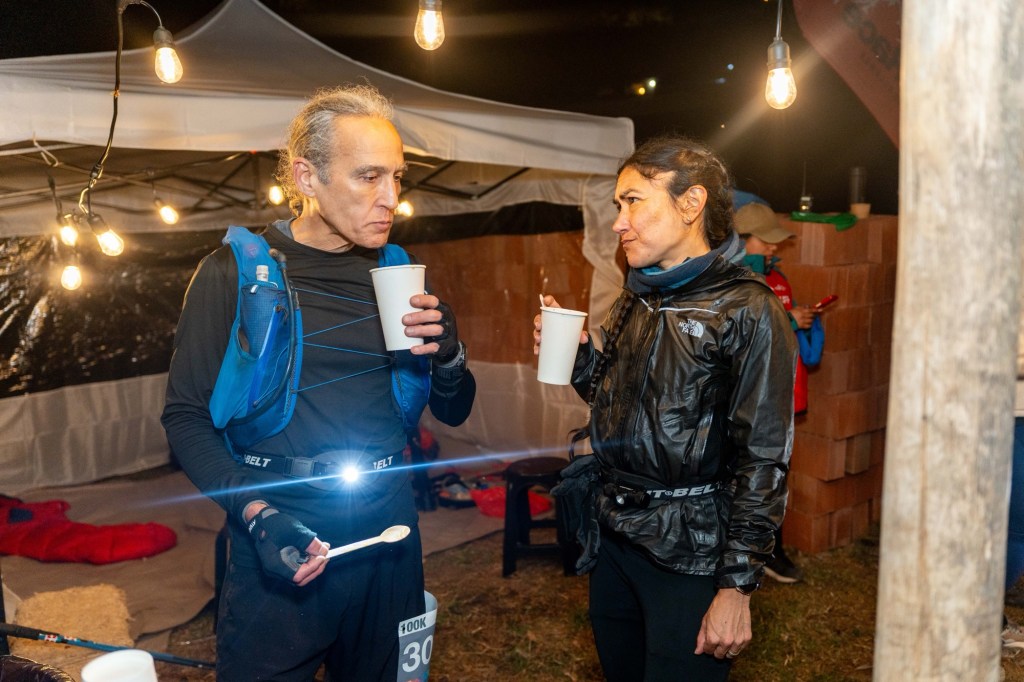
Yuch and I deliberating over quinoa soup at Lares, 40k in
Leaving Lares

Although the race profile does not exactly show it, we had a nice long runnable section after this aid station. The race director had told us we had about 9k of runnable trail and then we should look out for a turn. After that he said it was downright horrible, or something to that effect. 

It was clear when we got to the downright horrible section. We immediately starting climbing up the side of a mountain with no apparent trail, our eyes following the ribbons as best as possible. For whatever reason, the ribbons in this race are not as reflective as another ribbons I’ve seen at night. Yuch volunteered to lead and I was grateful to follow his footsteps instead of searching around for ribbons myself. In this first ascent we would climb 2500 ft in about 3 miles. 

We knew we were climbing to one of the coldest spots on the course, Chupani, at approximately 14,000 ft. The race director had mentioned at the pre-race briefing (which we did not go to but I saw a snippet online) that it was estimated to be -5 degrees at Chupani (which I gathered to be Celsius). Although Chupani was not nearly as high as the first climb at 15,500 ft, we would be getting there at one of the coldest parts of the day; early morning. 

We weren’t cold yet though because of all the climbing. In fact, we both had taken off our down jackets earlier and opted to hang them on the outside of our packs to dry out after being dampened with sweat from earlier on. 

On the way to Chupani I would constantly ask “are we there yet?” especially when we got to a flat section which I thought might be the top. But we were nowhere near the top. It would be another 5 miles of climbing and course finding before we would reach the official aid station at Chupani, at 58k. Around this time we observed a number of fresh runners passing us, with the keyword being “runners” because we were walking now. We were later told that this was the 60k race which had started at 1 am. It started to get colder and we finally stopped to put on all our remaining layers. The only layer Yuch had left that he was not wearing was his pants. 

We arrived to the Chupani aid station around 5:15 am. It didn’t feel like morning because it was pitch black and I’m not sure I had any concept of time having started this race at such an odd hour. The aid station was located in a nice closed building with a heat lamp. Yuch was still having stomach problems and now on top of that, he was shivering uncontrollably. We immediately got more of the quinoa soup to sip on and I added some potatoes to it hoping to bulk up my strongly lacking carb consumption. In the hot drink area they had hot water for instant coffee, coca and muña (mint) tea, and Milo (which I later learned is a Peruvian brand name for hot chocolate). I drank several cups of the tea and popped my first caffeine pill. Yuch was ahead of me on caffeine pills but they weren’t making a dent in him. He was exhausted, could not warm up, and still couldn’t take in much because of his stomach. He stood next to the heat lamp while I filled his soft flasks with hot water. He finally changed into his last layer, his pants. I ate some bread and cheese and lastly took some nuts and dried fruit for the road. We continued on into the cold. 

As we descended from Chupani, we started to warm up. Yuch was so exhausted he urged me multiple times to go on without him but I refused. I never entered this race to compete. It was always the larger adventure and I loved that we were doing it together. I doubted my strength without him and also didn’t want him to lose hope. I’m sure he was more wasted than I could ever understood but having known and run with Yuch for a long time I also knew that he was stronger at that moment than he thought he was. I knew it would be dangerous for him to give into his “Central Governor” aka his brain, slow down, or worse – decide to drop out. I kept telling him he would feel better when the sun came up, but I wasn’t sure that was completely true. 

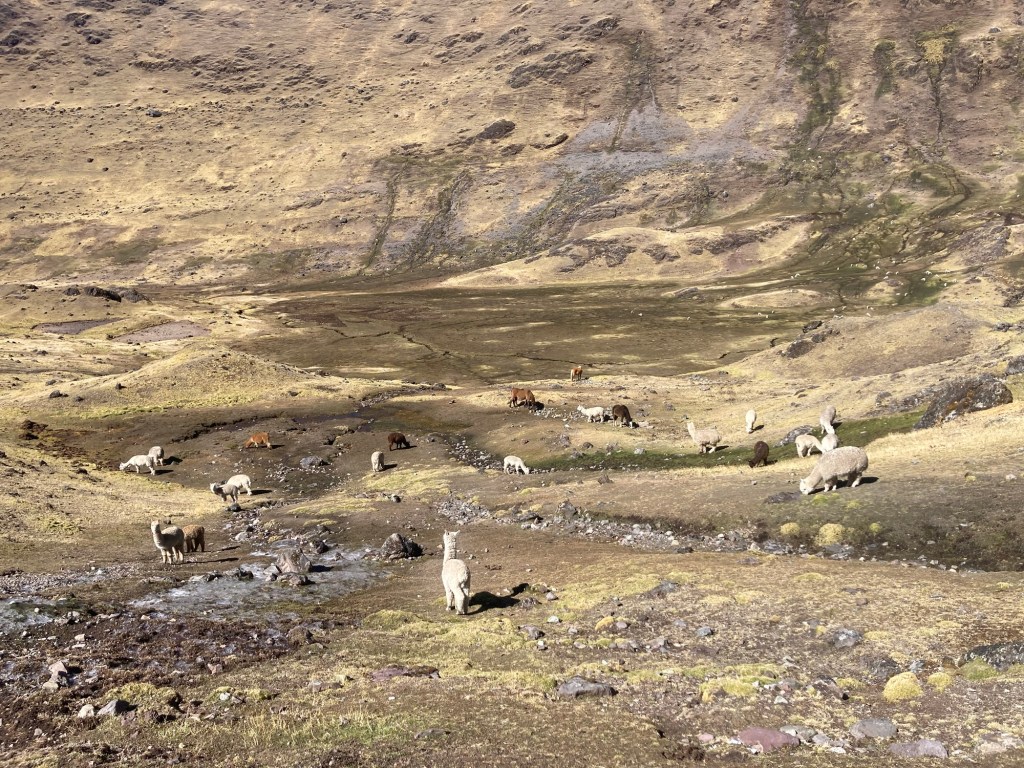
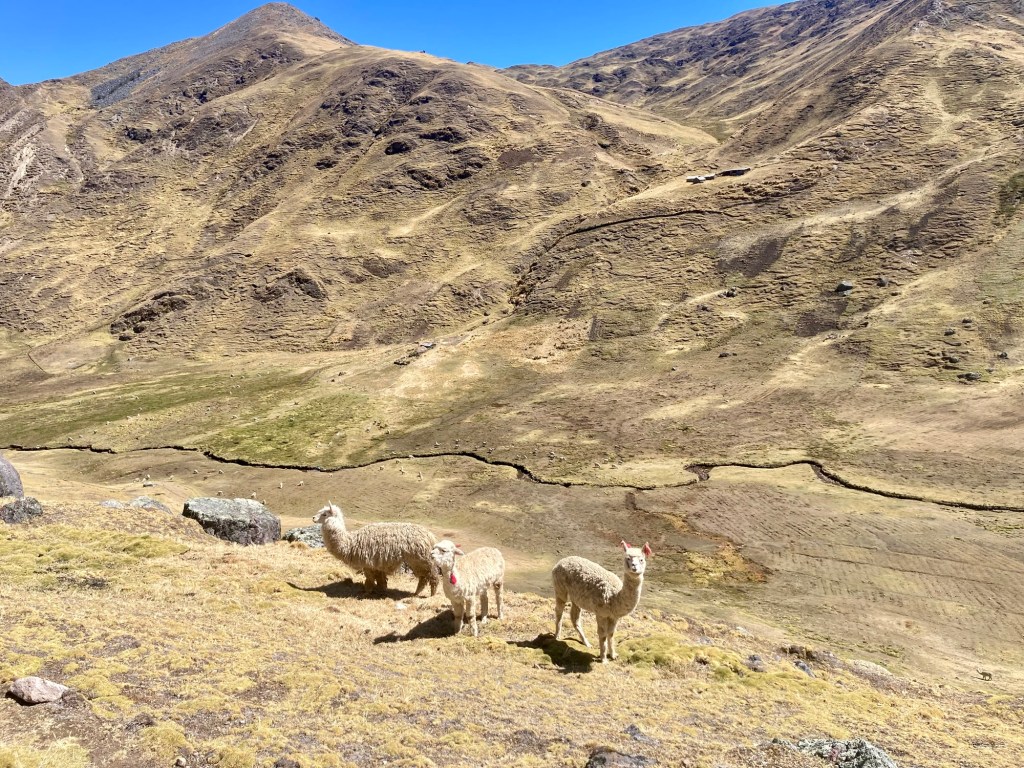
When the sun finally rose, we were eager to take off all of our layers. I have never worn pants for so long in a race before and was happy to strip down into my shorts and long sleeved sun shirt. We were now returning to “civilization” and passing by farms with llamas and alpacas.
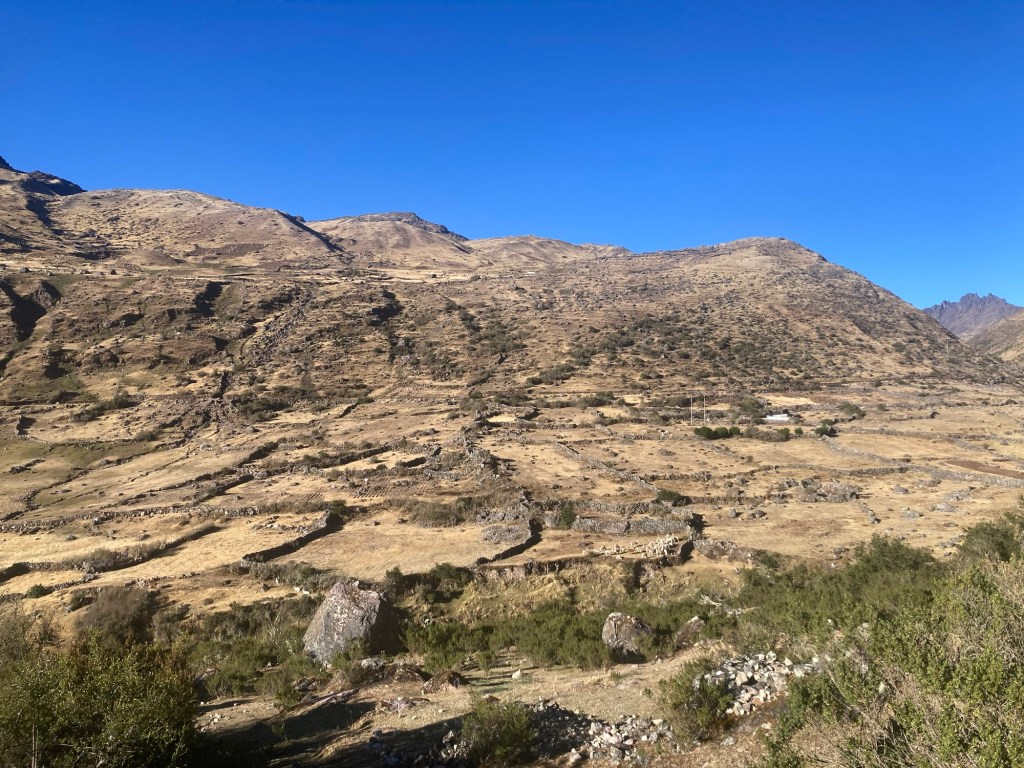
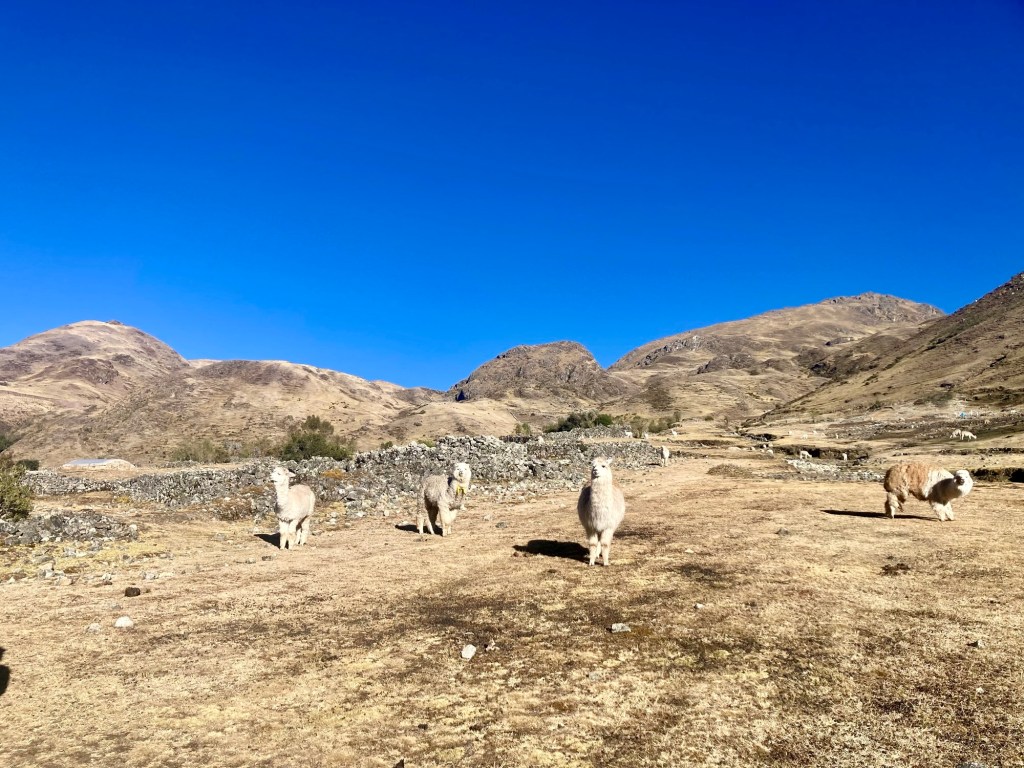
Arriving to “civilization”
Friendly faces greet us

The next aid station was at Huacawasi (71k). Even though it was only 8 am, it was already getting warm! This was the most minimal aid station and we filled up on fluids and grabbed a couple pieces of banana and orange. I offered Yuch my last Tailwind packet since he still wasn’t getting sufficient calories in.  One of the aid station volunteers spoke English and told us the rest of the course was the “fun part” and “Have fun!” In my mind, I imagined that we were approaching the home stretch and that it would all be literally and figuratively downhill from here. 
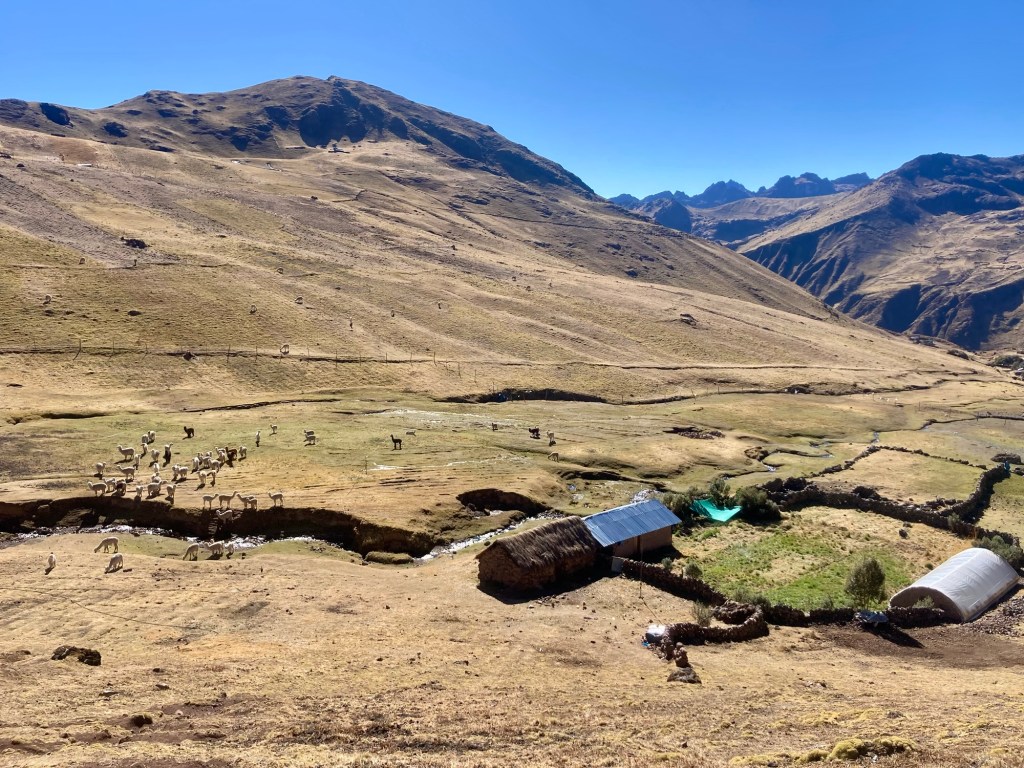
Departing Huacawasi and heading for the final climb

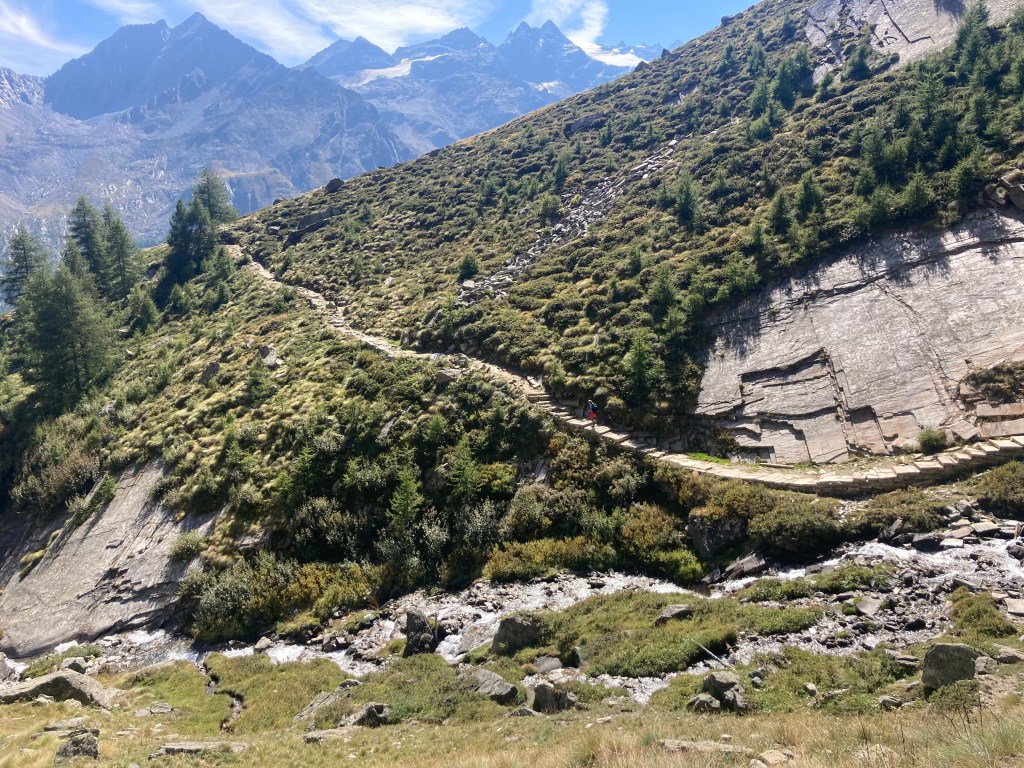
The last climb to Ipsaijasa was a scenic one. Llamas and alpaca grazed happily in the valleys as we made our way up and out. It was so beautiful I didn’t mind the work it took. Yuch continued to struggle, having a hard time processing how much climb we had left ahead of us. I continued to stay positive with the hope of battling his inner voice. I knew we just needed to get to the top and it would all be downhill. After all, the volunteer had said this was the fun part. 
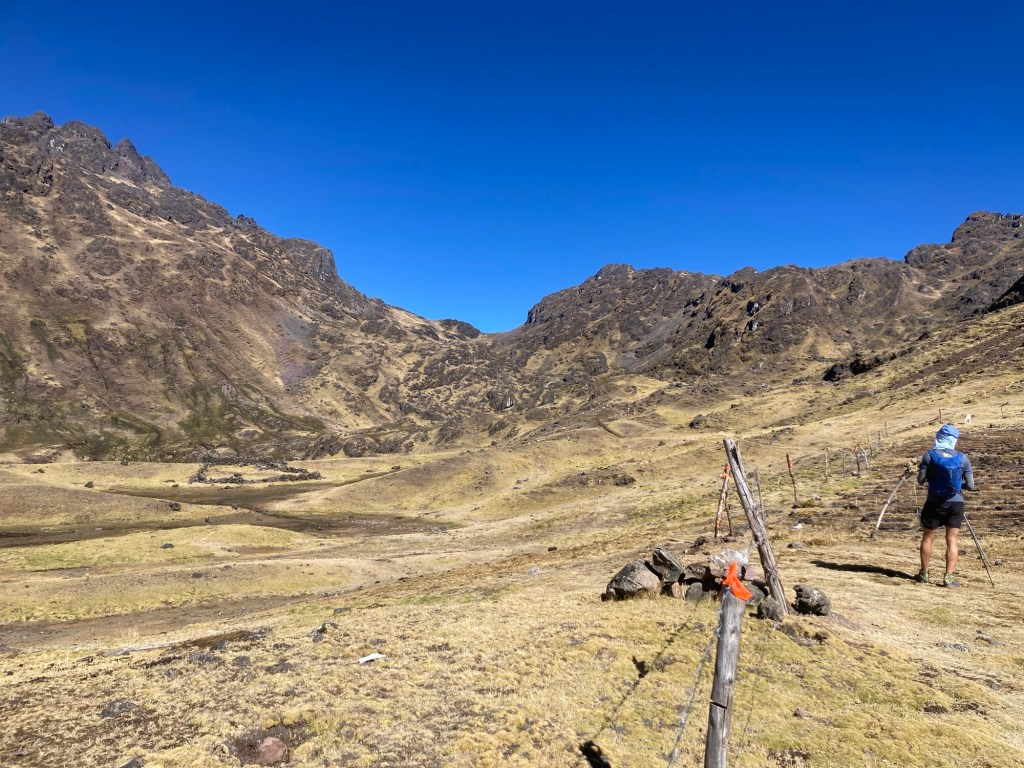
Final pass in the distance
View from behind
Happy grazers

We finally arrived to the top and topped off our bottles at the water station.
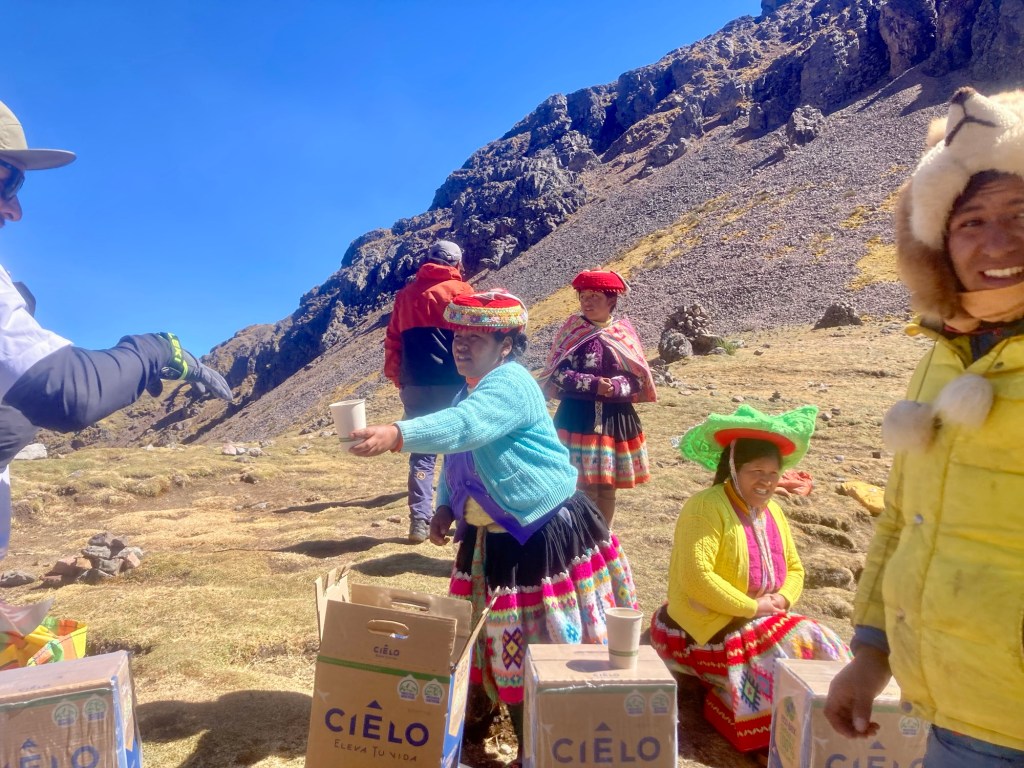
Ipsaijasa water station

We descended for what seemed like forever. Now the 30k and 13k runners were passing us and we would step aside to let them go by, breaking our momentum. Although I had been waiting for this moment of lengthy downhill, I was starting to get tired and wasn’t moving as quickly and effortlessly as I had pictured I would when envisioning my finish. I looked at my watch to see we were at 52 miles and after all of that downhill, I couldn’t believe there was still over 10 miles to go. 
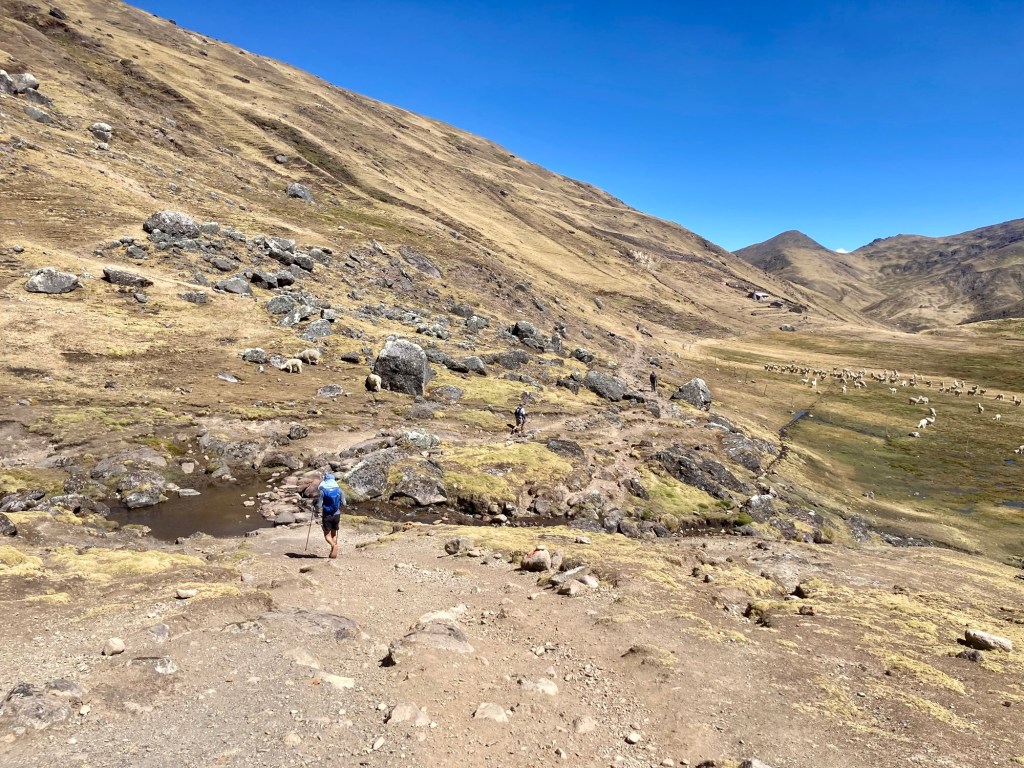
Yuch leading the descent
You can never have too many llama pics…

Although I had been preaching verbally (and also in my head) the importance of staying optimistic, the realization of the remaining distance started to chip away at me and my optimism. How could we be on the “home stretch” and still have so much distance to go? The truth was that only I had given myself that expectation and no one else. 

It probably took about 3 hours to do the last 10 miles.  Although the course profile makes it look all downhill, it sure didn’t feel that way. These last miles were most comparable to a Tor descent into a lifebase; never ending and soul sucking. As we got closer to the finish, I continued to peek around each corner looking for a glimmer of Ollantaytambo, but all I could see was a never ending single track trail rounding the corner – same as the last time I looked. 

Yuch and I split up and regrouped a couple of times. Once he stopped to use the bathroom and I walked purposely slowly so he could catch up. The second time he fell behind even though we were both walking. There were times I wanted to start running and he maintained that he couldn’t, that he was no longer physically able to. I knew he was having a hard time but felt like I needed to go my own pace and give him his space. We regrouped at the next water station. 
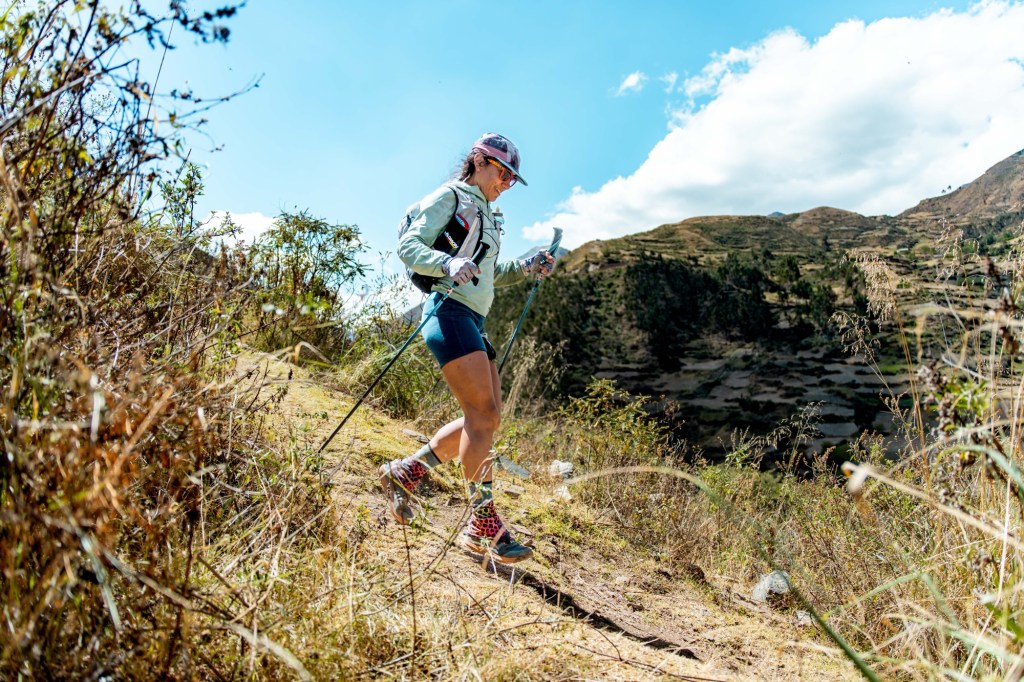
Running solo. Are we there yet?

I stayed true to what I had said before. I wasn’t doing this race to compete, but for the adventure and a big part of the adventure was the shared aspect. I wanted to finish together. However, we had 3 miles left and we could either walk the last 3 miles and it take an hour or more, or we could try and run and finish sooner. Yuch agreed that it was a better option to not prolong the torture, and mustered up every little last bit of strength that he had to run those last miles. 

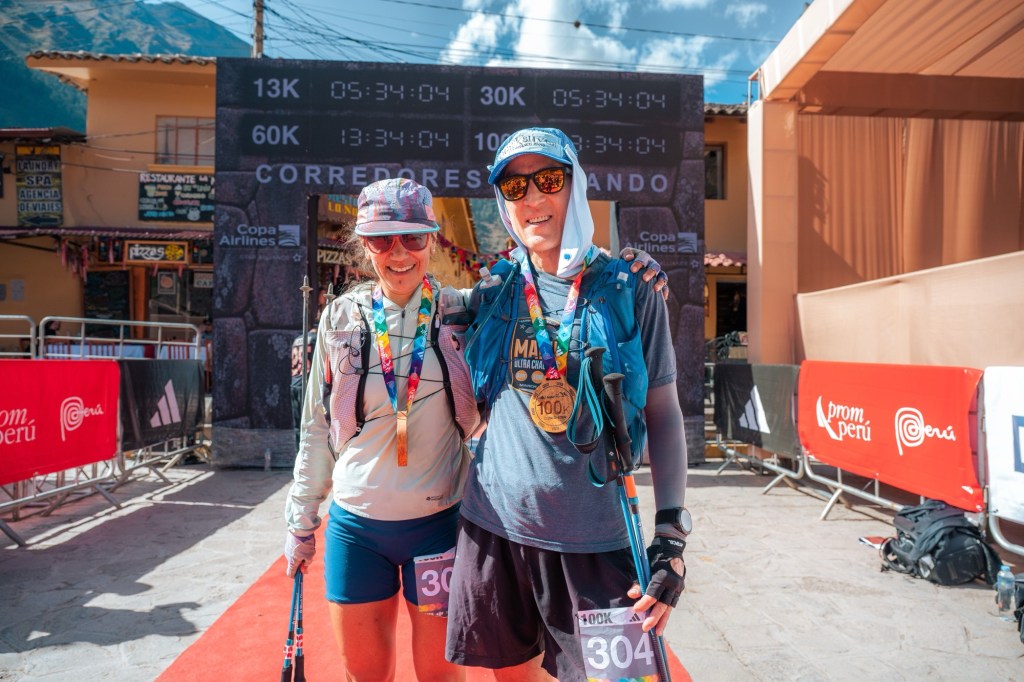
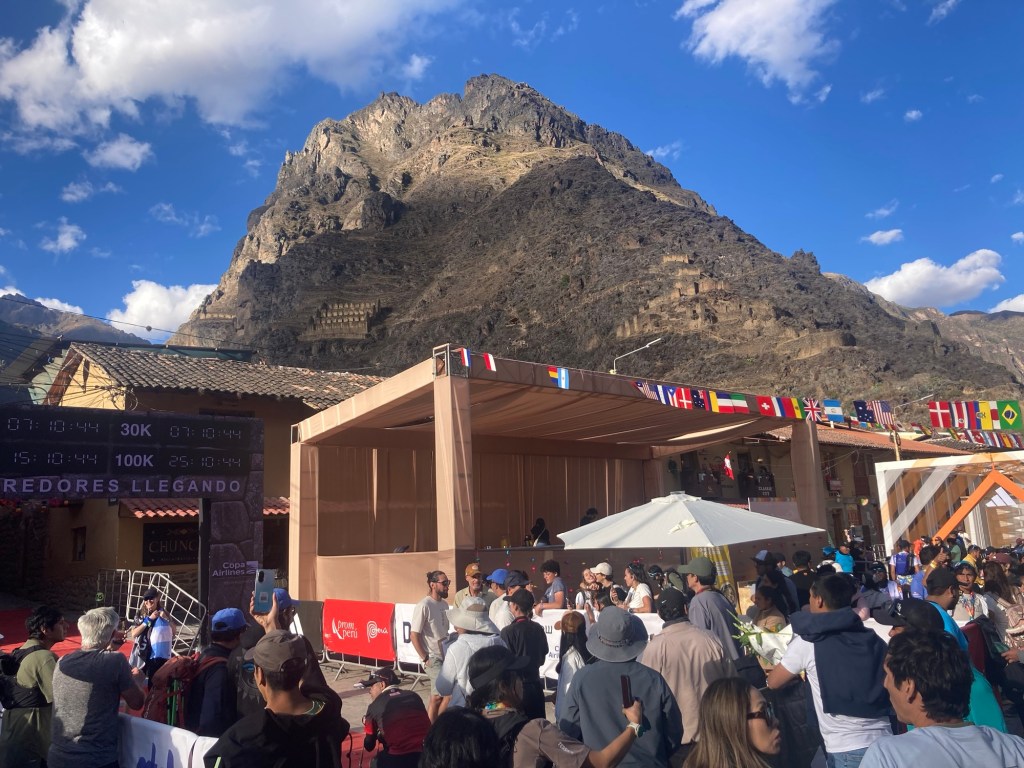
Arriving to Ollantaytambo, spectators lined the cobblestone streets cheering loudly. Although the finish reminded me of running into Courmayeur at the end of the Tor, this time we were finishing at a decent hour. Someone yelled out “los estados unidos!” and I wondered how they knew that, but we kept on moving focusing on careful foot placement on the uneven cobblestone ground beneath us. We crossed the finish line together at 2:34 pm, with a finish time of 23:34. The cutoff for the race is 26 hours. 
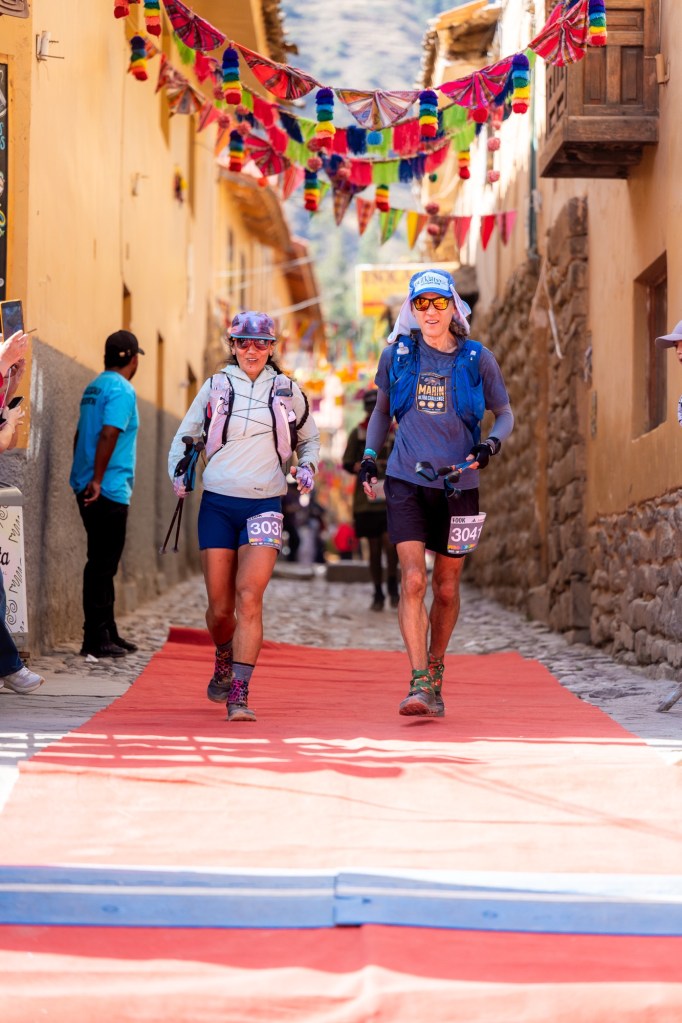
Red carpet finish line
Finish
It’s not every day that you get to cross a finish line with Incan ruins in the background!

After finishing, our first priority was getting back to our Airbnb (literally around the corner), showering, and taking all of our dirty clothes to the 2-hour laundromat. We would be heading back to Cusco the next morning and in addition to our race clothes, had accumulated quite a bit of dirty laundry. Yuch’s body had completely shut down and after his shower he climbed straight into his bed and under his covers. I dropped our clothes off at the laundry and headed back to the finish line. 100k runners would still be trickling in until the cutoff at 5 pm. 

The 101k racers were completely outnumbered by all the other race distances so it was difficult for me to identify them. I identified a photographer that I had seen at the 101k start and asked him if he knew where I had placed in the 101k women’s field (all 4 of them). After telling him my last name, he said he was pretty sure I got second place. Although I hadn’t been necessarily competing, this surprised me as I didn’t remember another 101k female passing us. However, we had been moving pretty slowly at the end so I admitted it could have been likely. I wondered if and when they were going to have a women’s 101k podium ceremony. I sat down and pulled out my phone looking for a tracking website. I had been the first female in the 101k.

I couldn’t hold out to the 5 pm cutoff because the sun was getting low and I was getting cold. I never saw another female finisher come in so in the end, I headed back to the Airbnb. Yuch and I went back to the same vegan restaurant, Ashka, for dinner that night and ordering the vegan platter; a platter of vegan meats, roasted potatoes, chocló, and veggies. 

I later learned that there were only two female finishers, the second arriving only 25 minutes after me. If Yuch and I hadn’t decided to run those last 3 miles, she would have definitely passed us. I felt a little sad that there was no 101k female podium ceremony. All the other distance podiums were celebrated with the winners receiving awards. I wasn’t upset because I thought I deserved anything or necessarily ran a “fast” or “good” race. I just felt it was a little strange to not be acknowledged. Plus, I felt very proud as a half Peruvian female to have won even if there was only one other competitor. 

I absolutely loved this race and my time in Ollantaytambo and Peru more generally. It makes me sad that everyone in the ultrarunning community is so focused on two races: Western States and UTMB, and all the qualifying races in between to get you there. The Andes 101k was hands down one of the most incredible races I’ve ever done. It is beautiful and challenging, especially with a 26 hour cutoff for what feels like the difficulty of a 100-mile race. I love the history of the race and that the local indigenous Peruvian community volunteer at the aid stations. I thought the race was very well organized and I always felt safe. I can’t say I loved the 3 pm start but in the end I probably spent an even amount of time in the light and in the dark. I hope this blog entry inspires at least one person to sign up for this incredible race! 

Choquequirao – 8.9.26

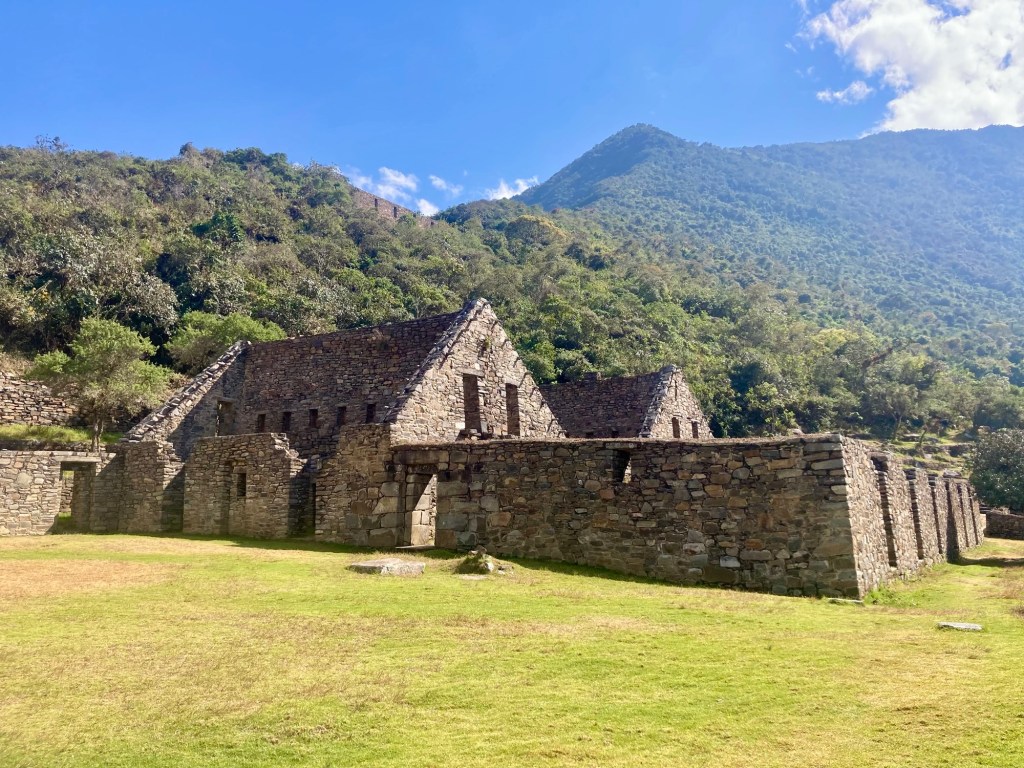
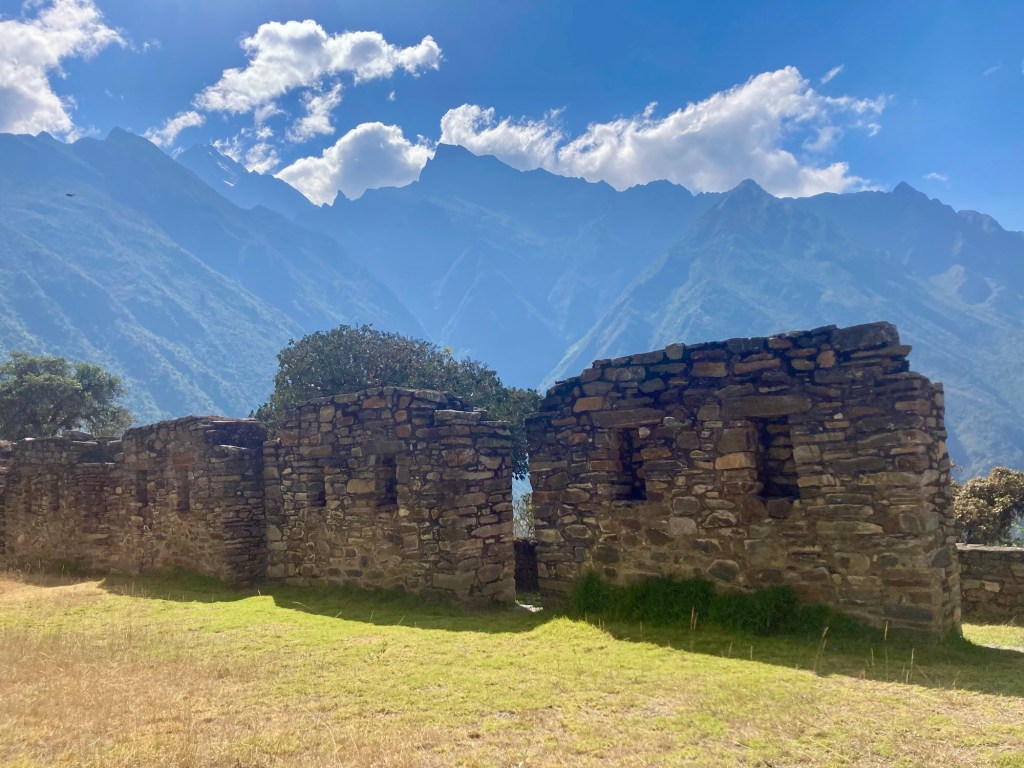
Everyone has heard of Machu Pichu. It is THE spot to visit when you are in Peru, and having gone there myself in 2018 I can attest that it is a magical place well worth visiting in your lifetime. But most people have not heard of Choquequirao, an extensive complex of Incan ruins high up in the Vilcambamba mountain range overlooking the Apurimac river canyon. 

Choquequirao is known as the “sister ruins” to Machu Pichu. While Machu Pichu was built by and for the Incan ruler Pachacutec, it is thought that Choquequirao was built for his son Túpac Inca Yupanqui in attempt to outdo his father. 

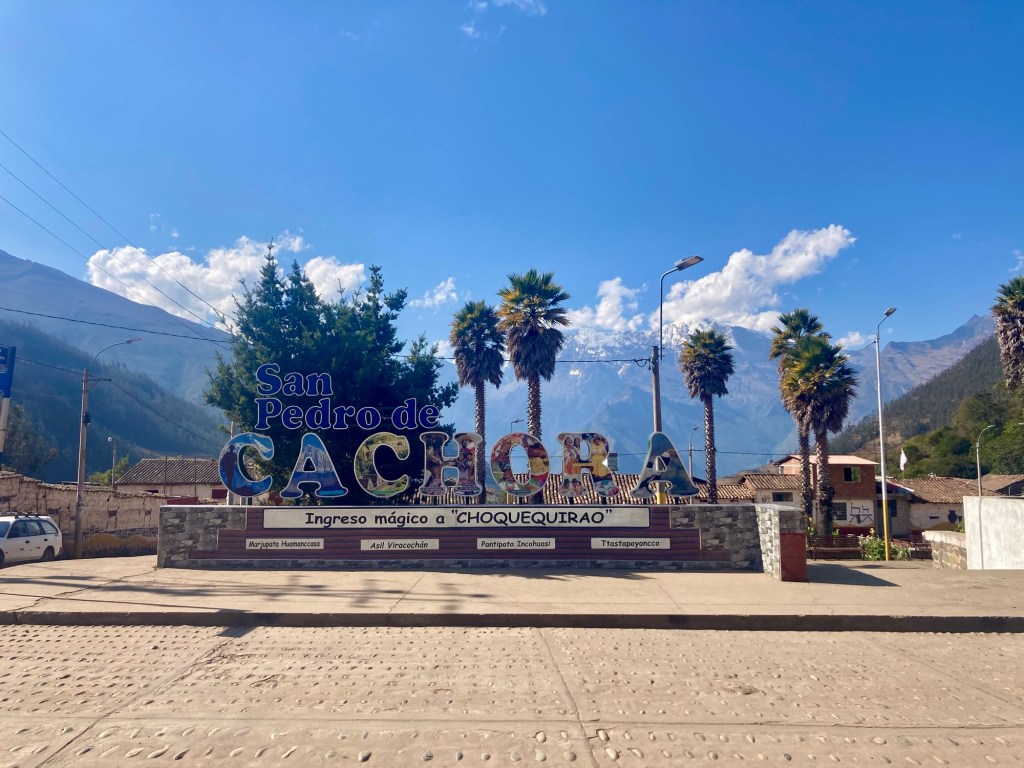
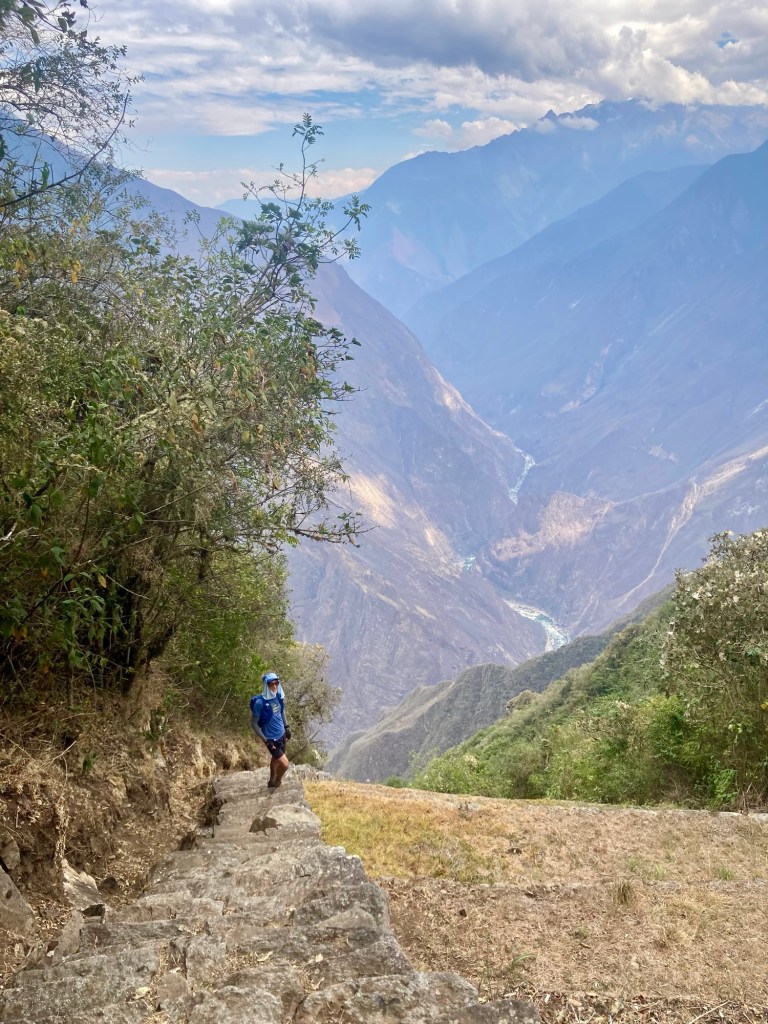
Probably the biggest reason that you haven’t heard of Choquequirao is that it is very difficult to get to. Therefore it receives far less visitors than Machu Pichu. Currently the only way to get to Choquequirao is by foot. It involves a demanding multi-day trek – 24 miles total with approximately 12-13,000 ft of elevation gain. Most people complete the trip by doing chunks at a time and staying in villages along the way. Keep in mind these numbers only apply if you are lucky enough to get a ride to and from the trailhead at Capuliyoc, in the small town of Cachora. Additionally, these stats do not include any mileage and elevation that you accumulate inside the park itself, which spans about 10 square kilometers. In a nutshell, the journey to Choquequirao is not only physically demanding but also logistically challenging. This is how we did it in one day. 

The first logistical hurdle is getting from Cusco to Cachora. Yuch had initially rented a car which was pretty cheap and seemed to make the most sense. However, as the day approached the anxiety regarding road conditions and car insurance (and lack of car insurance on off-road trails) was unsettling enough to prompt us to pivot. He cancelled the car reservation and instead booked a driver. 

The dry season is the peak tourist season and many locals get most of their work by driving tourists around. Our driver would be pulling an 8+ hour day each way, since he had to leave from his home in Compone which is west of Cusco, pick us up in Cusco, drive us to Cachora (4ish hours), and then drive back. The cost for there and back was 760 soles – thats about $258 for let’s say 16 hours minimum, approximately $16/hr. To us, it was worth it to not have to deal with driving. We got 1000 soles from the ATM in Cusco before departing thinking we would have more than enough for our trip to a place that likely does not have ATMs.  

On the drive to Cachora we got the chance to practice our Spanish with our driver Rolando. He was super nice and forgiving with our Spanish. The drive was smooth and the roads all fairly easy to navigate, nothing that a rental car couldn’t handle. The only caveat is that Peruvians do a lot of passing, some of which can be slightly aggressive and unsettling if you’re a back seat driver. However, we made good time to Cachora in 4 hours which I’m not sure we could have managed on our own. On the drive, Rolando mentioned how he got good money from his job, that his passengers were often very pleased and left him good tips. Yuch and I quietly absorbed the fact that we had not factored in a tip when getting our last ATM withdrawal. 

On the road to Cachora

Rolando dropped us off at our Airbnb in Cachora. We asked him if we should pay him half now and the other half later, to which he responded he would take the full amount now. I guess that wasn’t so strange to pay upfront, but then Yuch asked if he should tip now or later to which Rolando again said he would take the tip now. Yuch gave him more of our precious cash and I began to feel slightly apprehensive about our quickly diminishing “efectivo”. 

Before Rolando took off he told us he would look into a taxi the following morning. This presented Hurdle #2: getting a taxi at 3:30 in the morning from our Airbnb to the trailhead at Capuliyoc, and getting a taxi back to our Airbnb at who-knows-what time at night. We had also read that Elizabeth, our host, had been very helpful in arranging these taxis for previous tourists. Rolando and Elizabeth spoke briefly about the taxi, but we didn’t think much of it. As long as we had a taxi and we didn’t have to run the extra mileage early in the morning and late at night, we were happy.

The Wooden House has a similar structure as a hostel. We had our own room with two beds, but the bathrooms, showers, and kitchen were in the main house. Between the main house and the rooms is a nice front lawn with multiple covered patios and a nice garden with “tomate de árbol” and “aguaymonto” aka golden berry. The sign in front of the hostel notes that they have “hot showers”, which was a welcoming sign! Thus far, our previous “hot” showers had meant lukewarm. It would be nice to be able to get a hot shower after our all-day adventure the following day! 

Elizabeth arranged the taxi to pick us up at 3:30 am the next morning. She also said it would pick us up later that night and that we could just text her as we got closer to Capuliyoc. We honestly didn’t know if we would be getting back at 8 pm, 10 pm, or midnight! We just couldn’t imagine how long this run would take. 

Things were falling into place and we were feeling good. We bought water and some other small provisions, again using more of our cash because these small towns don’t take credit cards. We went to the main restaurant in town that Elizabeth recommended, Cachora Bar Restaurant, which advertised a “menu turístico” and that they took Visa. Perfect! The tourist menu included a starter and entree for 30 soles. We both ordered the palta relleno (stuffed avocado) to start followed by a vegetarian omelet over rice and potatoes.

After eating our delicious starter (in Peru they are much more generous with avocado portions than in the United States), Yuch received a text from Rolando. He wanted to let us know that he arranged for a taxi to pick us up the next morning. Oops. We let him know that Elizabeth had already arranged one and that we were good to go. At first he responded with a thumbs up. Then moments later he proceeded to send an additional message asking how much we were paying. We began to get an apprehensive feeling that there might be some competition happening between him and Elizabeth and told him we didn’t know the cost, but we no longer needed a ride to the trailhead from him. Again he continued to send us messages that we couldn’t quite understand, but we knew we’re not exactly positive/conducive to a good nights sleep. Our entrees arrived and we began to eat, no longer feeling content about our upcoming adventure. We were confused but also worried because Rolando was our ride back to Cusco and we didn’t want to get on his bad side. We had after all already prepaid and pre tipped! We finally ended the conversation saying we didn’t need a ride, we appreciated his help, and that we could no longer discuss the situation because we were going to bed. 

When it came time to pay the bill, we asked if we could pay with our credit card and the woman shook her head with a look on her face telling us “you think we take plastic in a place like this??” We dispensed more of our draining pile of cash. 

On the walk back to the Airbnb I began to wonder about the price of the taxi. We hadn’t really thought about it but Rolando bringing it up made me wonder if we would even have enough cash to get to and from the trailhead. If we didn’t have enough, we’d have to run a ton of extra mileage. We told Elizabeth about the conversation with Rolando and how we didn’t understand his intentions. She looked at the trail of messages and agreed that the whole thing was annoying and that it made more sense for her taxi driver, who knows the area, to drive us. She called and confirmed with the taxi driver that it would be 50 soles each way. Again, this did not include tip. We had just enough money, but including the 70 sole Choquequirao entrance fee plus bottled water we would need to buy on the trail, it was going to very tight. 

The next morning we woke up at 2:30 am. Elizabeth had left us a thermos of hot water for coffee. We made cowboy coffee, piled our fully-loaded packs on us, and departed from the Airbnb. The drive to the trailhead took about 40 minutes. Our driver was very nice. We paid him 55 soles and told him we’d see him later that night. 

We departed from Capuliyoc at approximately 4:18 am. We had our down jackets on but surprisingly it wasn’t too cold at 9800 ft. The trail descends about 5,000 ft in the first 6.5 miles to the river. We moved efficiently. We had agreed that we needed to be as efficient as possible to maximize daylight. No dillydallying like we had in the Colca Canyon. As we descended, it got warmer even though it was still dark. We took our jackets off probably after the first mile and I would already be sweating pretty good as we approached the Apurímac river at 4800 ft. 

The first village before the Apurimac is Chiquisca, 4.8 miles in. We noted that it took us an hour and twenty minutes to get there which would be helpful to estimate how long that final ascent would take on our return. At the bridge, we stopped to put on bug repellent. The bugs were swarming anytime we stopped, but thankfully we had read about them in someone else’s account and had come prepared. 

Crossing the Apurimac. Time to climb!
View of the Apurimac river

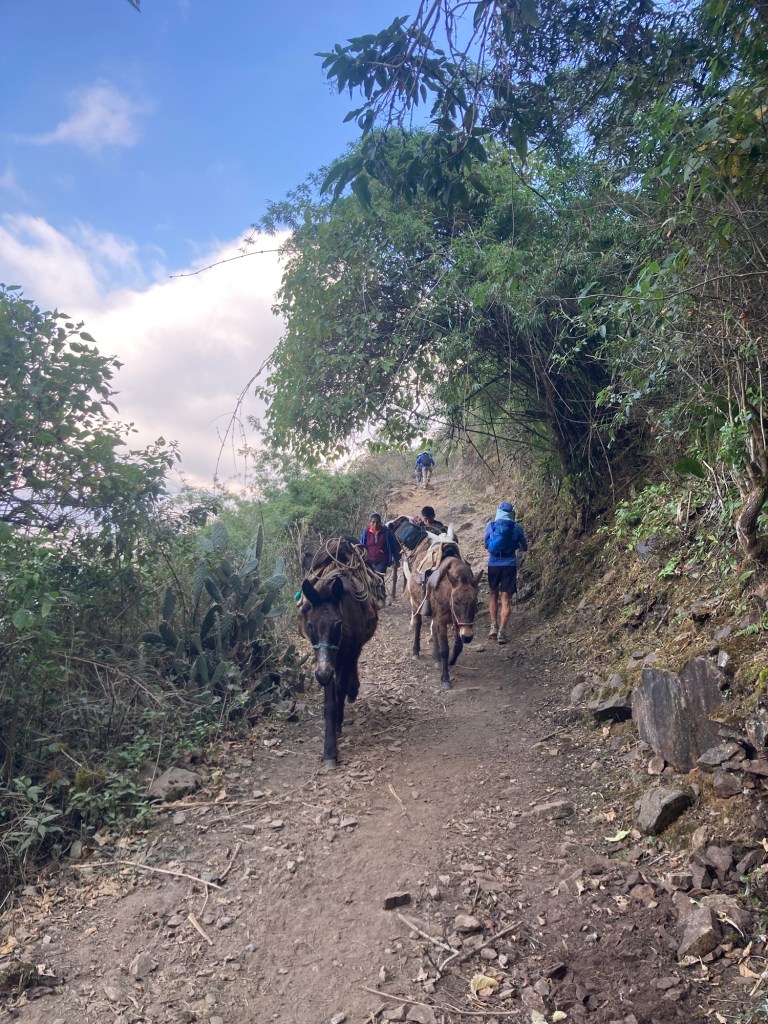
By the time we crossed the river and began our ascent, the sun was starting to rise. From here it would be about 5.5 miles to Choquequirao, mostly climbing. I hiked briskly, with Yuch leading the way. I was able to hike faster than at the Colca Canyon while keeping a similar heart rate (140-150s). I felt like my body was finally adjusting to the altitude. I was surprised with the number of people on the trail, some of which did not look like they were going to make it. Most of them had started from the river and were doing a partial hike that day. Some had burros with them and were descending. I’m guessing the burros bring supplies to the villages along the trail.

Burros on the trail

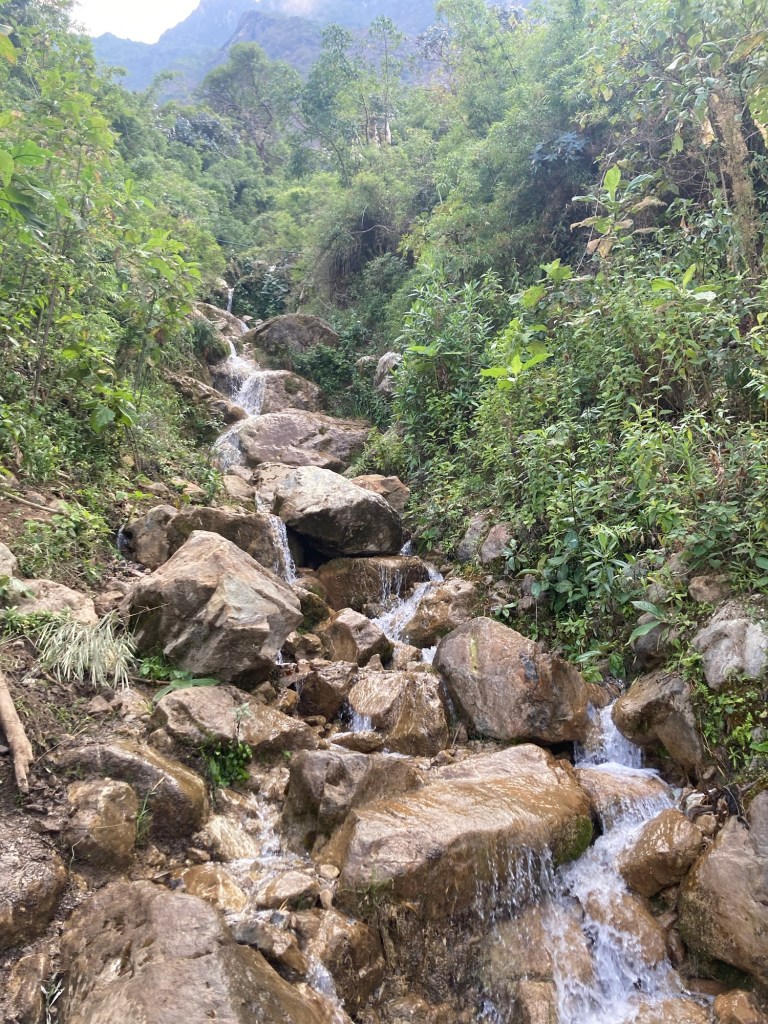
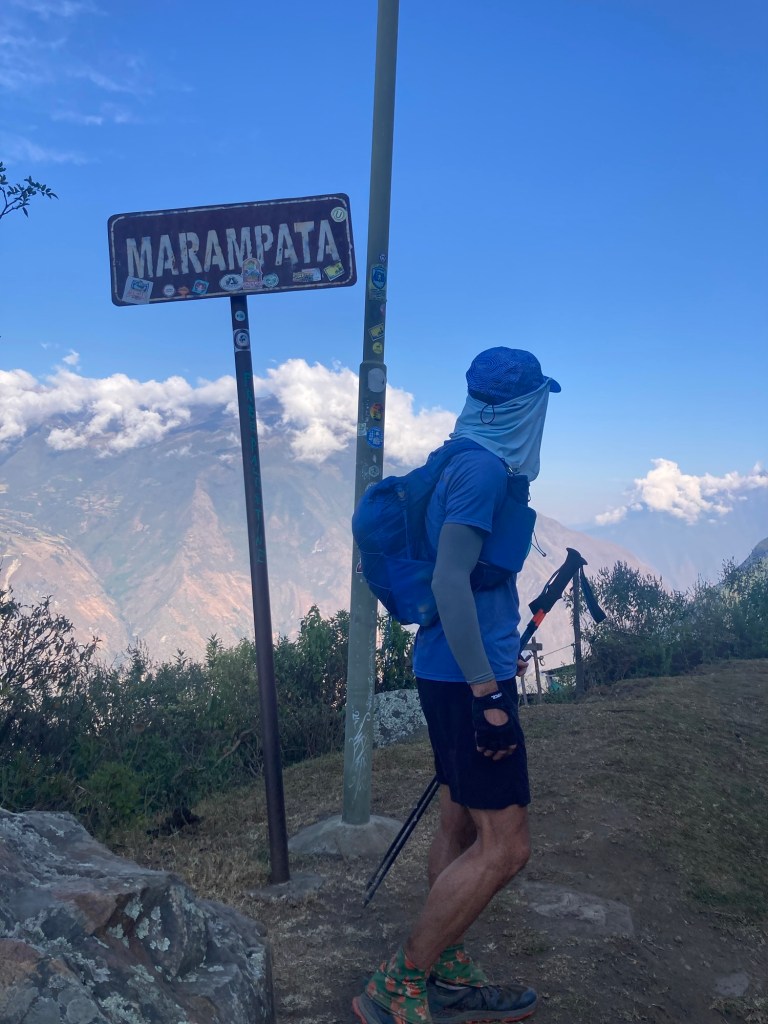
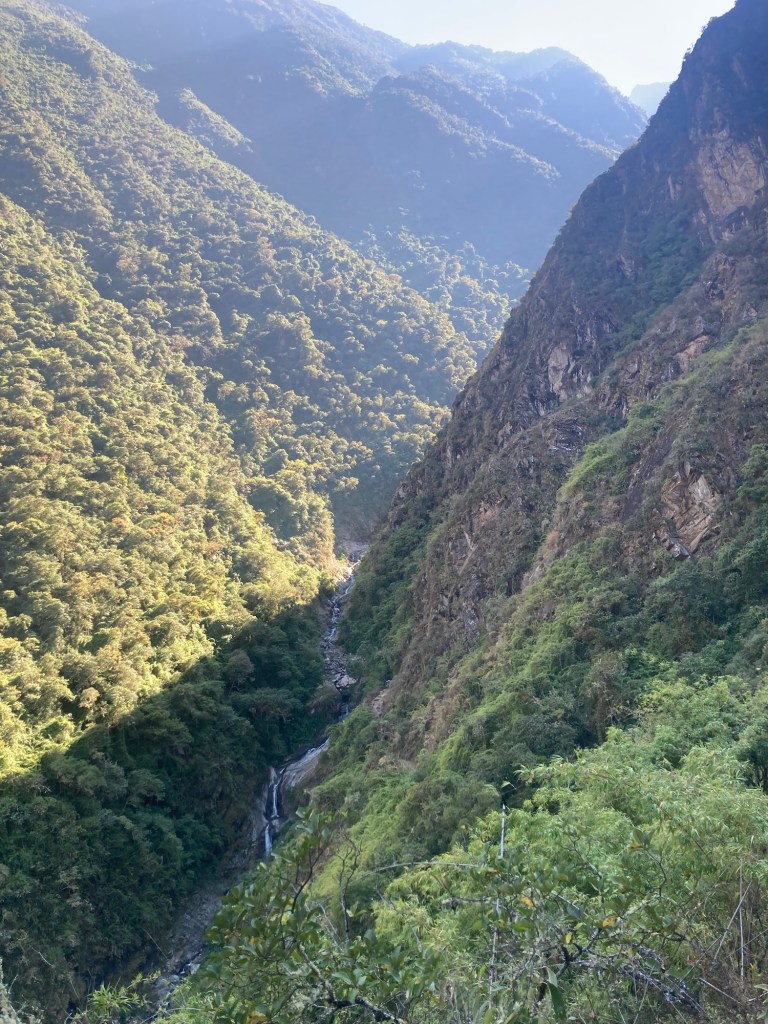
The first village on the ascent is Santa Rosa Baja, followed by Santa Rosa Alta, and finally Marampata, probably the place most commonly stayed at by trekkers. Halfway between Santa Rosa Alta and Marampata we came across the Uchuhuerta waterfall. We filtered water and realized that in addition to another upcoming waterfall closer to Choquequirao, we probably wouldn’t need to buy any bottled water! 

Santa Rosa Alta
Uchuhuerta waterfall
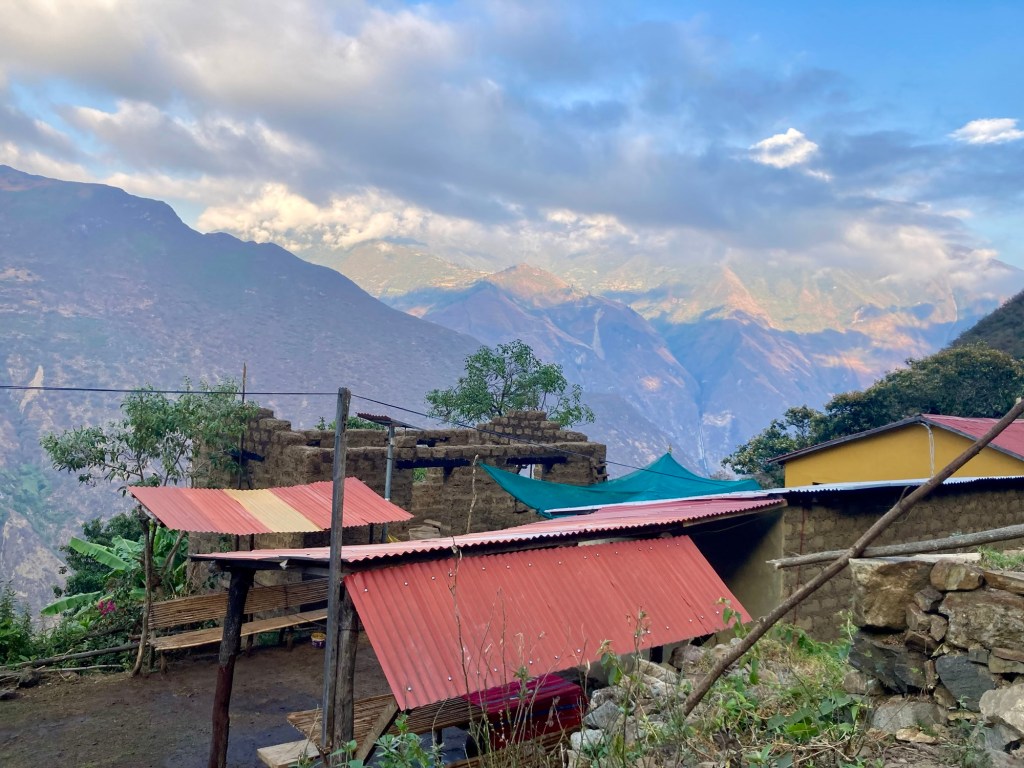
Arriving to Marampata
Departing Marampata

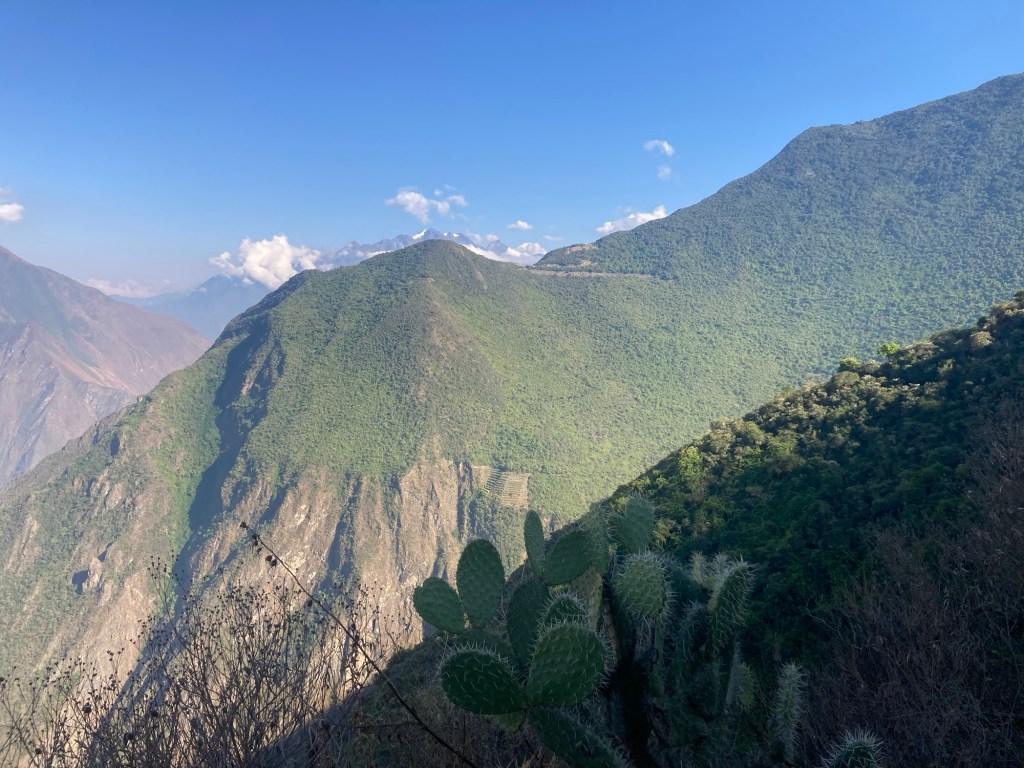
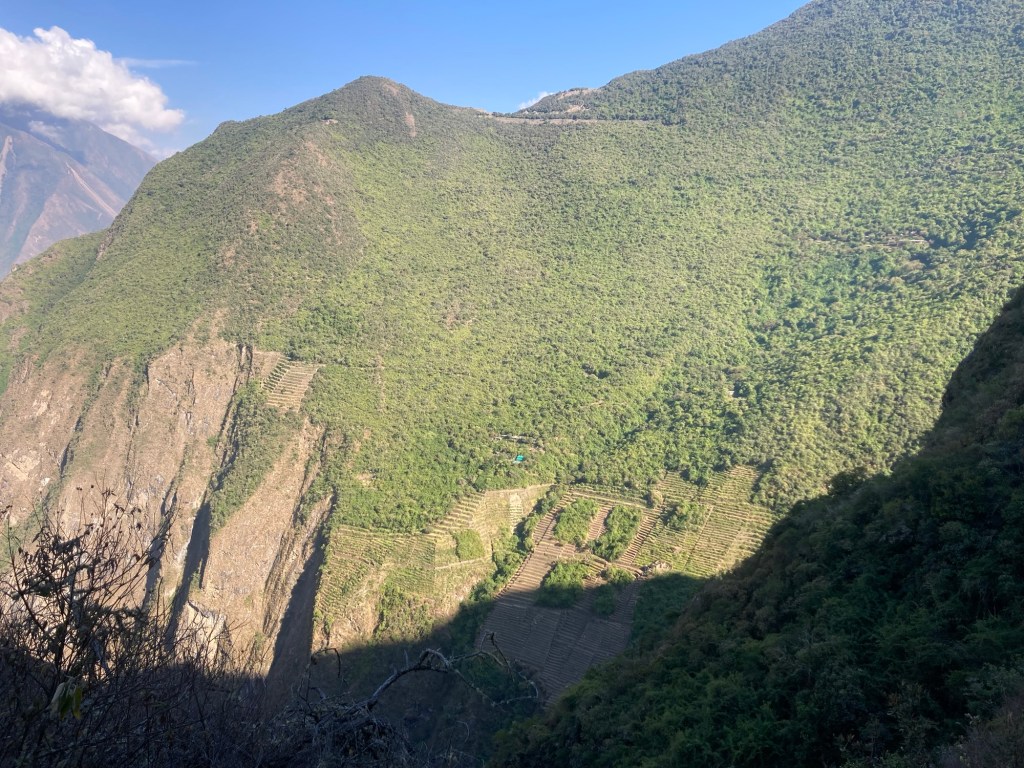
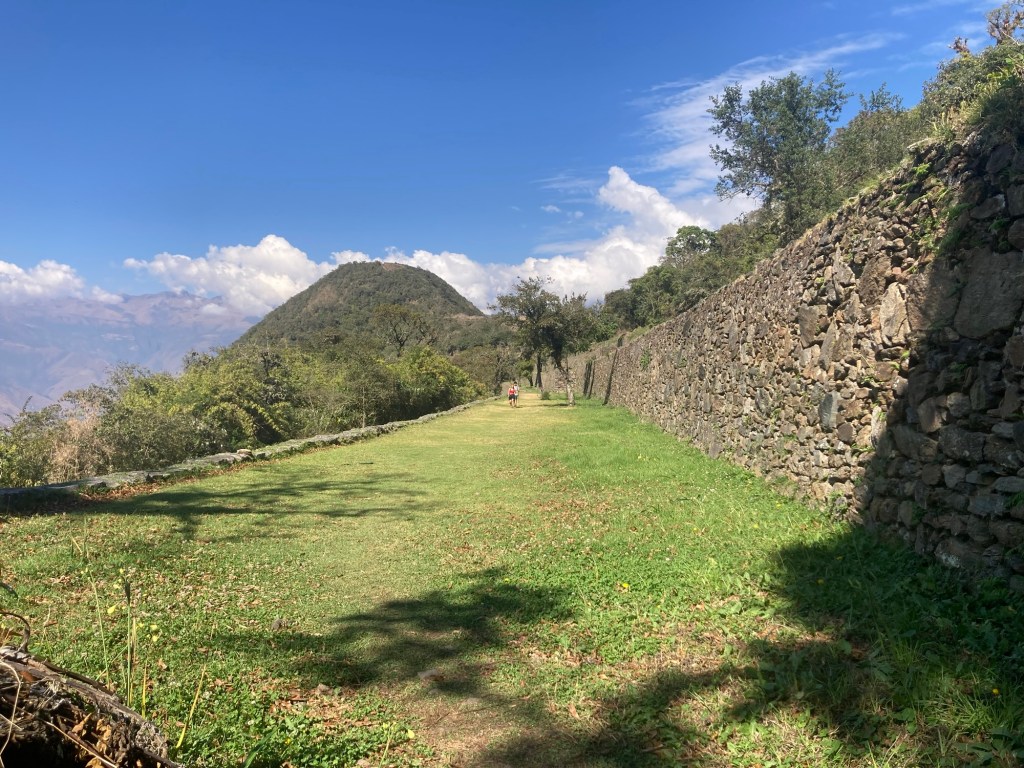
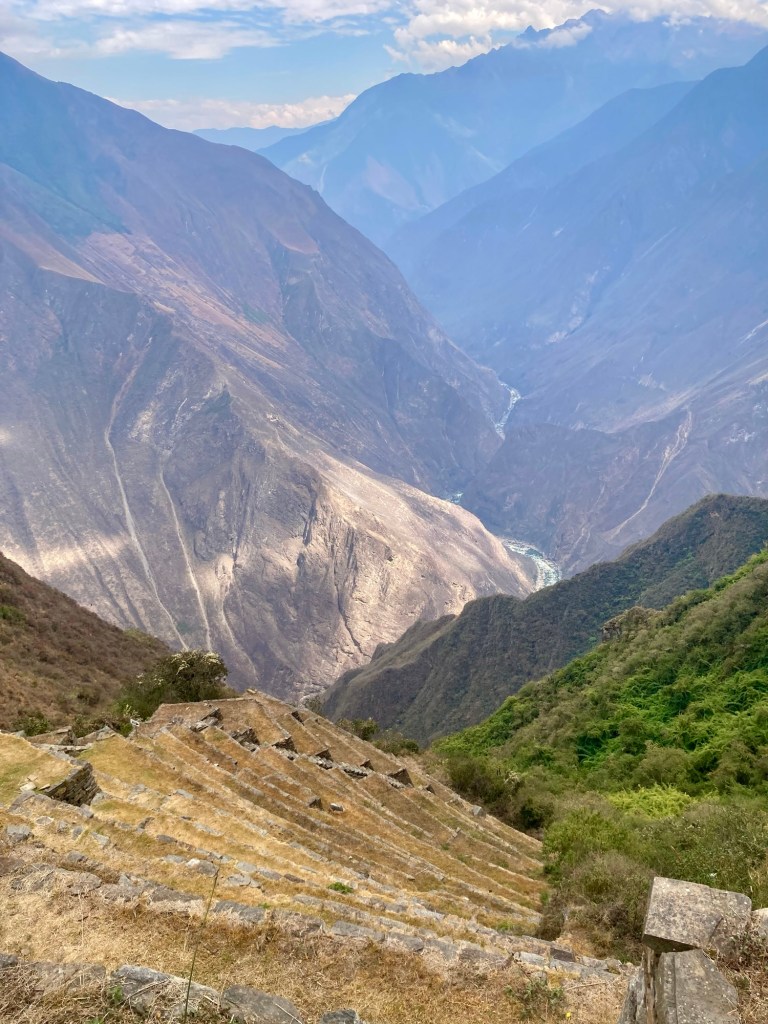
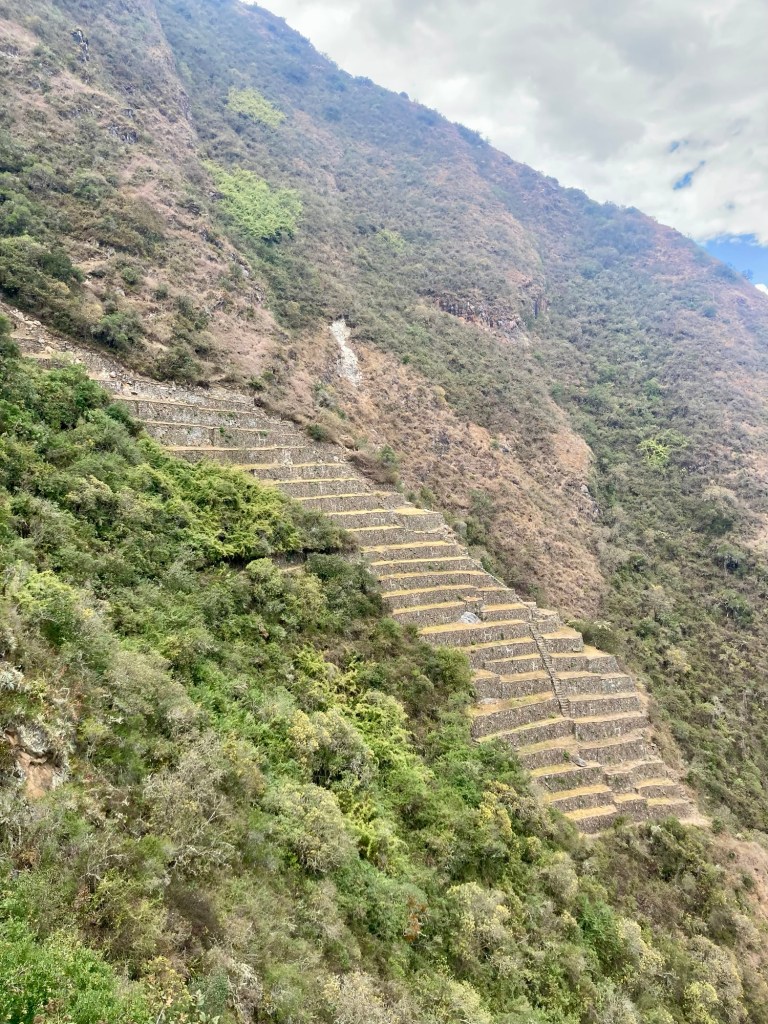
The trail after Marampata is nice flowy single track with a little bit of up and down. It was here that we caught our first glance of the terraces at Choquequirao. It was so beautiful and we stood in awe as if we were the first to discover these ruins!

First view of Choquequirao. Zoom in to see the terraces!

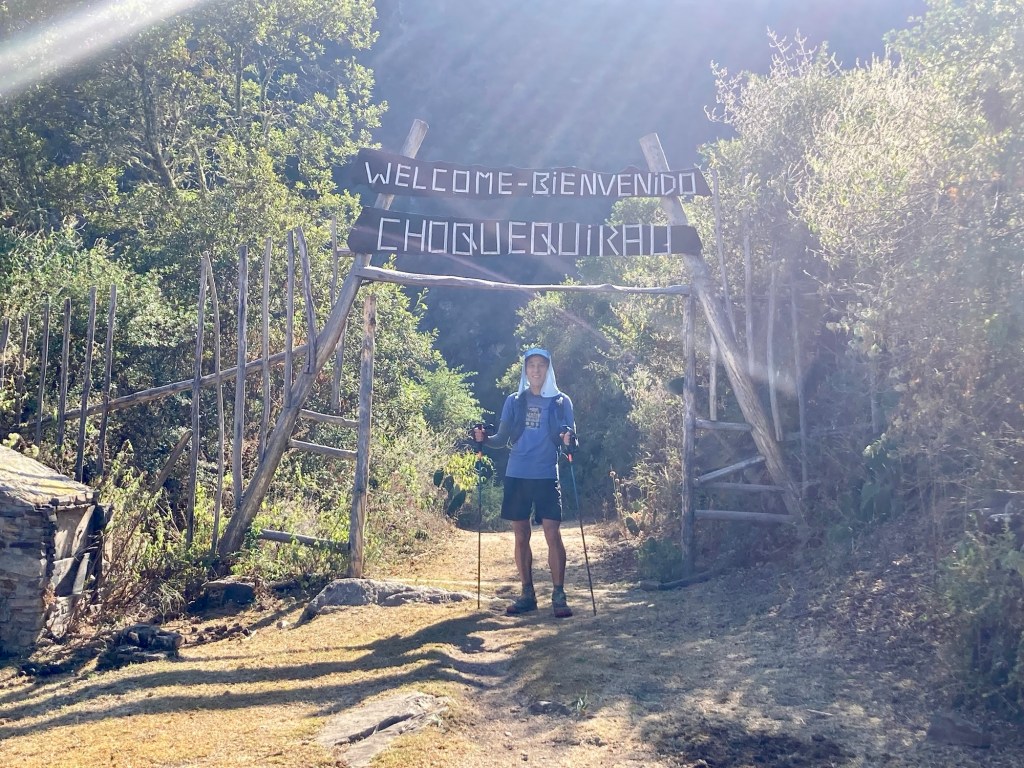
At the main entrance of Choquequirao we encountered a sign but no one there to take our money. We really had no idea when and where we might have to pay our admission fee. 

Choquequirao entrance
More terraces coming into view

We continued on to the Paqchoyc waterfall but didn’t need to fill up quite yet so continued on. 

Panchoyc waterfall

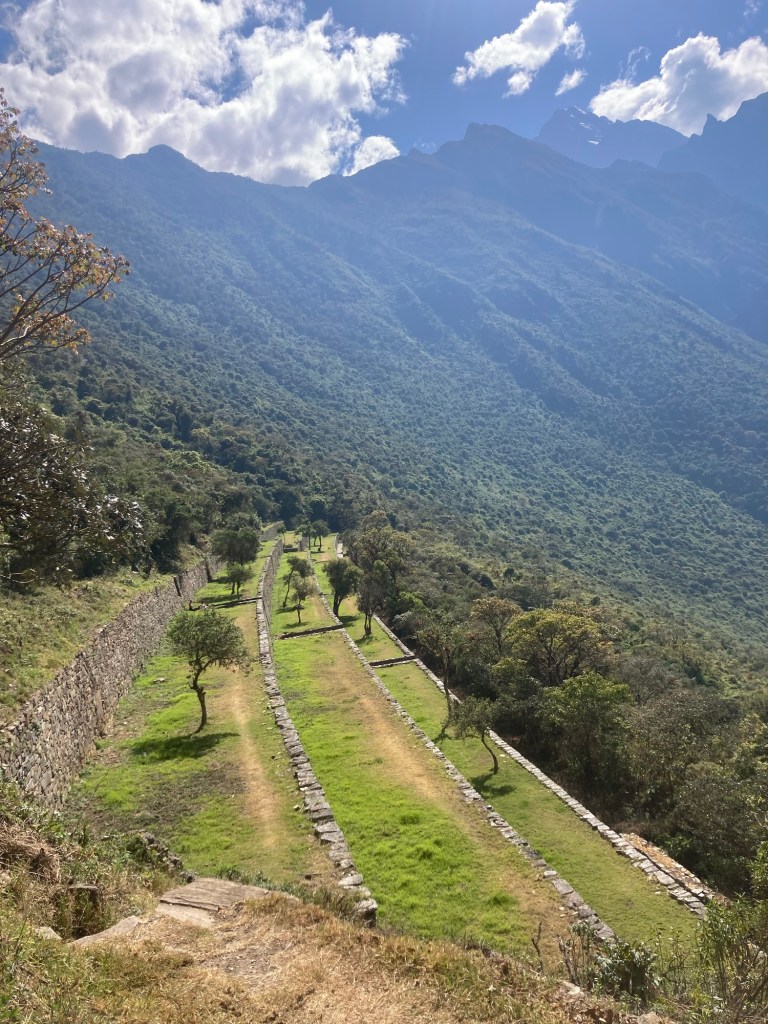
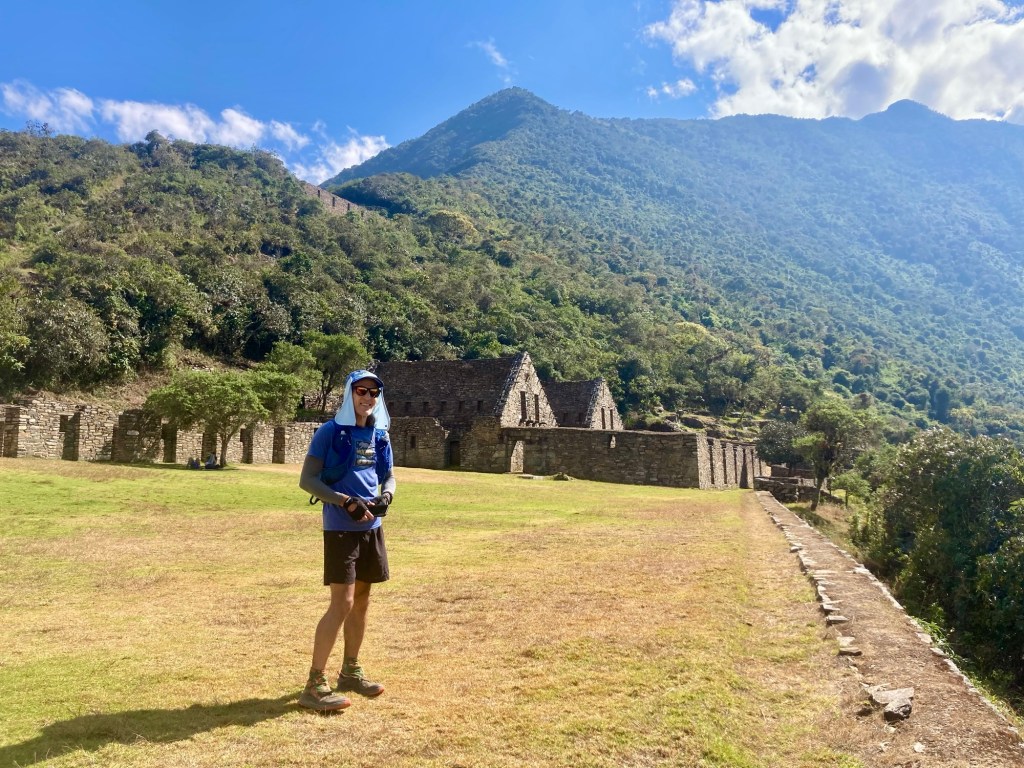
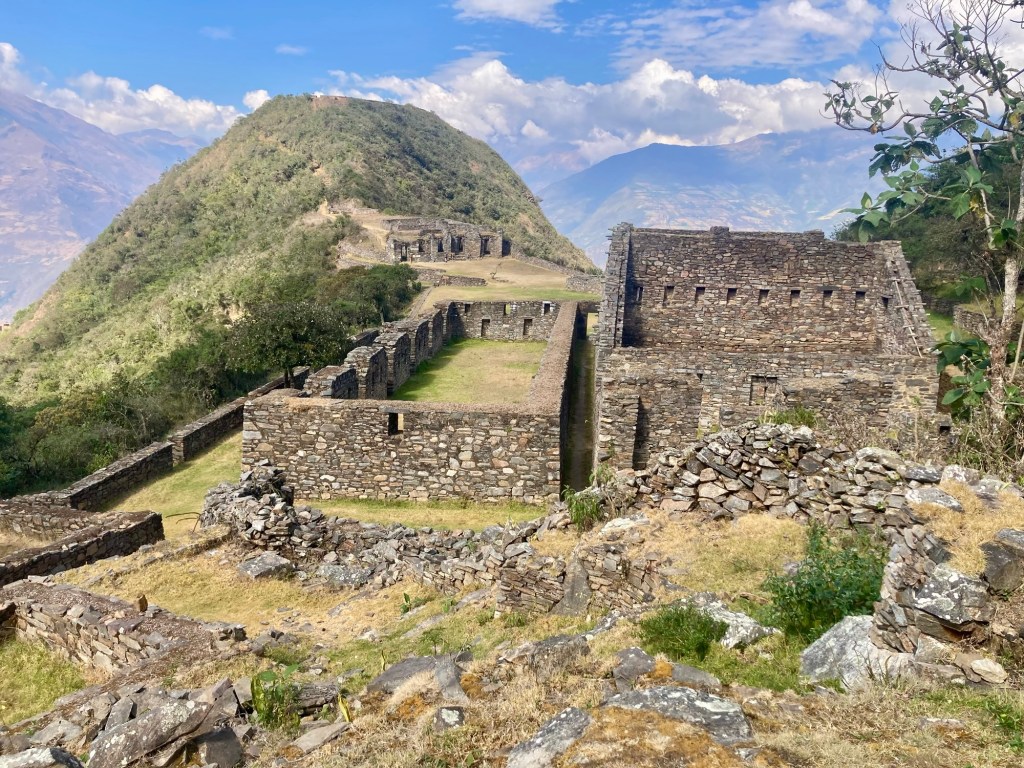
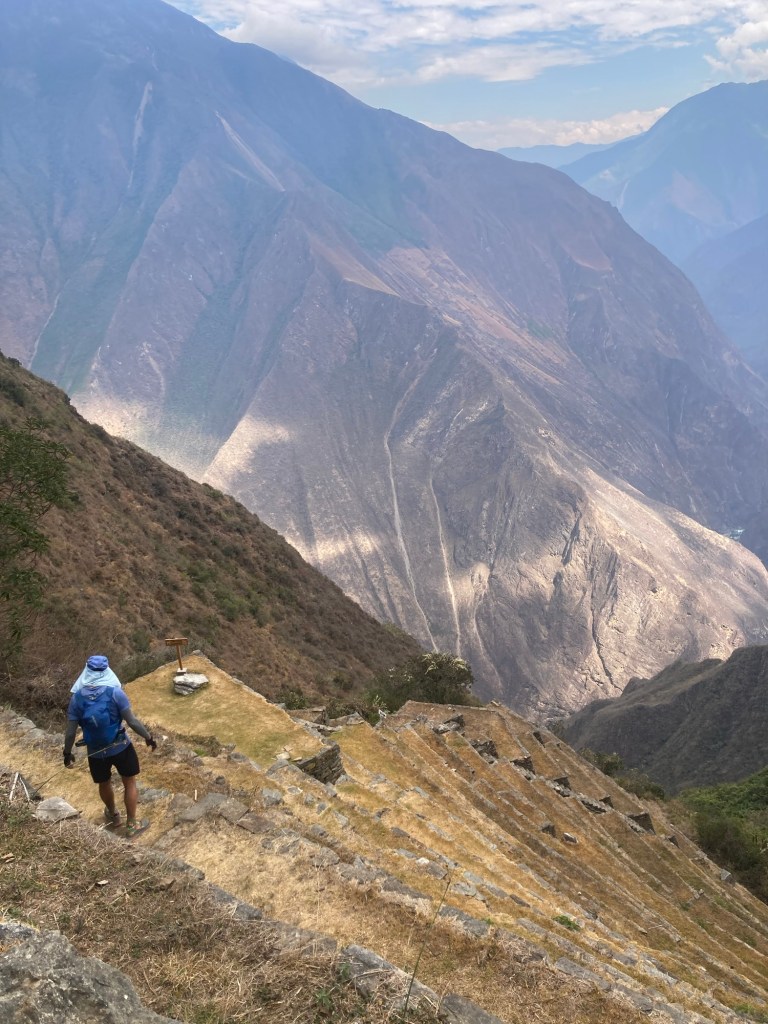
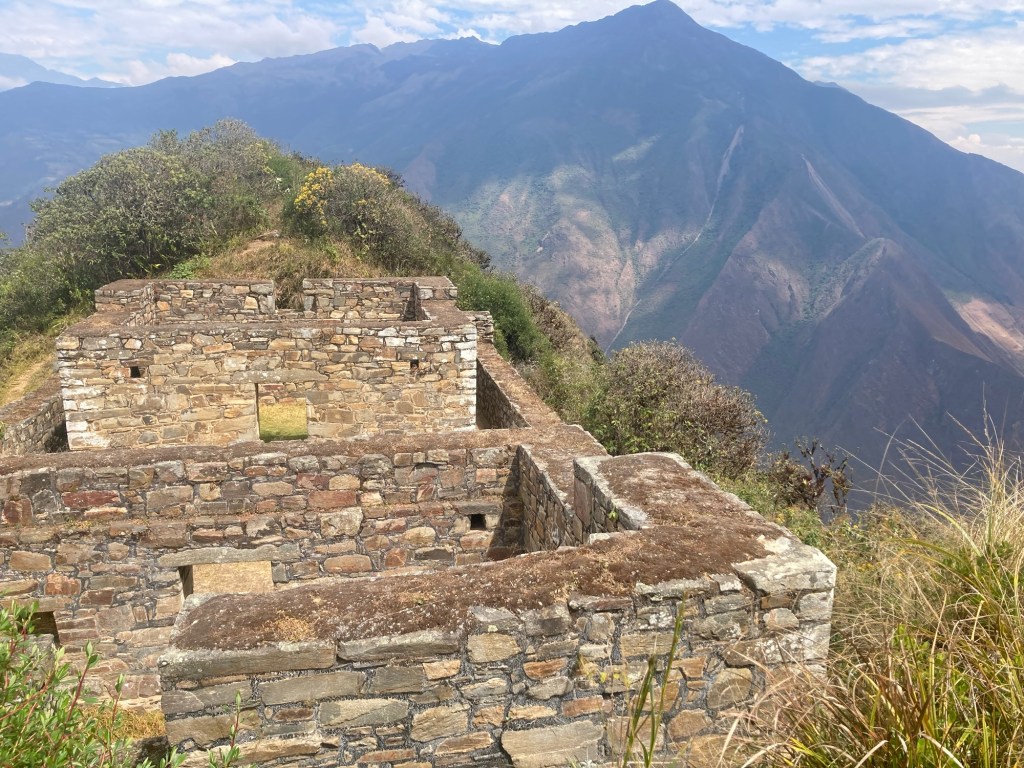
Yuch had plotted a 10k loop around the park starting at the sacred terraces. From there we went to the main plaza, which has the most “house-like” structure with rooms and alcoves. We explored the qolcas (warehouses for storage), and then continued up to the Hanan temple. The Hanan temple is the highest part and has incredible views of the valley and river below. Walking back down from Hanan we also had amazing views of the Ushnu, the ceremonial platform at the top of a hill where sacrifices often took place. But our next stop before the Ushnu was the llama terraces! 

Terrace with Ushnu in background
View from above the terraces
Yuch at the Main Plaza
Main plaza
Main plaza
Main plaza
Main plaza with Ushnu in backdrop
View from Hanan temple

We followed the signs to the llama terraces which took us down quite a bit. When we finally got to what looked like the terraces, we ran into three guys sitting and relaxing on the top terrace. It turns out they too were runners and one of them would be running the Andes 100k! We asked “are we at the llama terraces?” To which one of them pointed down. “Down there”, he said. There were two ways down: the steps or the single track. We opted to take the steps stating we would take the single track back. WOW! I’ve never been down so many steps in my life, and steep steps they were! I joked to Yuch that they were just like the Dipsea steps and soon I’d be doing two-at-a-time. 

Making our way down to the llama terraces
Looking back up. Still no llamas!
Looking down. Almost there!

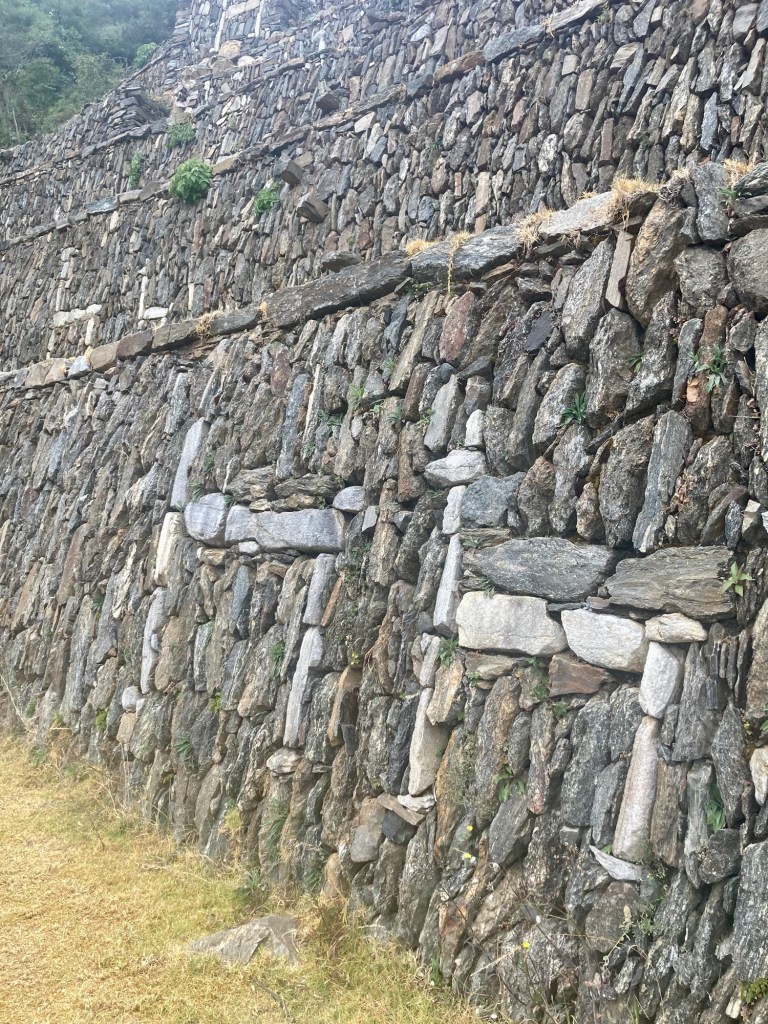
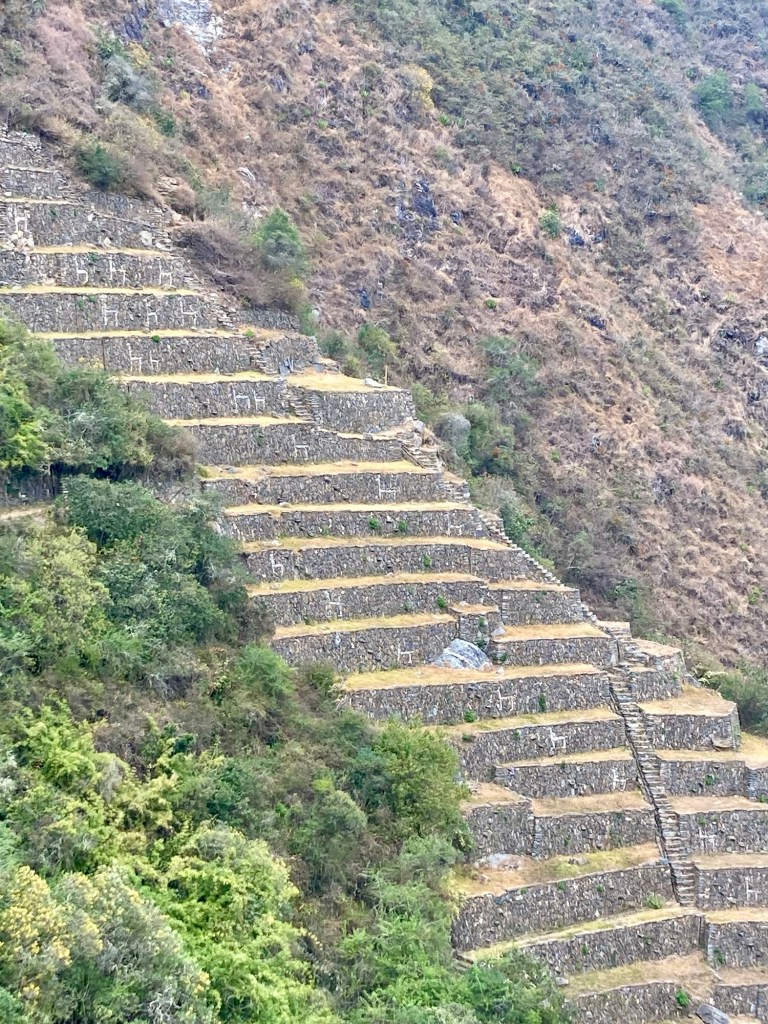
We finally got so far down that we could no longer see the men up above. We had reached the llama terraces! The llama was a sacred animal to the Incans, as they were used for transportation, wool, and sacrifices to the gods. It is speculated that these white granite llamas artistically laid into the terraces may also have had spiritual significance and perhaps were placed as an offering to the gods to promote agricultural fertility and prosperity. It is difficult to see the enormity of the terraces when you are close up. Thankfully there is a small trail that leads to a lookout point. It is totally worth the very small detour to see all the llamas from a distance!

Llamas up close
Llama terraces from lookout
Zoom in on llama terraces

What goes down must go up, and now it was time to climb back up. This time we took the trail. The last big stop at Choquequirao would be the Ushnu, the ceremonial platform. Yuch commented that a lot of blood had been shed on that hill. I lay myself down in the middle and imagined what it would be like to be a human sacrifice. 

View of main complex from Ushnu
Ushnu sacrifice

At this point it was noon. It had been 3 hours since we had been in the park. If we left now we estimated we’d be back by sunset! It had taken us approximately 5 hours to get to the park and we estimated a similar amount back. But Yuch had a few more places in the park that he wanted to visit: the house of the priest, Paraqtepata, and the Casa de la Caída del Agua. The house of the priest was easy, since it was on the way.

House of the priest

The latter two definitely added an additional hour on to the trip and a lot more vert. From the  Casa de la Caída del Agua you can (obviously) see the Paqchoyc waterfall across the way but the only other views are of the trail itself, in addition to Marampata. Other than these views, you will find a zillion more terraces with steep steps. At this point we opted not to explore all the steps below. We had gotten sufficient vert! 

Paqchoyc waterfall from Casa de la Caída del Agua
Endless terraces

We departed Choquequirao at about 1 pm.  We had spent 4 total hours in the park and covered approximately 2k feet of vert. I had been eating along the way, but was completely out of water. I was ready to head back and fill up at the waterfall. 

Leaving the park, we both agreed that we could have skipped the last two stops. Since this was likely a “once-in-a-lifetime” experience, we were glad that we saw the entire park. However, if I were to recommend to anyone else visiting I would say: you are not going to miss out by skipping them. The most impressive thing about those terraces at Paraqtepata and Casa de la Caída del Agua is not being there itself, but actually seeing the views of them from the trail. 

We filled up all our soft flasks (I brought four 500 mL flasks and Yuch brought two + his bladder), and continued on hoping to reach Capuliyoc by an estimate of 6:40 pm. 

Elizabeth had asked us to text her at all the villages along the way so she could get a good idea of when to send the taxi driver. We paid 10 soles for Wifi at Marampata and gave her the estimate of 6:40 pm. 

As we descended towards the river, I observed Yuch going into “last 10k of a race pace”. He was moving very quickly down the steep descent. I could tell he was motivated to make good time. I was in agreement and followed closely behind. We ran into hikers on their way up who cheered us on. I guess they’re not used to seeing runners on this trail. A man named Hugo stopped and asked us if we were runners and told us he was running the Andes 30k. We took a picture with him and continued on. 

Our goal to Chiquiska had been about 4 pm. Elizabeth had told us most hikers take about 3 hours from there to Capuliyoc. We thought we could do it in 2.5 hours. As we continued descending towards the river Yuch looked over at the zigzagging trailhead across the way and commented that he didn’t think there was any way we’d get there by 4 pm. There was too much descent remaining followed by a bunch of ascent. I told him to keep his eyes on the prize. 

We got to Chiquiska around 4:15 pm. We again had to pay to use the Wifi. This time it was 5 soles. Good thing we had not needed to purchase any bottled water! We stuck with the estimate of 6:40 pm to Capuliyoc. 

 It had started to rain lightly at this point, but it was still warm. I had been pleased with the weather the whole day. It was partly cloudy which made for perfect weather. With clear skies at that elevation, the sun can really beat you down. 

The ascent to Capuliyoc is much more runnable than the ascent to Choquequirao. Although there are steep sections, they are broken up with flat runnable parts. We took advantage of the runnable parts so we didn’t have to push ourselves too much on the climbs. I was surprised at how many hikers we saw descending at this time – late in the afternoon. I figured they would probably stay the night at Chiquiska. 

The scenery was beautiful, very different than the other side of the river. We hadn’t seen  it before because it had been completely dark on our way out.

Yuch taking in the view
Final ascent to Capuliyoc
Looking back at the trail behind us

When we could finally see the zigzagging single track ascending to “the top”, Yuch really physically and psychologically slowed down. I could hear a lot of noises behind me. To him, the sight of that ascent suggested “a long way to go”. To me, I found it very motivating to know how close we were to the top. I pulled ahead and kept hiking briskly hoping he would hang on. The sun was getting very low and I wanted to see how far we could get before taking out our lights. 

Yuch was not keeping up with me and in fact was pulling away. He shouted to me that he was getting really weak and needed to stop and take a break. We are SO close, I thought! I knew he had been eating and drinking well along the way, but he hadn’t gotten very much – if any – sleep the night before, so it was possible that he was more sleep deprived than anything. I told him, ok – let’s take a break. We’ll get out our lights and eat some sugar. We put our light-belts on and he ate some dates. We continued on.

We let out a huge sigh of relief when we reached the top. It wasn’t too far from the trailhead now and it was pretty flat. We wondered if someone was finally going to ask for our money, but no one ever did. We arrived at the trailhead at about 6:35 pm to find our driver already there waiting for us. 

We paid our driver 70 soles this time. We were grateful for his service and we were now 140 soles “richer” since we never had to pay the park entrance fee. After all our stress about not having enough cash, everything had worked out!

Returning to the Wooden House, it started to pour. We had finished just in time! The last hurdle that we didn’t know would be a hurdle was taking our showers. I had been looking forward to the advertised hot showers all day! But, as was the case with all our previous showers…this one was luke warm at best. I squealed and screeched as I did my best to clean all the parts, but after all was said and done, we were very glad to be clean and to put on warm clothes. 
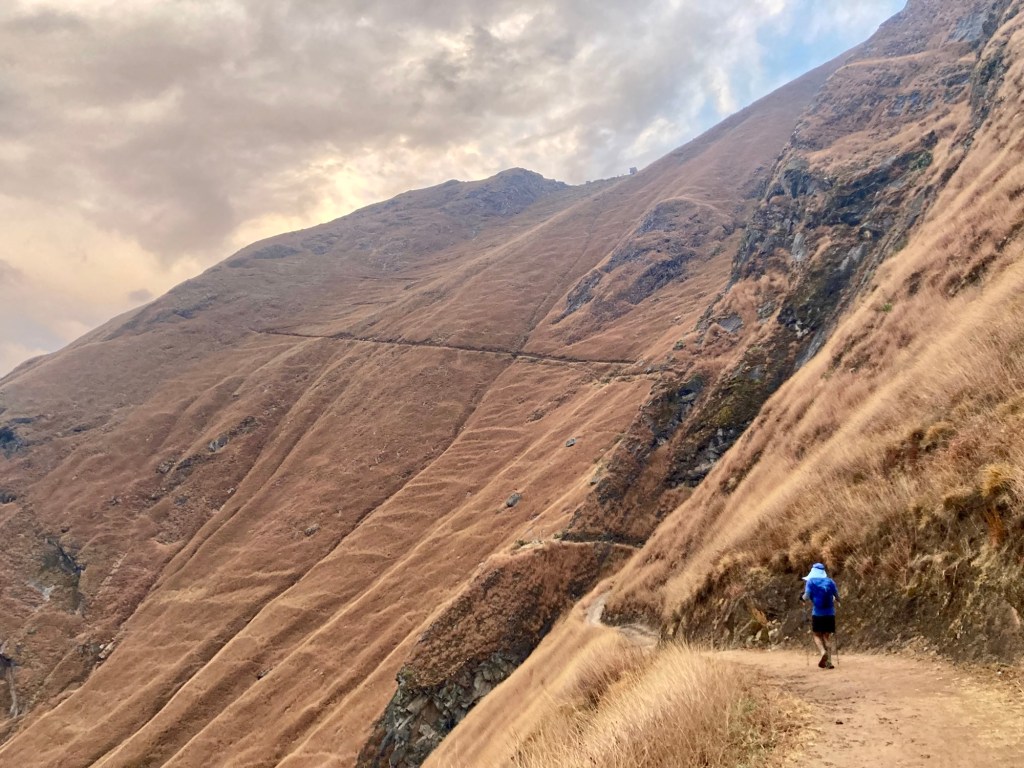
We got into our beds and listened to the rain pouring down outside, grateful to have successfully completed our journey. For me, dinner consisted of a Lucuma yogurt drink and a chocolate bar while Yuch snacked on nuts. 

The next morning, Elizabeth made us a traditional Peruvian breakfast of eggs, avocado, and bread. Rolando picked us up around 9:15 am. We had previously agreed on 10 am but we’re pleasantly surprised at the early arrival since we were ready to go. We apologized for any confusion about the taxi to which he responded “no te preocupes”. In the end, Yuch tipped him again for the second leg. For the next 24 hours or so we figured since we evaded the Choquequirao park fee, the least we could do is give it back to Peru in good tips. 

Final thoughts and tips on running Choquequirao:

  • Total distance ended up being 31 miles and 14,500 ft of gain. 7 of these miles were within the park itself.
  • Total time on trail: 14 hours, 14 minutes.
  • If you are an ultra runner, this can absolutely be done in one day! In fact, if you are an ultra runner you should absolutely put this on your bucket list. This adventure was MADE for trail runners. It would be difficult and inefficient to cover all of Choquequirao without running. 
  • Many Peruvians that we had told that we were going to do this in one day didn’t totally believe that we could. One person told us we wouldn’t have time to enjoy the park. In the end, I believe we spent more time in the park than anyone we saw that day. We observed people arriving after us who left earlier. 
  • If you are running this, you can filter all your water from the waterfalls and streams on trail (just probably don’t filter from the river)
  • Bring more cash than you think you will need! The tiny town of Cachora is not set up to take credit cards snd definitely does not have ATMs. Relieve yourself of any stress of not having enough cash. And remember that just to use WiFi will cost you some money! 

Choquequirao is probably one of Peru’s best kept secrets. The cable car to the park has now been approved but it will probably still be some time before people can visit Choquequirao without having to trek 24+ miles to do so. There are pros and cons to this. Some say that if tourists can easily access Choquequirao, it will reduce the numbers of tourists at Machu Pichu. However, building a cable car to Choquequirao would also mean that all the villages along the trail would lose the majority of their income. My opinion is that if you can, you should make this epic trek now. The challenging journey to and from Choquequirao will make it even that more rewarding! 

Tor des Geants 330k – 9.10.23

I had a lot of concerns going into the Tor des Geants 330k. Would the course be too formidable for a big scaredy cat like me? Would I make it out alive without falling off some precipitous descent? Would I be able to gracefully handle days on end of sleep deprivation? Would Yuch and I survive 100+ hours together without tearing each other’s heads off? I never once thought that the biggest barrier to finishing the race would be my physical condition.

You see, my body has always been quite sturdy. I thru hiked 2,600+ miles of the Pacific Crest Trail in 2016. In 2019 I ran for 24 hours in circles around Chrissy Field in San Francisco with the most painful part of the experience being when I stopped. I may not be fast, but I’ve always felt strong when it came to the long game. On the other hand, my anxiety has always been a limiting factor when facing anything new, daunting, and well “scary”. Scary being any situation in which I could possibly harm myself or die. Going into the 2023 Tor des Geants, I worried that while my body might hold up, my mind might not. In contrast, I worried that Yuch’s physical body may not hold up. I’ve seen him at the end of 100-mile races and it’s not pretty. I also worried about our relationship. I wanted us to run together, but how compatible would we be when it came to his sleep issues and my fear of well, everything? I imagined us at a sleep station, me ready to go, and him going through his 30-minute teeth brushing routine. When he joined me on the PCT in 2016, we got into some terrible fights surrounding my inability to compromise with another human being who is different than I am. We had now been together for 9 years…would I be the same person who I was back then? Could we complete 330 kilometers in the Italian alps while keeping our relationship in tact?

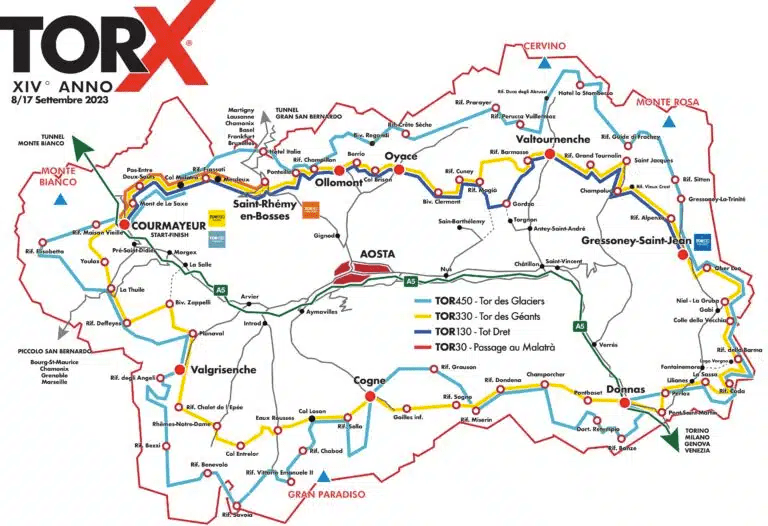
The Tor des Geants aka Tour of Giants aka the TOR is a 330 kilometer tour (approximately 205 miles give or take) of the Aosta Valley starting and ending in Courmayeur, a beautiful north Italian village at the foot of Mont Blanc. It is easiest to wrap your head around this monumental voyage by dividing it into seven sections, with each section being approximately 50 kilometers of ups and downs in the mountains bookended by big refreshment/aid stations called “life bases”. At the life base, runners can recharge batteries (literally and figuratively), stock up on food, get a massage, sleep, and take a shower. Essentially it’s a part of the course where you can do all the things that you couldn’t do up in the mountains, and get all the things done you need to get done before going back up into the mountains. Not to mention, if you are going to drop from the race, the life base is where you do it. Dropping out in the mountains is not really an option, unless you want to request a helicopter pickup. Sprinkled in between each life base are smaller aid stations – huts and rifugios where food, hydration, and minimal aid are available. Some have sleeping options, too. There could be between three and nine aid stations between each life base depending on the section, and how many mountain passes or “Cols” it has. The big goal of the TOR is to get back to Courmayeur within 150 hours, but the smaller goal is to get to the next life base. The even smaller goal is to get to the next aid station in between life bases. One foot in front of the other.

The yellow line follows the TOR330 course

My TOR journey started in January 2023 when I applied for the Tor des Lucas scholarship. The scholarship was created following Lucas Horan’s tragic death with the purpose of selecting one lucky person to train for and execute Lucas’ favorite race, the Tor des Geants 330k race around the Aosta Valley in Italy, in honor of Lucas. The scholarship provides financial support (race entry + travel stipend) as well as coaching from Peter Fain, Lucas’ former coach and previous RD of the Castle Peak 100k. I got the scholarship. Yuch decided if I/we were going to fly all the way out to Italy for me to do this race, he might as well tag along. He had also been interested in doing the race and it only made sense to do it all in the same year.

Getting into the TOR is not as easy as just signing up. Like many popular races these days, there is more demand than there are spots, so a lottery is held. Yuch got chosen in the lottery, but I did not which meant I would have to spend an extra $1000 to purchase a charity bib. Charity bib secured. Now all that was left was the training.

Peter told me he would coach me not just for the TOR, but also for every race I had leading up to it. This ended up including the Lake Sonoma Women’s Half Marathon, the Dipsea, and the Beaverhead 100k. We started by building up my aerobic capacity, working on my speed, and laying down the strength training groundwork for a strong core and upper body. Heading into the summer, the focus turned to weekend adventures in the mountains, running with a fully loaded pack, vert, nailing my nutrition, mastering trekking poles, and running on tired legs. When Peter first started coaching me, I had been battling a year long bout of plantar fasciitis that was long gone by now. I had also overcome a hamstring injury from spring soccer. My body felt strong.

Approaching race week, I talked to Peter about my strategy. I expressed my concern about running with Yuch, and also about running without him. Peter’s advice was to run our own races. If it worked out that we ended up going the same pace while running our own races then we could embrace it, but until then we should be flexible aka “Operation Slinky”. Yuch was agreeable to the plan.

A lot happened the week before race week. I secured a new job at Marin Health, the job that I’d wanted since the moment I secured my graduate degree. I quit my job at HeartWorks, the job that I had loved for the last year and a half. The new job was significantly closer to home and would pay me a lot more. I felt invincible. Every decision that I had made since grad school was in pursuit of this job at Marin Health. I finally got my dream job and now I was going to do this epic race.

Although it was our preference to take public transportation, we rented a car in Geneva that we would drive to the race start and finish in Courmayeur. This was due to the Chamonix-Courmayeur tunnel closure that was conveniently occurring after UTMB, but before the TOR. The closure of the tunnel meant there would be no trains to Courmayeur. Instead we would be forced to take a very long detour by car.

In Geneva, we were able to see my friend Noemie, and her two kids. We then drove to Chamonix, aka Disneyland for trail runners, where we spent two nights taking in the scenery (but only doing one very easy run) and seeking last minute TOR items such as sunscreen (for me) and a Gatorade substitute (for Yuch). Both were surprisingly difficult to find. Do these people not use sunscreen?? Yuch ended up finding a sports drink that he later would find revolting. I would later settle on a small tube of overly priced sunscreen at an athletic store in Courmayeur.

Beautiful Chamonix

In the end, the tunnel was open allowing us a quick trip from France to Italy. Our Airbnb in Courmayeur was pretty close to the Sports Center, where the TOR expo was, but a short drive to the town center. The day before the race the plan was to pick up our bib and drop off our follow bags at the expo. The follow bags are big duffel bags that runners can pack with necessities that they might need along the course. They would be available to us at every life base. My follow bag included an extra set of running clothes, extra socks, extra pair of shoes, a long sleeved shirt, a light weight hooded mid layer, extra Light Belt batteries, two extra headlamps, a phone charger, two portable phone chargers, soap in the event that I wanted to shower, a small towel, toothpaste and toothbrush, two big bags of potato chips, several bags of gummy candies, extra Skratch electrolyte packs, and some energy bars. Let me ask you this: Does this seem like too much, too little, or just the right amount of items for a follow bag? Read on to find out…

Unfortunately the bib pickup was not a fast process as there was a huge queue of runners ahead of us waiting to pick up their bibs. We grabbed a number and after realizing we would be waiting there for hours, we decided it made the most sense to wait it out at the Airbnb. We ended up parking the rental car at the Sports Center since we actually had found a spot that we weren’t so sure would be available later in the day. Where we would park this rental car while we were out on the course for an entire week without getting ticketed or towed had been a huge worry of Yuch’s, so it was a massive sigh of relief to have this problem solved. The only downside being we would now have to walk back to our Airbnb, back to the Sports Center, back to the Airbnb, and to the race start in the town center the next morning. That’s a lot of walking before running 330 kilometers. Or is it?

Courmayeur town center

Leaving the Sports Center we ran into Jan Horan, Lucas’ mom who offered to drive us back to the Airbnb, and anywhere else we needed to be shuttled. Jan had come to crew Lucas when he ran the TOR in years past, and now it has become a tradition to come out to the race and support the scholarship recipient. She ended up giving us a ride back to the Airbnb and offered to pick us up in the morning to take us to the race start.

Yuch makes a last minute bakery purchase before the race start

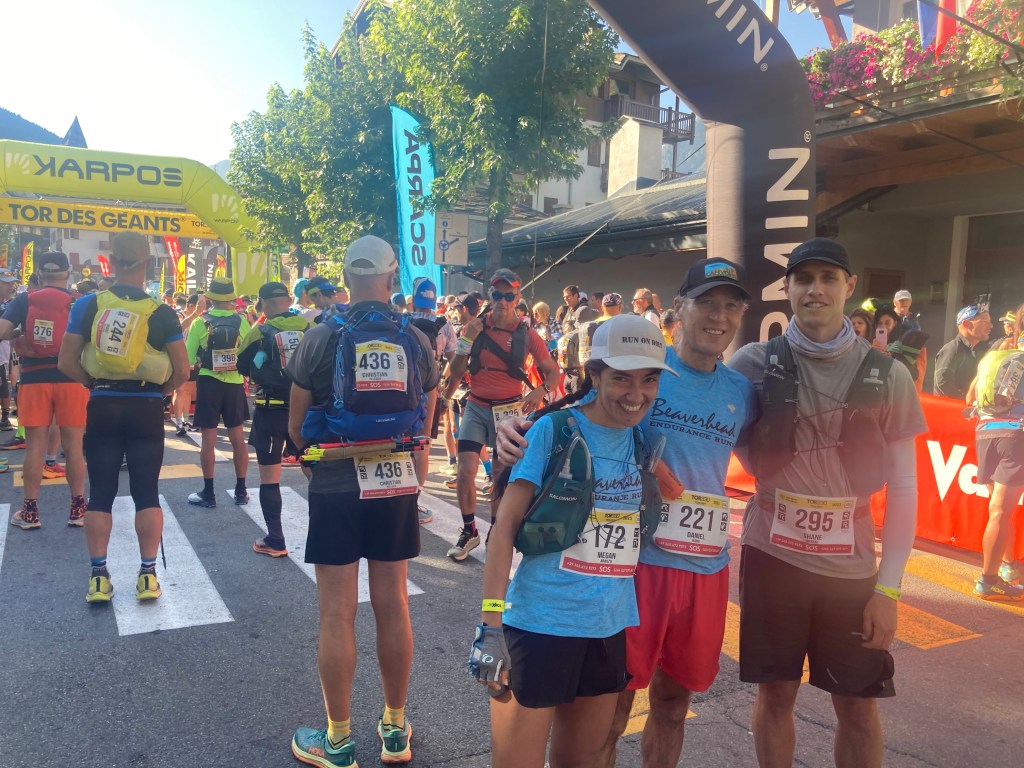
At the race start we immediately located Shane. Oh wait, I haven’t told you about Shane. I know, I know. You’ve been reading this far and I’m still not even at the race yet, but you must know about Shane! We first met Shane after the 2022 Swiss Peaks 100k. We were on the train the next morning after the race and started talking to another runner who had done the 360k, and he just so happened to be from San Rafael. What are the odds? I asked Shane who he ran with. Tamalpa? SFRC? Anyone we know? He replied, “no one”. I guess we left it there. Maybe we would see him sometime, running with no one, somewhere…in Marin.

Fast forward a year later. Yuch and I are training for the TOR by going up one of the steepest ascents to Tam. A trio of runners are coming down and one of them remarks at my t-shirt, “Swiss Peaks!” We meet Shane again but this time exchange numbers after learning he too is training for the TOR. As we got closer to the race, we exchanged itineraries and phone numbers. Yuch and I kept our U.S. phone numbers (only $100/month through Verizon international travel plan), but Shane had gotten an international phone number. As it turned out, something went awry with the phone number and he was unable to use his phone over there, and we were unable to reach him. But that’s okay, because what we would soon learn is that Shane always seems to appear, even when you least expect him. For example, when we went to the bib pickup at the expo, we had only just arrived when bam – out of 1,200 other runners tightly packed in a gym, there was Shane. That was when he told us he was unreachable by phone. We hung out for a bit and concluded that hopefully we would run into him again. And we did, the very next morning at the race start.

Race start. Great minds think alike…

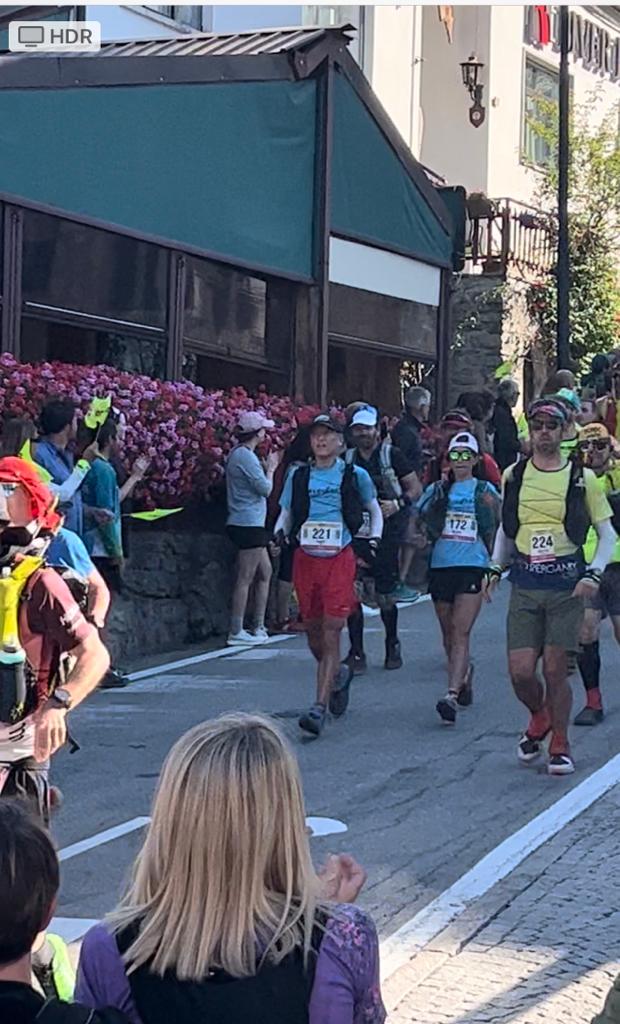
The race started at 10 am on September 10th on the bustling street of Via Roma in the Courmayeur town center. There was so much noise and fanfare, it was as if were out to do something EPIC, and we were! We met a gentleman who said he had run the TOR eight times. I thought, wow – he must really love this race. I think I will be happy to do it once. Any advice, I asked? He responded, go easy on the downhills.

Departing Courmayeur – photo courtesy of Jan Horan

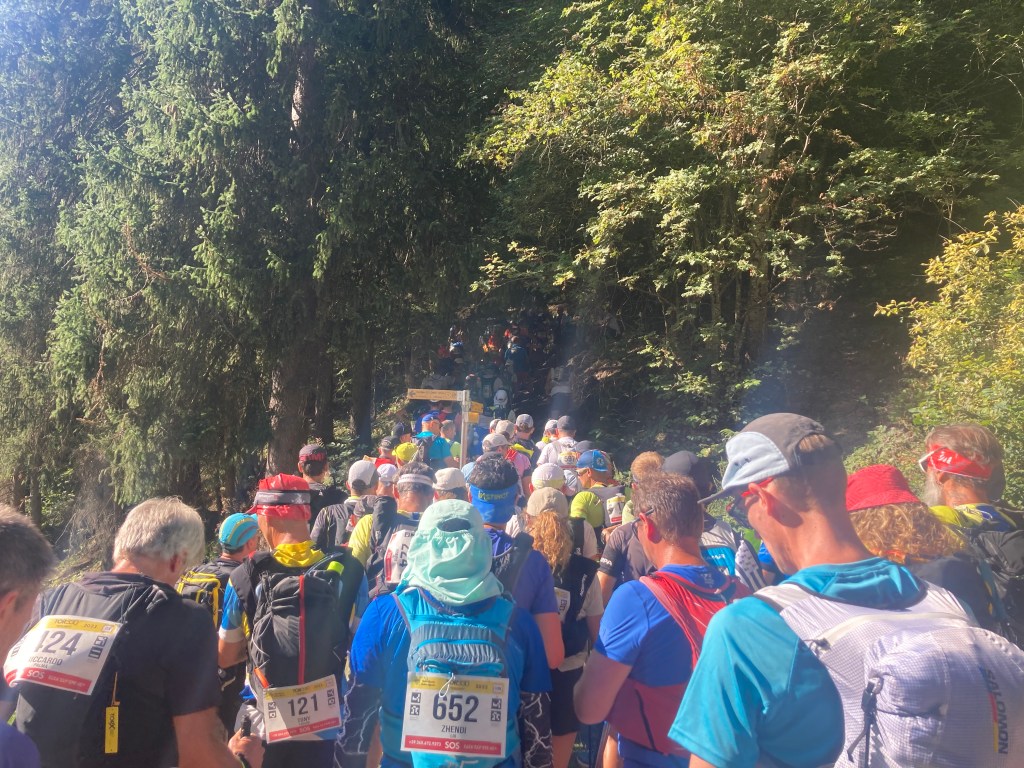
Leaving the town center the course merges on to a single trail, going straight up hence a huge bottleneck. I didn’t mind though, because we had plenty of miles ahead of us, and plenty of time to do it in.

Beware the Bottleneck

Courmayeur to Valgrisenche

Total distance and elevation gain: 48.55 k, 4048 m (13,280 ft)

I felt fantastic the first 50k. From the start to the first life base in Valgrisenche there were three cols, but who’s counting? It was pretty warm that first day, but I felt solid. As planned, Yuch and I traveled at our own paces. Each time I arrived at an aid station, Yuch was just leaving and would look back to me and give a friendly wave. This was a good compromise. If we weren’t going to be running together, at least we were close and aware of each other’s whereabouts.

Two hours in. A long ascent up Col ARP – 8,422 ft
A long descent
Descending into the village of La Thuile, 19k and 3.5 hours in

At the aid stations I grabbed bread, cheese, and dried fruit. I was pleasantly surprised when I got to the first aid station that had more real food options, polenta squares! Mmm, I could get used to this.

Heading to Rifugio Deffeyes
Rifugio Deffeyes – 28k and 6 hours in. Almost 2.9 miles/hr thus far!

Going up one of the early cols, I ran into Shane. He had stopped at the “side” of the trail, which at the time was a steep switchbacky trail up. He was curled up in a ball (upright) and had his hood on with his face barely visible. He did not look good. He said he was having trouble with the altitude, but would be fine so I kept moving on. I worried about him. If he was having trouble now, would he be able to do this?

Col Passo Alto – 9,370 ft – Getting ready for a good descent 30k in
Col de la Crosatie – 9,258 ft – 36k and 9ish hours in

I don’t know if I was surprised by the terrain yet or not. The ascents were steep, so you just hiked. Easy enough. The descents were steep, too, but seemingly runnable. I passed by many runners on the descent to the first life base at Valgrisenche. They seemed to be going downhill unusually slow and skiddishly. Meanwhile, I felt great and was flying. I thought about what the runner had told us at the start. Go easy on the downhills. I thought I was going easy. But was I going easy enough?

Descent into Valgrisenche

It was just starting to get dark as I approached Valgrisenche. I located my follow bag, but what the heck did I want from it? It was completely packed to the brim and difficult to locate items which I had segregated into individual ziplock bags. I began to peruse the buffet at the life base, which looked like a Thanksgiving dinner smorgasbord. Although I don’t typically eat meat, I decided I could use some protein so grabbed a piece of turkey and some potatoes on the side. Yuch was at the life base, too. I think we were having the same thoughts and fears about leaving the life base alone and heading out into the dark. We unanimously decided to go into the night together. 

Valgrisenche to Cogne

Total distance and elevation gain: 104k, 9282 m (30,452 ft)

I can’t really remember the cols we covered in the night. Like the last section, this one had three. One of the cols, either Fenetre or Entrelor, had a memorable descent. It was very steep, and especially precarious in the night time. I recall I couldn’t keep up with Yuch but was comforted to have the company of a Ukranian woman who was just as slow, if not more than I. She had done the race several times. I told her “You must really love this race!” She said that she was pretty sure she failed to remember each time how absolutely crazy it was.

The sun was just beginning to come up as we approached the last col, Col Loson before the life base at Cogne. The sunrise was a game changer. The early morning before the sun comes up can be the coldest, and the arrival of the sun not only meant warmth, but emerging from the nighttime aka the time when people should be sleeping. I wasn’t really tired, but I was getting there. Yuch and I had decided that there was no need to sleep in the first 24 hours. In a 100-mile race, runners do not typically sleep, so why start now? We planned to get some sleep on our second night, wherever that might be.

A little hut on the ascent up to Col Loson

We reunited with Shane on the ascent to Col Loson. It was nice to have the extra company, especially company that speaks the same language! The climb was relentless – over 5,000 feet in 7.5 miles. On the way up I noticed one or two runners who would cut the switchbacks, which seemed like an odd thing to do in a race like this. This would not be the last time we witnessed this.

Ascent to Col Losson, 10,807 ft (the highest pt on the course)
A long way down
Descent into the second life base at Cogne

Arriving to Cogne around 1 pm on Day 2 (Sunday, 9/11), I first began to doubt my journey ahead. We were 27 hours in, 100k down with over 200k to go, and already my legs felt wrecked. I thought I had been taking it easy, but nothing prepares your body for the damage it will endure on the TOR. Entering the life base at Cogne, a volunteer asked me how I was doing. I told them my legs felt trashed, and I seriously wondered how I was going to do more. Being Italian, they didn’t totally understand the word “trashed” so I had to find an alternative word to use. Once they understood what I was saying, they told me not to worry, that I would feel as good as new after leaving the life base. They also mentioned that John Kelly, previous Barkley finisher/winner, had felt the same way entering Cogne. He nearly dropped out, but after a short rest left in tip top shape (or something to that effect).

Yuch appears stunned to return to a civilized village after being up in the mountains

Taking a shower seemed to make sense at the time. It was really warm and we were exhausted. The shower was time consuming, but felt amazing to emerge clean, renewed, and with a fresh pair of running clothes. We again then faced the task of contemplating the life base buffet and our follow bags. For all the work that I had put into stuffing my follow bag, none of this stuff was of interest to me nor very easy to contemplate in a tired state. Yuch and I must have easily spent an hour unpacking our follow bags, staring at the items, moving the items to and fro, and then repacking them. Shane was now with us although he hadn’t wasted his time showering and probably thought we were crazy. His follow bag didn’t have nearly the same amount of junk that ours did. When all was said and done, I think we had spent three hours at that life base. I think Peter was worried that I wasn’t moving because he kept texting me “constant forward motion”. Easier said than done.

Cogne to Donnas

Total distance and elevation gain: 149.77k, 12050 m (39,534 ft)

Just as the Italian volunteer had promised, we felt pretty good leaving Cogne. We had 46 kilometers to the next life base at Donnas, and there was no way we were going to make it there by night. We started planning when and where we would sleep that second night. Surely we would be ready for some shut eye by then. Our cheat sheet showed three rifugios between Cogne and Donnas. Rifugios are basically what they sound like, high elevation huts along the trail to seek refuge (food and place to sleep). With a whopping three rifugios in our future, perhaps we didn’t need to make plans. We could play it by ear and stop at whichever one we fancied.

Except, we made one mistake. The first two rifugios were actually NOT places that we could stay. Upon further scrutiny and to our dismay, we realized that these were simply listed as “way points” on our cheat sheet. Why we should care about these abandoned rifugios with no food, water, or beds, I never understood. What I did know is that now we were going to have to book it to Rifugio Dondena, the only place with a bed between Cogne and Donnas. Feeling demoralized at that last non-rifugio rifugio, I told Yuch I was so tired maybe we should just sleep there. He was not happy at the thought of sleeping somewhere that was not an actual rifugio or life base, so we powered on.

Despite the recent bad news and our exhaustion, something miraculous happened between Cogne and Donnas. I felt stronger. The human body is amazing. It wants to adapt to the conditions that we give it. The Cogne volunteer had been right. Some food and rest had apparently been enough to keep my body moving forward. It was adapting along the way, and as long as I kept sprinkling in some food, water, and rest I might in fact be able to keep this engine moving! Yuch felt the same way, and we were in disbelief that this race was so quickly transforming us.

Ascent to Finestra Di Champorcher – 9,275 ft

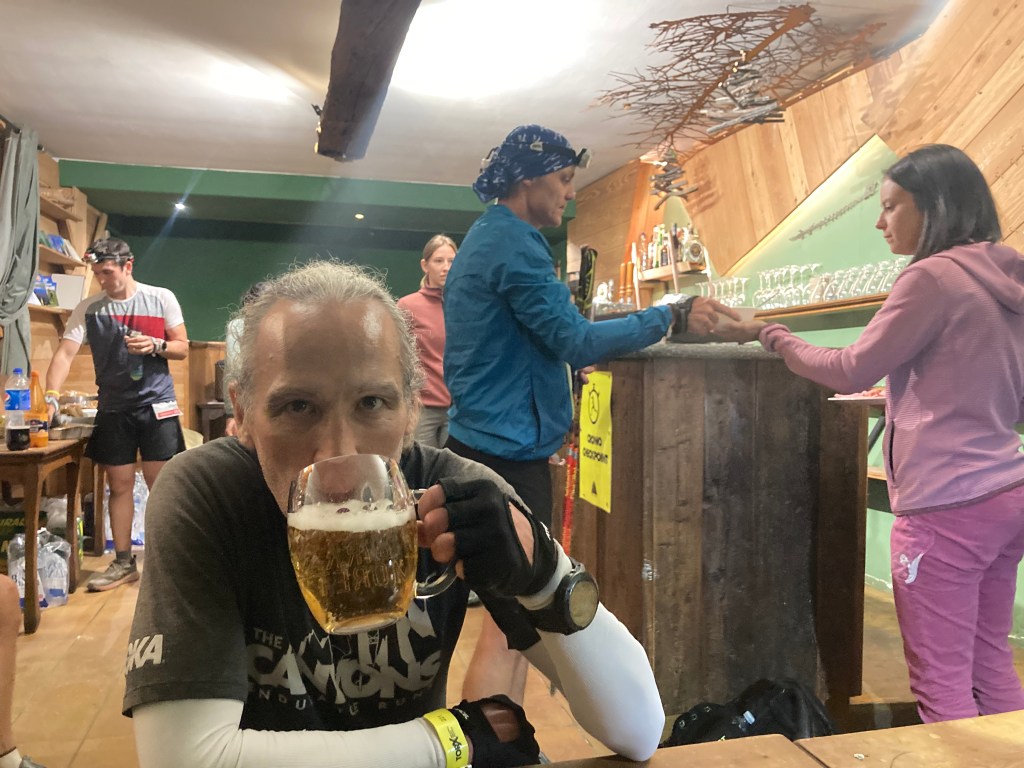
We arrived at Rifugio Dondena around 9 pm. The timing could not have been more perfect. Cold and exhausted, we stepped into a warm cozy dwelling with a roaring fireplace and a barkeeper at our service. Would you like pasta or spelt salad? How about a beer? We opted for the spelt salad as it seemed like a nice reprieve from everything else we had been eating. Yuch got a beer. Although the aid station bread, cheese and dried fruit had seemed delightful at the beginning, it starts to get old when you see the same thing aid station after aid station. We took the bistro table right next to the fireplace. I was in heaven.

Yuch downs a beer at Rifugio Dondena – 126k and 35 hours in

After dinner, we inquired about some beds to sleep in. Beds could only be “rented” for 2 hours. As soon as we entered the room, the clock started, and two hours later, someone would wake us up promptly. There were no private rooms available so we were put into a dark room with a number of beds and runners already fast asleep in them. As quietly as we could, we peeled off our noisy layers and placed our dirty listless bodies into bed. 

Lying in bed I shut my eyes, but I did not find darkness. Bright colors and objects moved from side to side in every which direction. Every thought I’ve ever had moved wildly in my head. This was not going to be easy. I looked over at Yuch and he looked fast asleep. What was I going to do, just lie here for two hours doing nothing? At some point, I woke up. It was only at this moment that I had realized that I must have fallen asleep. It had been one hour. I looked over at Yuch who was again, seemingly fast asleep. I realized I needed to get up. I grabbed my belongings and tip toed out of the room.

Outside of the bedroom the rifugio was alive with the energy of the TOR. Runners were coming and going. I requested a cup of coffee and sipped on this wonderful brew while sending out a couple of texts to friends and family, and catching up on my Duolingo (can’t break that streak). This was way better than sleeping more. I had had just enough sleep and after this coffee would be ready for more that the trail had to offer. When the two hours had been up, I noticed the woman who had checked us in was not going to wake Yuch up. Perhaps it had been an unspoken arrangement that since I was now awake I would wake him up. I went into the room, and knelt down next to his bed with my hands atop his blankets. “Yuch, Yuch! It’s time to get up!” It was only after receiving a tired and confused “huh?”, that I realized I had gotten the wrong bed. Oops. I apologized and moved over to the next bed over.

As I waited for Yuch to get his stuff together, I headed down to the dining room. I was pleasantly surprised to find Shane who had just recently arrived. He was feeling pretty down in the dumps and did not think he was going to be able to continue. I couldn’t fully understand why as nothing seemed to be especially wrong. He said he just wasn’t having any fun anymore and thought if he dropped out he might be better able to enjoy Italy. I asked him if he was eating to which he responded – not really. He said he had been trying to eat at the aid stations, but then would get so wrapped up in the trail that he couldn’t be bothered to eat in between. I could totally related to this, but told him he would feel much better if he ate. He did, and after Yuch joined us, we told him we should all set out together. He had been running alone up to this point and that could have also been playing a role in how he was feeling.

I felt an amazing sense of renewal leaving the rifugio, now Day 3 (Monday, September 12th aka my 40th birthday!) The three of us were running together and I thought, this is what I love about running – running in the night time when most people are sleeping, enjoying each other’s company, on a crazy adventure. At one point we picked up another runner to join our group. He did not speak English very well, but we gathered enough to understand that he did not want to run alone as he had been hallucinating earlier. We welcomed him to our group. This run from Rifugio Dondena to Donnas would be one of my favorite memories from the TOR.  We arrived to Donnas in the very early morning (around 6 am) while it was still dark. Jan ended up meeting us there and bringing me a pizza which was well received. Nothing at the life base nor my follow bag looked of interest to me, although to me and Shane’s dismay, Yuch seemed to find pleasure in eating a large number of hard boiled eggs. At Donnas I decided to get a short massage which was painful but hopefully would help me going forward.

Donnas to Gressoney

Total distance and elevation gain: 204k, 17983 m (58,999 ft)

I left Donnas feeling mildly grouchy. Yuch can attest to this, although he may argue with the “mild” part. I’m not really sure why. I think I was just really tired. Although the coffee had really perked me up the previous night, I was now going on 48 hours with only one hour of sleep. With a lifetime of experience, Yuch is a master at going days on end with little sleep. Some might even say he had been training his whole life for this! Me, on the other hand, I was a softie who needed 7-8 hours of sleep a night if I were to keep my emotional faculties in order. So the ascent out of Donnas was a quiet one as Yuch and I stuck together, but mostly didn’t speak.

Leaving Donnas, the third life base

Even thought it was only 8 am, I started wondering when our next sleep opportunity would be. Yuch did not love the experience at the rifugio. He already has anxiety around sleep and it didn’t help to have a strict time limit, nor did it help to be surrounded by a number of other quietly sleeping runners who may not be very pleased to be woken up by any sudden rustling. He had already decided if he was going to sleep again, it would have to be at the next life base at Gressoney. But that was 54 kilometers away, and we weren’t exactly moving fast. Who knows how long that 54 kilometers could take?

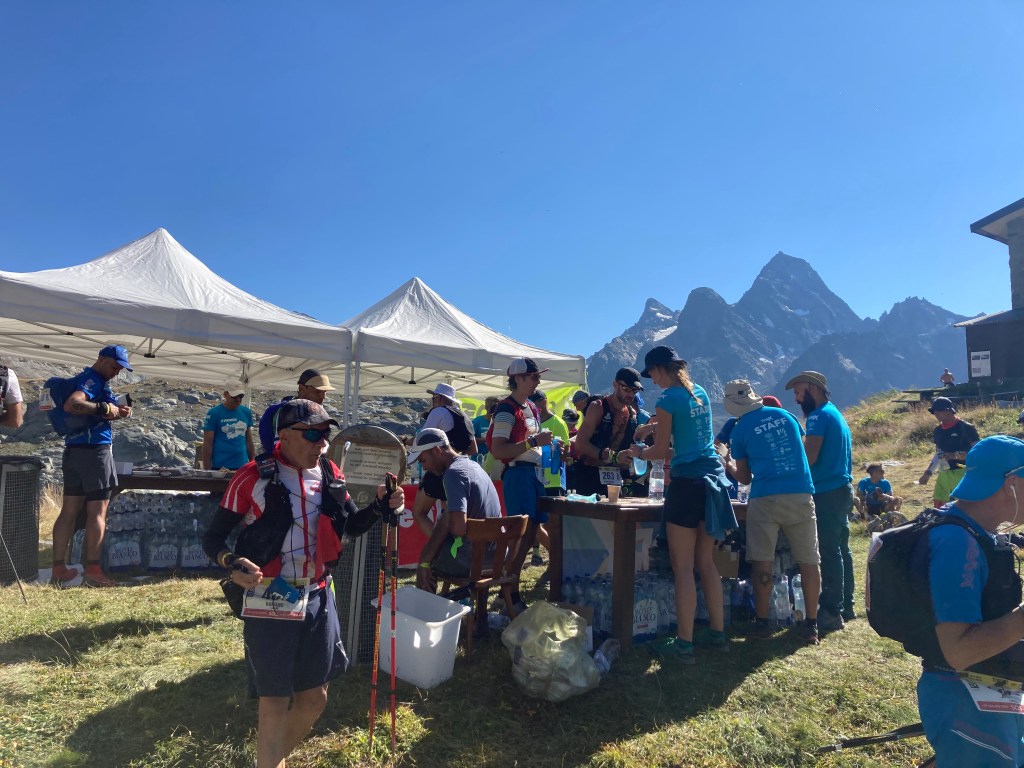
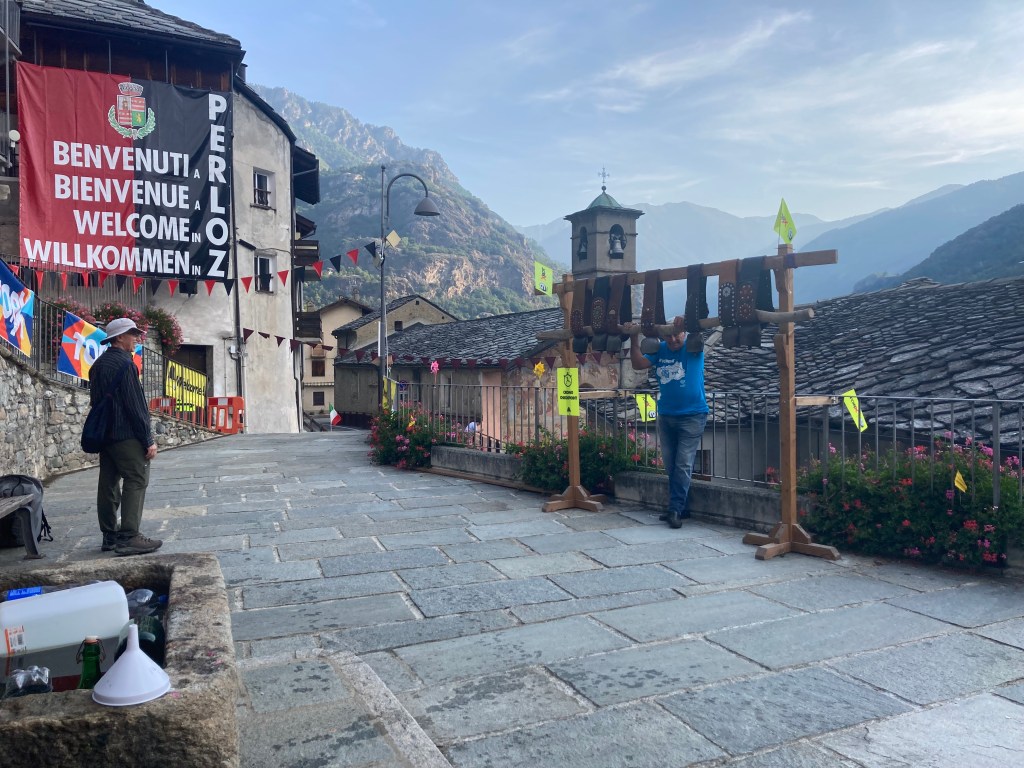
The first town leaving Donnas was Perloz where we were greeted by a symphony of cowbells (courtesy of a Perloz resident) pastries, and delicious fresh squeezed orange juice. It’s true we had only come 6 kilometers from Donnas but remember, the TOR is very slow-going, and even a 6 kilometer stretch deserves celebration and a rest stop!

Perloz – 155k in
Somewhere on the ascent to La Sassa. It all begins to become a blur…

The next big climb on this stretch was to Rifugio Delfa E Agostino Coda – at 7,400 ft. I’m not sure how this happened, but at some point Yuch ended up behind me. I kept ascending, thinking he would eventually catch up. It didn’t make sense to wait, especially with Operation Slinky in effect. As I arrived to the top of Rifugio Coda around 2:30 pm, I started to wonder if something more serious had happened. In the meantime, I helped myself to delicious rifugio food – namely a homemade quiche and cubed melon. Eventually Shane arrived, but no Yuch. I waited and waited and ate more quiche and melon. Shane decided to move on. Finally, Yuch arrived and indeed, something had happened.

Rifugio Coda – 167k and 52 hours in (now averaging 2 mph)
Looking back at the trail coming up to Rifugio Coda. Where is Yuch?

On the climb up to Rifugio Coda, Yuch’s hand started to really bother him from gripping his trekking pole so he had stopped to wrap it up. He was in a terrible state of worry when he arrived at the rifugio, stating that he had no idea how he was going to go on. He appeared to have some kind of overuse injury and the simple act of using trekking poles was causing him a lot of pain. I started to worry too. If he had to drop out, that would leave me on my own. My first suggestion was  to ditch the trekking poles, but he responded that there was absolutely no way he could do this cray steep course without poles. My second suggestion was to seek help from the medics at the rifugio. Yuch did not think this was a helpful suggestion as he could not fathom what they could do to help. He finally agreed that while he would not ask for help, he would allow me to ask them for help. In the end, they were able to help, by suggesting an alternative way to gripping the trekking poles that would put less stress on his hands. Crisis averted.

The next place we would get aid after Rifugio Coda was about 8.5 kilometers away, Rifugio Barma. But just as it is for everything on the TOR, that 8.5 kilometers took way longer than expected, roughly 2.5 hours. Not only did it take a long time, but we kept getting faked out by perfectly good looking structures and huts, only to find out that they were not Rifugio Barma. Here’s a suggestion if you ever decide to do the TOR. Do not look at your watch. Do not anticipate when you will arrive to the next aid station, because it will always take so much longer than you think it will take. Even when you think it is just around the corner, it never is. And even if it is around that corner, that is the biggest and longest corner than you can ever have imagined. So take my advice and be in the present. And when that aid station or rifugio arrives sooner than you expect, allow yourself to have that pleasant “surprise.”

Where the heck is Rifugio Barma?
Is that it? False alarm. It’s just yet another random structure out here…
At last, Rifugio Barma appears in the distance

Arriving at Rifugio Barma was a double edged sword, for me. It was a relief to get to a nice warm shelter with hot polenta and coffee. But it also killed me mentally knowing that we were not staying. I was so tired, but we had agreed we would not sleep until the next life base at Gressoney. I could not thoroughly enjoy what the rifugio had to offer me because all I could think about was the long road ahead, and the long night ahead. I was scared about what was yet to come.

Rifugio Del Lago Della Barma – 176k and 55 hours in

We climbed Col du Marmontana after Rifugio Coda, and arrived at the Lago Chiaro aid station (181k) around sunset. I arrived in tears. My legs had slowly been breaking down since Donnas, but my right leg was noticeably becoming harder and harder to bend on the descents. It felt as though with each bend, I was doing more and more damage to the quad attachment to the knee. I imagined reaching the final leg bend and that attachment just snapping. Arriving to Lago Chiaro I asked Yuch to fetch me some food from the aid station. I could not bear to show my tear stained face to anyone. He brought me back more of the usual – crackers, cheese, cookies. I could not stop crying. I didn’t know what I was going to do. Yuch, being the wonderful person that he is, said this: “Well, when I didn’t know what to do with my hand, you suggested I ask for help. Maybe you should do the same thing”.  

So, that is what I did. Although, I can’t remember if I did it myself, or asked Yuch to do it for me! Either way, I found myself in a dark tent behind the aid station. The sun had set by now and the only light in the tent came from the headlamps on top of the volunteer’s heads. They sat me down and assessed my knee. With minimal English they suggested taking some painkillers and wrapping the knee. The other option would be to take a helicopter down the mountain. The latter was out of the question. I did not have a broken leg, so surely I could continue on. Part of me was annoyed that they could not do more for me. I wanted them to give me an answer to my question which was, “What is wrong with my leg and do you think it is safe to continue?”. But they could not give me the answer I wanted and could only offer me two options – continue or not. I accepted the painkillers and bandage, and continued on.

The painkillers and the bandage helped at first. Until they didn’t. It was only 4 kilometers from Lago Chiaro to the next aid at Colle Della Vecchia. I found that I could still ascend. It was the descents that were the hard part. It got even harder because I started favoring the injured side, so much to the point that I was now having even more knee pain on the left side. Because it hurt so much to bend my knees on the descents, I had a brilliant idea. I would no longer bend my knees. Man, I’m so smart. Much to Yuch’s alarm, I started descending sideways. I rejoiced that I had found a solution to my issue, but to Yuch it was not a solution. I felt I was moving quite briskly using this new technique, but to him I was moving at the speed of a snail.

Arriving at Colle Della Vecchia (185k) around midnight was yet another victory, but we were not victorious. In fact, Yuch was pretty darn sure that I could not go on. We played the same game that we did at Lago Chiaro. Ask the medics for help, and get offered two suggestions: continue on, or take a helicopter down. I again refused the helicopter. Yuch was furious, perplexed, you name it. The reality he saw was that I was barely moving up and down these mountains. Sure, I had gotten helicopter insurance (and I suggest you do, too!). But my reality was that I was still moving. In retrospect, I was not being stubborn. I think when my legs first started to be a problem, I genuinely thought that I could work through it. At this point, I knew – ok, maybe I’m not fit to finish this race, but I’m not broken and I can make it to Gressoney without a helicopter if I just keep moving forward. Regardless of what we were going to do, at that moment I could not do anything. I could not make a decision. I was so tired. We had been moving for over 60 hours with only one hour of sleep. Maybe if I could just get some sleep, I would wake up and feel better. Maybe my knee would work then. The volunteers at Colle Della Vecchia suggested getting some sleep in the tent behind the aid station, which had only two cots.

I felt bad that we were taking up the only two cots that they had at the top of this mountain with other desperate runners arriving in the middle of the night. But, I also knew I was in a desperate situation. Lying down on the cot, I covered myself with a wool blanket that had been used by multiple runners before me and tried to fall asleep. My legs were throbbing with pain. I could not fall asleep. I texted Peter but could not get through to him. Yuch had fallen asleep and I was lying here useless, not getting any sleep at all. Maybe an hour later I realized we couldn’t stay here anymore. We were taking up two valuable spots that others could use to get critical rest. And I had absolutely nothing to show for it. No sleep, and the same messed up legs. I tried to wake Yuch up and told him we had to go and we had to go now. Emerging from this brief sleep was a huge shock for Yuch. To his complete surprise, he had sweat during his sleep and awoke to an absurdly soaked shirt and down jacket. To make matters worse he had slept in his contacts this time around and they were now stuck to his eyeballs. He fumbled to gather all his things in the dark in a half-asleep stupor with hard lenses stuck to his eyes. He had nothing dry to put on, was freezing cold, and now we were getting kicked out of this tent and off this mountain back into the cold night.

It was only 5.6 kilometers to the next aid, “Niel”. Maybe, I should stop using the word “only”. We arrived around 4:30 am. You do the math. Gressoney was so close, yet so far away. Dortoir La Gruba is actually a bed and breakfast in the small village of Niel , but tonight it was acting as a bustling rifugio for a select group of weirdos who like to run, walk, and hobble in the mountains for days without sleep. I peeked into the kitchen to see giant vats of polenta and boiling water for pasta. Runners were all over the place, mostly upright, but some tucked horizontally under benches taking much needed naps. Everyone seemed to be having a good time. Everyone but me. I sat, eating my polenta slowly, filled with anxiety about leaving the rifugio once again. And then it started to rain.

Leaving a cozy rifugio w/ unlimited polenta and pasta to go into the dark and rain is not an easy task. It was 14 kilometers (8.7 miles) to the life base at Gressoney aka my finish line. But before then we had about 3,000 feet to climb and 3,300 feet to descend. The climb was brutal. Although I had previously been excelling at climbing, this was no longer the case. My tiredness was now becoming painstakingly evident in my emotional state. I was having trouble keeping it together. I cried and told Yuch if I found a suitable rock or tree, that I would just curl up and fall asleep. He urged me to keep moving as he was not generating much body heat with the current pace. We reached the top of the climb as the sun was rising, but the worst was yet to come. It was so cold and my legs had reached their maximum bending allowance.

Although it was officially morning, the sun had yet to do its job in fully warming us. I tried to keep up with Yuch, or at least lessen the gap between us but I could not move any faster. It took about 3.5 hours to travel the six kilometers between Niel to the last aid/rifugio at Bleckene. I saw the rifugio long before I arrived to it, and I believe the same was true for the volunteers and me. They knew something was wrong as they watched how long it took me to arrive.

At this point the goal was unequivocal: get to Gressoney. We tried to communicate the situation to the volunteers, but the language barrier was making it difficult. Despite the language barrier, my current ability was not at all difficult to comprehend. They had seen how absolutely and insanely slow I was moving, and there was still talk about me getting a helicopter for these last seven kilometers. I couldn’t believe that people were still discussing helicopters when I was so close to where I needed to be! In the end, they gave me more painkillers (in sublingual form), and we set on our way for the final leg.

Seven kilometers has never taken so long in my life. Nor has it ever taken so long in Yuch’s life. Of all the descents of the entire course thus far, this was the easiest, most gentle, most runnable, most forgiving. But none of that made any difference to me, because every single step forward, whether it was up, down, flat, or sideways felt the same – the most Herculean effort I could possibly give. This probably didn’t seem the case from an outsider’s perspective, so you’ll just have to take my word for it. With every step, I prayed that my quads would not snap. I had reached my painkiller max, and they were no longer helping me. Yuch was now going at his own pace which meant he would go on ahead, then stop and close his eyes until I caught up. Apparently my pace was too sleepy for him, so this method was preferable. Many many runners passed me during this time. They seemed to be flying by, but then again, that’s probably what it’s like to be a snail – everything is that much faster.

We arrived at the Gressoney life base just after 11 am on Tuesday, September 13th. I had covered 204 kilometers (136 miles) in 73 hours with the last 20k taking about 11 hours. I had been in communication with Jan through WhatsApp so she was waiting for us as soon as we arrived. I went inside to officially drop out and to grab my follow bag. Dropping out was a no-brainer. I never once debated whether I should continue on or not. Gressoney had been my finish line for a very long time, and I was so proud of myself for getting there on my own two feet.

Speaking of my own two feet, here they are. Right knee noticeably more swollen than the left

The only problem with dropping at Gressoney is that you are a long way from where you started in Courmayeur. Thankfully, Jan had a hotel room in Gressoney, so the plan was to shower and rest there, then she would drive us back to Courmayeur. While we were showering and resting she made us some soup with the little ingredients she had in her hotel room. We then passed out in her king size bed. That evening she drove us back to our Airbnb in Courmayeur.

September 14th – The day after

The next morning I woke up with a full on cold. I had a headache, congestion, fatigue, and mild fever. I walked myself over to the closest market to fetch soy milk for my tea and was surprised that I could walk. I was glad that I hadn’t damaged my legs beyond repair. I made myself tea and went back to sleep. I had a lot of catching up to do. Around 3 pm we began to fully emerge from our Airbnb and decided we wanted to pay Shane a visit at the last life base at Ollomont. We were pleased to know he was still in the race and wanted to support him as much as we could. Since he had been struggling with eating, we thought he could benefit from some non- aid station food. We stopped by a market in Aosta and picked up a variety of options – smoothies, pot-stickers, and naan. In retrospect, this is a weird combination of food items, but they seemed like good alternatives to aid station food at the time.

I was in the middle of a laughing “attack” (which sometimes happens) when we approached this store in Ollomont and thought this little scarecrow person was hilarious. Sadly, the store was closed.

Although we had been tracking Shane the whole day and had the whole day to get to Ollomont, we missed his arrival. When we arrived to the life base, he had already checked in. Unfortunately, non runners are not allowed inside the life bases without a previously procured badge, so we were stuck waiting outside, hoping that we might see him when he exited, which could be between zero and five hours. Yuch ended up asking a volunteer if he could sneak in briefly to find his runner, and they approved. The next thing I knew, Yuch had located a bone-weary Shane and brought him outside to the crew designated picnic tables. Shane was very confused as to why we were no longer running and instead bringing him food. We caught up him up on the events of the previous day as he wrapped potstickers up in his naan into a naan-potsticker burrito. Turns out the food was edible after all.

September 15th – The day after the day after

We planned to watch Shane’s finish in Courmayeur the next day, but once again our timing was bad, and we missed him. We ended up driving to the Sports Center where we knew he eventually would need to get all of his stuff. Supporting Shane had been our last hope and joy, akin to supporting your child achieve their dreams even if it is too late for you. I was so proud that he finished the race, despite being curled up on the side of the trail with altitude problems so early on, and nearly dropping out of the race that second night at Rifugio Dondena.

The Sports Center in Courmayeur. This is what a sleep station looks like at a life base

To me, the race had been a huge success because Shane had finished. I, too, had gotten to my finish line at Gressoney. I was not sad that I had dropped out. I was proud that I had done what I had done, which was more than I had ever done before. I had been through beautiful mountains and villages, experienced ups and downs, and witnessed the strength of the human body and mind. Most of all, I was proud that Yuch and I had supported each other along the way. I had come a long way from the person that I was on the PCT in 2016, the person who was not able to compromise or roll with the punches. I had waited and helped Yuch troubleshoot his trekking pole woes, but he had the far more arduous task of staying by my side for that very exhausting trek to Gressoney. He could have left. He could have waved and said, “See you there!” But for some reason, he decided to stay with me. I thought, this person must really love me.

Yuch celebrates our journey with a very large beer
Yuch, Jan, and I watching the last finishers arrive to Courmayeur

September 17th – Geneva, Switzerland

I was not able to “celebrate” much in the days after dropping. The cold had overtaken my body which couldn’t put up much of any kind of decent fight due to its depleted state. Yuch had gone with Jan to visit some castles, but I had spent most of my time in bed, with a couple of trips to get gelato in the town center. Even on our last night in Geneva, I was still sick. We were staying in a very nice hotel with excellent proximity to the airport where we would depart the next morning.

That evening, I was lying in my bed resting. Yuch was dealing with the important task of checking us in for our flight the next morning. For some reason he was able to check me in, but not himself. Each time he would try to check himself in a big red alert sign would pop up. I thought it was kind of amusing, but he was getting very frustrated. I kept telling him not to worry about it, and that we’d figure it out in the morning at the airport. The frustration and pacing back and forth continued. And then suddenly, he just stopped and walked over to my bed and sat down. Out of nowhere, Yuch presented a ring and proceeded to ask me to marry him. I was very confused by the quick turn of events but eventually said yes. Although we had been supporting each other in various ways for the last nine years, our journey together through the Italian Alps had been the culmination showing us that we wanted to continue to support each other in the years to come.