"The day we're born we start to die – Don't waste one minute of this life – Get to livin' – Share your dreams and share your laughter – Make some points for the great hereafter" – Dolly Parton
Author: Meg(an)
My name is Meg(an), and I love to run. More generally, I love to be outside! Via my blog, I hope to offer you my perspective on some of the races that I participate in, and perhaps to inspire you along the way to run in some of these beautiful places.
I recently listened to an episode of Hidden Brain, with psychologist Jonathan Adler, that talked about the power of storytelling as a way of reflecting on our past experiences. He commented that Americans historically are drawn to stories of redemption, as it helps us reframe or justify experiences, especially when they may have not gone the way we had envisioned them. In this way, we can make sense of our experiences in a more positive transformational light. Everyone loves a redemption story. But what about a story in which there is no redemption…a story in which nothing special happens, or even more extreme – a downer of a story with a grouchy main character and a blase ending? No one wants to hear that story. Right?
After this year’s Tor des Geants, I’ve struggled to put into words my feelings towards my race. I’ve drawn a blank when people have asked me “So…how was it?” My answers have consisted of “hard, long, exhausting, crazy”, but (a) it took me a long time to answer, and (b) none of my answers have exactly been “positive”, like they were the last two years. So instead of telling my story, I instead chose to shove it aside. I guess I felt a little bit of shame that I didn’t have the perfect story to present. But after listening to this podcast, I’ve finally decided to start writing down some thoughts. Every story deserves to be told, even if it’s not the prettiest one.
I knew going into this year’s race that I was not going to do the Tor again in 2026. I already have my heart set on the Andes 100k in Peru in August and there’s only so much PTO and money that I have for international travel. Plus, after spending the last two years in Italy for the Tor and the previous year in Switzerland for Swiss Peaks, I’ve decided it’s time for something else. I had this feeling during the race that I might not see the Tor for a while, but it wasn’t until later on that I realized this with more certainty.
When asked about my goal for this year, I told my friend: “to finish”. Most people might strive for a PR when doing a race a second or third time, but that’s the weird thing about the Tor: it is not a normal race. To strive for a PR assumes a finish, and in my mind a finish at the Tor is never a guarantee, even for the best runners. My main goal for this year was Western States, and I trained hard for a good race there. Finishing the Tor would just be the cherry on top to what I felt was already a successful racing year. Upon further introspection, I told Peter my goals were to (1) not get sick (as I have the last two years), 2) be more efficient at aid stations and lifebases, and 3) not stress out.
Prior to the race, I made myself a little “Note to Future Brainless Self”, a.k.a. a cheat sheet on things to do when I got into lifebases. It doesn’t seem that hard to remember what to do, but you’d be surprised how clueless and spacy one can get when going days on end without sleep. Here is my cheat sheet:
I also made myself a short note on my phone, with lifebase arrivals and departures from last year and goals for this year, based on shorter lifebase stays. I lined up at 10 am on Sunday, September 14th, perhaps a little more physically and mentally prepared having attempted this race the two previous years.
As the race unfolded, I was comfortably arriving and departing from the lifebases earlier than last year. I didn’t feel that I was running faster. I was running smart and decided I would go easy on the descents at least until I made it to Gressoney. I wasn’t going to make the same mistake as 2023 when I potentially compromised my quads on the descents, but I also didn’t feel the need to be as conservative as last year.
The long ascent to Col LossonAscent to Col Losson. Zoom in to see the tiny runners
I mostly ran alone. Yuch was ahead of me and the gap between us would continue to grow throughout the race. I was really happy for him. Although it can be helpful to have a partner to run with, I think it’s also really important to run your own race (if you can even think of Tor as a race) and listen to your body. Although I spent brief amounts of time (less than an hour) with various runners throughout the race, this year’s Tor was mostly a solo experience. This was a huge contrast to the last two years in which I spent pretty large amounts of time with Yuch and/or other runners that I met on the course.
Leaving Rifugio Dondena, Donnas boundDescent from Col della Vecchia, Niel bound
Even though I enjoy my time alone in life and in running, there will always be a part of me that craves and needs social connection. At each lifebase I would turn on my phone and read the current Whats App conversation between our group of runners on the course. This was enough to fill that need. Just knowing my friends were out there on the course, struggling and persevering, helped me to know that I was not doing this alone. Additionally, the Whats App group served as a support group/pseudo-crew for me. Those who were not racing (Maureen, Jan, Nate, and Sarah) provided encouragement, and when I discovered blisters on my toes in Valtourneche, Maureen told me to “pop them, tape them, and slap your socks back on”: simple but useful advice for someone who has never dealt with precarious blisters before!
My loneliness that I didn’t know existed became apparent on the second-to-last day as I was making the climb out of Oyace en route to Ollomont. I had been starting to feel negative the previous evening when, on the descent from Fenetre Du Tsan (252k in), a runner blazed past me at lightning speed, followed by more runners descending so fast I began to wonder if I was standing still. I soon realized that these were not 330k runners, but 100k runners! Tor has a 100k distance, but I had no idea that it overlapped with our race. If this was the case last year, I clearly hadn’t noticed. I soon began to feel resentment towards these fresh flashy runners. Here we had been moving along at a snail’s pace going on our fourth night without sleep with the unspoken bond between us that this was fucking hard, and these runners had now completely changed the vibe on the trail. The trail was now a race course.
When I arrived at Rifugio Lo Magia, I found it inundated with 100k runners and their crews. It was packed! I had to squeeze my way in to get food and tea because runners were standing several people deep in front of the aid station table. I was really tired but decided to press on. This place was so crowded and Rifugio Cuney was only a few kilometers down the trail. Rifugio Cuney is perhaps one of the tiniest “rifugios” on the course, but they amazingly are able to fit quite a lot; a table with benches, a small kitchen, and a room with double bunks stacked up three high. One of my favorite things about the Tor is the nights, and this year with the good weather the nights were so beautiful with the only lights coming from the stars and the runners’ headlamps. However, as I got further into the race, the nights were becoming less and less enjoyable and more and more mentally challenging as I struggled with sleep deprivation. I ended up sleeping at Rifugio Cuney for 30 minutes, but was shocked to find 100k runners taking up bunk space in this tiny rifugio with limited space.
Needless to say, I was eager to get to Oyace after my nap. The sun had come up. I decided if my knees had made it this far, it should be ok to stash my poles and take advantage of the downhills finally. Plus, I had fond memories of running this stretch with Yuch last year. For the first time in the race, I started pushing it on the downhill to Oyace.
On the climb out of Oyace my grouchiness came to a head. At the beginning of the Tor everyone is so closely packed together, but as the days go on, people get more and more spread out. However, the arrival of the 100k runners had bunched everyone back up again and it was giving me anxiety having these resource-taking people surrounding me. At this point, I had grown extremely annoyed with the 100k runners and with the poop on the trail.
Yes, you heard me right. The poop on the trail. In 2023 during my first Tor, I noticed poop and toilet paper left on the trail for the first time. Yuch, Shane, and I joked that there was a “serial pooper” ahead of us on the trail and laughed about it later. But this year was different. This year showed me that this was not just one person, but most people defaulting to going to the bathroom and leaving their toilet paper right smack on the trail.
I began to retreat into my head, to a place where I could and would never understand other people who do things differently than me. Is it SO hard to step off the trail and dig a hole? Are you SO entitled that you can just shit on the trail and ruin it for everyone else behind you? Do you REALLY need to sleep during a 100k? My lack of understanding of other people turned into a complete lack of faith for people more generally. This is when I first came to the realization that it would be extremely difficult to do this race again.
Ironically, nothing had actually gone wrong to this point. I was making good time and my legs felt good. Yes they were tired, but each time I rested and/or ate, I felt completely recovered and new going back on the trail. The sleep deprivation was difficult, but I was doing my best to manage it as best as I could. I could have eaten more, but my nutrition was going fine. But it was at this point that things started to change. On that final ascent to Col Brison, my knee started to bother me with each step up. Even worse, the descent was painfully slow, and I began to have memories of my DNF in 2023. I began to catastrophize and wonder if I really wanted to continue an entire 50k after Ollomont, with the possibility that it could take me as long as 28 slow and painful hours.
Col Brison 2,519 meters
On the descent to Ollomont I came across a woman with tons of kinesio tape all over her legs. She was moving even slower than I was. I commented, “It looks like you have the same problem as I do!” She responded, “What? You’ve been on the trail for days on end without any sleep either?” I laughed and said that it looked like she was more specifically having similar knee problems as me. She said she had “knee problems, feet problems, quad problems, pretty much problems with everything”. Talking to her and realizing that she was much worse off than I really put things in perspective. In contrast, I actually had very few problems. I couldn’t believe that she was seriously not just considering but planning on duking it out to the end at that pace.
When I arrived in Ollomont, I still was not feeling great about continuing. I was worried about my knee getting worse and it being a painful slog to Courmayeur. I had already finished this race last year. What did I have to prove? That I could suffer? Plus I was starting to feel sick. Again. For the third year in a row.
In order to meet my goal of “not getting sick again”, I had masked at work for the month prior to the Tor, masked on the plane, masked at bib pickup, and just overall tried my best to practice good sanitization. I also utilized a buff around my mouth at the higher and colder elevations to minimize the risk of developing the ubiquitous “Tor cough”. There were times that I noticed the urge to cough as I got higher and the urge decreasing as I descended, showing me that not all conditions are created equal when it comes to stressing the lungs, and that I had some control in the situation by modifying my pace. My cough actually was not as bad as previous years and I only found that it increased as I got to higher altitudes and colder temps. Now in Ollomont though, I felt like I was actually getting sick. Again, I started to freak out that this last stretch was going to be very unpleasant if I chose to continue.
The What’s App group urged me to rest and told me that I had tons of time. I really hadn’t planned on resting in Ollomont. In fact, I wanted to spend as little time as Ollomont as possible since last year I had spent enough time for both years put together (8 hours total). But then I thought, ok Megan let’s just spend some time taking care of yourself right now and then see how you feel. First, I decided to take a shower because I smelled like urine, sweat, and blood. Ok, I don’t know if blood has a smell but I had gotten my period at Rifugio Coda and while I was grateful that a Volontor had a couple of maxi pads to give to me, I haven’t sat in a pad of my own blood since high school so it only added to my grossness. After my shower, I ate and visited the massage people hoping they could give me some helpful solutions to my knee problem. They couldn’t do anything but slap a bunch of kinesio tape on me like they had everyone else, but part of me was starting to feel a little bit more optimistic. I texted with Garret who said maybe the kinesio tape would work if I believed it did and encouraged me to continue on, saying that if shit really hit the fan I could always drop at Bosses. The castastrophizing had been reduced to a more manageable “one step at a time, let’s see what happens” kind of mindset that I could deal with.
Col de Champillon 2,711 meters
That last 50k was hard. It was hard going into the last night knowing that Yuch would be finished before midnight, but I would be continuing to slog through the mountains with the other zombies until morning. My hallucinations to this point had been mild – mostly auditory, and the visual ones were simply distortions of reality. Despite this, I felt like I was losing my mind. The night seemed to go on and on. The flags seemed to go on and on. At times I wondered if the trail would ever end, or if the bright yellow reflective flags would just continue on forever. There was no one to share my thoughts with which made me feel even crazier. Those who I attempted to share my thoughts with could not understand.
Col Malatra 2,921 meters
When I arrived at the final checkpoint, Rifugio Bertone, I knew I needed to lie down and shut my eyes for ten minutes. On the approach, the trail had turned into a flowing stream of water beneath my feet and I was finally beginning to have full on visual hallucinations. I wasn’t scared, but I knew that I needed some brain repairs before continuing on that final descent. Seven minutes of shut eye seemed to do the trick and I stumbled down the trail to the finish line, finishing at 7:45 am on Friday. I had finished in 117 hours and 45 minutes; 14 hours faster than last year.
Despite my attempts to not get sick, I got sick anyway. It’s unclear if I got sick on the trail or if my immune system was so broken down that I quickly picked something up afterwards, but I felt like I was getting sick on the trail and was sick for two weeks following the race. My goal to be more efficient at aid stations worked. I spent at least 7 hours less time at lifebases this year. My “running” time can’t have been much different, but perhaps it reflected less time at aid stations between lifebases. As for the stress…it reared its ugly head when I started getting annoyed with the 100k runners and the poop.
I can’t say I “enjoyed” this year’s Tor. I enjoyed seeing parts of the course in the daylight that I had previously experienced in the dark. I was happy to spend 14 fewer hours as a zombie. I was happy to feel mostly strong, resilient, and able to solve problems that came up. However, I did not enjoy losing my mind and having no one to bring me back to reality. I don’t mind being alone for the most part, but I do feel like if I had someone with me to share the experience perhaps I would have seen the beauty beyond what I felt was ugly. Plus, friends make everything better. Lastly, I don’t enjoy the long term effects of sleep deprivation that carry on months later. It is because of these feelings that I have that I held off on sharing this blog. Because if I can’t say I had a “good” experience, what do I say?
I considered writing the Tor race committee after my first Tor, to comment on the poop on the trail but never did. After this year’s race, when I commented on the poop, people seemed to either not want to talk about it or wanted to focus on the positive pretty things. I get it. But, if no one wants talk about it we all get to see more of it! So, I wrote the following letter to the race people. This letter pretty much sums up my feelings towards this race and my experience this year.
To whom it may concern,
I have run the Tor des Geants the last 3 years. It is a very special race to me. In 2023, I dropped at Gressoney after realizing that it would be impossible for me to continue on with knees that could no longer bend. Even though I did not finish the race, I still felt like a winner as it took a lot of determination strength and grit just to get to my finish line at Gressoney! My boyfriend at the time stuck by me as I painfully and slowly inched my way down the trail even though he thought I should take a helicopter down the mountain. After the race, he ended up proposing to me, making the trip an even more special memory that I would always look back at fondly.
In 2024, we again tackled the Tor – now as a married couple. Even though we opted to run our own races from the get-go, we ended up together at multiple times during the race, ultimately crossing the finish line together.
I knew it would be difficult for me to not sign up for the Tor again in 2025. However, both years I have run it, I have never gotten in through the lottery and have had to buy a charity or eco bib. In 2025, my husband got in through the lottery (again), and I did not (again). For the third year in a row, I purchased a charity/eco bib! I guess you could say, I had become a Tor addict! Addicted to the beauty of the course, the epic challenge, the love and support from the Volontors, the overwhelming feeling of accomplishment after surviving something so difficult!
During this year’s race, it became clear to me that this will probably be my last time running the Tor, and I wanted to share with you why. This year the poop, toilet paper, and trash on the trail was simply overwhelming. In 2023 and 2024, I noticed poop and toilet paper on the trail and thought it odd, as this was something I have never seen before on the trail coming from the United States. However, the amount suggested it belonged to only one or two negligent runners. This year, the amount of feces and toilet paper on the trail was overwhelming, as if the trail had become the default place to go to the bathroom. I even saw one runner poop right in front of me, wipe his behind, and toss the toilet paper to the side without any shame. I cannot tell you how much this negatively affected my experience this year.
As I have said before, the Tor is a very special race to me. It is special because it is beautiful. It is special because it is wild. It is special because the Volontors put so much love and support into helping (or should I say enabling?) each runner to get to the finish line. It is special because the organizers put so much dedication and meticulous work into making sure the runners are taken care of and have the things they need to move forward along the course. Every detail down to the cell phone charging stations with volunteers meticulously documenting the runner who belonged to each piece of technology! I was especially amazed by the organization and separation of the various types of waste – compost, landfill, and recycling – at each aid station and the time and care that the volunteers took to separate all the waste!
It is this dichotomy that really made me feel terrible about all the waste and trash on the trail. The runners are given this beautiful pristine trail in the Aosta valley with dedicated volunteers along the way taking care of their every need, and in return the runners shit on the trail and leave their trash behind.
In the United States we have something called “Leave no Trace”. Those who use the trail whether it be runners, hikers, backpackers, do their best to not only make sure the trail is how they found it, but even BETTER than how they found it. Trash is to be carried out. If someone has to use the bathroom, they go off the trail and dig a hole.
It seems that it has become not only common for Tor runners to leave waste and trash on the trail, but it has become acceptable. I have not seen any mention of discouragement of this behavior on the website or any announcements by the organizers. I realize this is not the easiest thing to enforce, but I do think it is important to have some kind of policy or statement reprimanding those who participate in this behavior. The continuation of this without any kind of acknowledgement that this is unacceptable and reprimandable suggests a lack of respect for the trails, those that use the trails, and those that dedicate countless hours to supporting the Tor runners.
I finished this year’s race 14 hours faster than last year, and once again left Italy a changed person! However, I’m not sure I will go back to the Tor as I was too disappointed and disgusted by the state of the trails. This is heartbreaking to me because the trails of the Aosta valley are so beautiful, but the thing is they are not as beautiful when they are littered with waste.
I hope that the Tor organizers will consider adding some kind of statement in their Regulations and race emails regarding trail ethics, specifically regarding human feces and toilet paper (beyond “don’t leave rubbish”). In my mind, if this is not clearly written and discouraged, it may as well be considered acceptable by the race. I hope that one day the conditions on the trail will improve and that I can come back to this beautiful race!
Me, Jan, and Yuch the day after I finishedFrom Left to Right: Maureen, Laura, Marie, Yuch, Jan, Me, Mat, and Colleen
I was only 20 miles into the 2024 Tor des Geants race when I began cursing my coach, Peter. My knees were already starting to bother me, my legs felt trashed, and I still had 200 miles left to go. You see, after last year’s DNF at the Tor, Peter’s focus was to really prepare my quads and knees so that they didn’t break down as they had last time around. This entailed a lot of vert in my training, but also a lot of squats, hard descents, and back-to-back runs on tired legs. Four weeks before the race, Peter had me do the 55-mile Evolution Loop in the Sierra, which ultimately evolved into an FKT with Marie. The run felt good, good enough to run in Yosemite the next day on the way home. We still had time to really seal the deal before taper time, so the following weekend I raced the Tamalpa Headlands 50k. The race went surprisingly well for signing up on a whim and running on tired legs, but I did notice my knees were starting to whine throughout the second half. The next day, I did another big training day – four summits of Tam – finally calling it a day when my knees screamed “no more.” It was time to start tapering.
In the days that followed, I noticed my knees were not recovering. Specifically, the left knee was very sore and tender to the touch at the knee cap. I worried that I had overdone it. Yuch tried to convince me that it probably wasn’t serious; that I was just obsessing about my knees since they had betrayed me last year. As much as I wanted to believe him, I knew that my last training block had been hard, and I worried that in our attempt to stress my quads and knees, we had overshot. I started to catastrophize, and imagined myself going all the way to Italy unable to run the race, and instead crewing Yuch. Then, something interesting happened. One night I slept really badly. At work, I was completely exhausted. I was so exhausted that the entire day my attention had turned to how tired I was, and my knees no longer bothered me. At that moment, I realized Yuch had been right. My brain had been in full control of turning the pain knob up and down the entire time. I told Peter “Turns out I’m crazy”, to which he responded “Said no ultrarunner ever .”
The plan going into Tor was to enjoy it and to go really easy, easier than what I thought was easy. I also told myself I wanted to be in the moment, instead of anticipating each aid station and rifugio as I had done last year. Another goal was to not act on fear or anxiety. Sometimes when I’m racing I’ll run faster than I should in reaction to the paces of those around me, or based on fear of a bad performance. Instead I wanted to act practically. I wanted to listen to my body. But most of all, I wanted to get to the finish line. Every decision and action I made needed to be in pursuit of that finish line.
Start of the 2024 Tor des Geants. Photo by Marie Van Zandt
Apparently, I had started out so easy that Yuch, Dan, and Marie had bolted ahead from the start. Instead, I ran with Vicky, who was this year’s Tor de Lucas recipient. The rain started shortly after we began the first climb. The forecast had predicted rain for the entire week. I wasn’t worried about it because I didn’t believe that it was possible to rain for an entire week non-stop. Despite my attempt to run easy, my legs were already starting to feel trashed and the pain in my knees had already started to rear its ugly head This was way too early to be feeling this tired. Last year, I remembered feeling this way approximately 100k in but now I was barely even 40k into the race.
Me and Vicky at La Thuile, 19k
I arrived to Valgrisenche exactly one hour later, at 10 pm. It was now raining pretty hard. Arriving at the lifebase, my mind shifted from dropping out to thinking about all that I had to do while I was here – get my follow bag, use the bathroom, procure food, change my clothes, and grab additional fuel from my follow bag. A half hour later , I was leaving the lifebase into the rainy night, too busy taking care of business to consider dropping out.
Initially it was disheartening to learn that Yuch, Dan, and Marie were so far ahead of me. I would probably not catch up with them and was going to spend the race alone. But as I headed out into the night, I thought about my plans and goals going into the Tor. Enjoy the journey. Do not act on anxiety and fear. Be in the moment! I decided it was okay to be alone, that it would be just like it was when I was hiking the PCT. From that moment on, I fully accepted and embraced the solitude.
Unfortunately, I was getting very sleepy. I couldn’t believe it. Only 12 hours in, and already I felt like I was falling asleep on my feet. Last year I lasted 36 hours until my first nap! I had some seriously big cols ahead of me – Col Fenetre, Col Entrelor, and Col Loson. I knew it wasn’t smart to attempt a col in my current sleepy state, so decided to rest at the next rifugio. The next rifugio did not have a place to sleep, though, and I soon learned that a rifugio with a “R” on the timetable meant it only had food, while a rifugio with a “R+A” had sleep accommodations. Between me and the next R+A was Col Fenetre. I took my first half a caffeine pill, which did the trick and got me over the Col. Arriving at Rhemes-Notre-Dame at 63k, I decided I should sleep. I curled up on a cot, covered myself in a blanket, and set my alarm for an hour later. I lay there restlessly but could not sleep. My body was quickly beginning to cool down now that I was not moving, and I was shivering and producing a cold sweat. After 45 minutes of lying there cold and frustrated, I gave up and got up.
Col Entrelor enroute to Eaux Rosses
On the approach to Col Losson, the highest point on the course (10,800 ft), I met an Italian woman named Katarina. We had been hiking close together when she finally said, “Where are you from?” I had been solo to that point, and welcomed the companionship. She was from Cogne, and had “treated” herself to the Tor for her 30th birthday present. I was pretty impressed when she told me she had only started ultrarunning a few years ago. She was a good hiker and, in fact, reminded me a lot of my friend Noemie from the PCT, strong and confident. The most notable thing about Katarina, though, was her heavy black eyeliner, which remained amazingly undeterred by the weather and days on end of, well, existence in the outdoors. Her English was good enough for us to converse, but I knew it was a struggle for her, and I appreciated her efforts since I clearly was not going to attempt her language. We spent the ascent to Col Losson together but on the descent we parted at an aid station where I connected with a fellow American, Lisa. Lisa and I ran the final descent to Cogne together and ultimately caught up with Katarina and two other Americans, Jon and Brent. Arriving to Cogne I thought, maybe I’m not alone after all.
I arrived to Cogne around 4:30 pm on Day 2 – Monday, September 9th – to find Jan waiting for me. She told me Yuch was inside sleeping and that he welcomed my company on the trail if the timing worked out when I arrived. I couldn’t believe it. I responded with, “My love?! My love is here??” I checked my phone. We had an ongoing What’s App conversation going that included me, Yuch, Dan, Marie, Vicky, Jukka (Vicky’s Finnish friend who was also running), Jan, and Maureen back in Berkeley. Yuch had left a message that he was setting his alarm for 6:45 pm, and Dan had left a message that he was departing Cogne at 4:30 pm. Just then I saw Dan leaving the lifebase. Although he was on his way out, I cannot express how much joy it brought me just to see his familiar face and to know that Yuch was inside sleeping and that I would soon see him, too.
Dan and I embrace at Cogne, 104k in. I will not see him again until the finish!
After wolfing down a couple slices of pizza that Jan brought and organizing my hydration pack, I went into the lifebase sleeping room to find a huge auditorium with rows of cots and sleeping runners. I decided to pick a cot that was far off in the corner. Just as I was settling myself in, I heard a familiar cough. It was Yuch! I looked up to see him staring right at me with his sleep mask on. I waved with excitement, wondering how could he see me through his mask? I grabbed my stuff, jumped up and placed myself in the cot right next to him, comforted by the fact that when we woke up we could continue on the trail together.
I had been lying down for one hour, yet I only fell asleep for maybe 15 minutes. Even though I could’ve used the sleep, I had not been that tired upon lying down. When Yuch woke up he was surprised to see me lying right next to him. Apparently he had not seen me through his eye mask as I had thought, even though he had been staring right at me. Unfortunately, he was not ready to go, and still had the arduous task of organizing his pack ahead of him. I secretly wished that I had slept longer and had held off on my pack organizing, but now I was using my time to sit and watch him. I didn’t really care that much though, because I was so happy that we were together. Plus, Jan and I really got a kick out of watching him organize his pack.
As soon as Yuch and I started on the trail together, I told him I could not guarantee that we would be permanent running partners. I told him I had considered dropping at Valgrisenche, and that I was basically going to take it aid station to aid station, not knowing if my knees were going to blow up at some point. On the plus side, I had a positive attitude. I was really happy to be running in these beautiful mountains, and wanted to do as much of it as I could. I would keep going until I couldn’t go any more. I also felt strangely optimistic. Although my knees had started bothering me so early on, they weren’t getting any worse.
The stretch from Cogne to the next lifebase at Donnas is 50 kilometers, but it’s “easier” than the previous stretch with no actual cols. We were leaving Cogne so much later than last year and it was interesting to enter this stretch in the dark so early. On the ascent to Finestra Di Champorcher I turned around to see a string of headlamps zig-zagging up the mountain. It was beautiful. The next couple of nights would become some of the most memorable of the race. The rain had stopped, the sky was clear, and when I turned off my light I could see all the stars lighting the sky up above. I loved the nights. We didn’t spend nearly as much time at Rifugio Dondena as we did last year, nor did it have the same magic and nostalgia as last year. Last year one of my fondest memories was having Shane join us and running well into Donnas. My memory was that the stretch from Dondena to Donnas was very “runnable”. Apparently my memory stinks. For a net downhill section, this part of the course was deceivingly technical. Or maybe it just wasn’t the same without Shane.
Donnas arrivalJon and Brent arrive to Donnas
I arrived to Donnas around 7:45 am on Day 3 – Tuesday, September, 10th. Although I had two attempts at a nap, none of them were adequate and I knew I needed some sleep at this point. I also was really beginning to smell like urine. I had brought a ton of Skratch electrolyte powders in addition to their Super high-carb drink mix for supplemental calories, and with the cold weather and overhydration I was having to stop to go to the bathroom a lot. Stubbornly, I did not want to take all this fuel back with me on the plane so I just kept drinking, and therefore kept peeing. I took a shower, changed my clothes, and slept for two solid hours upstairs despite the room being pretty warm, a man snoring loudly next to me, and a fly constantly landing on me. I guess I was tired.
Yuch asked me if I was scared of the next section to Gressoney. This was the section that my knees had broken down on last year, the section that took me 27 long and painful hours to complete. I wasn’t scared. On the contrary, I was excited and curious about what a new experience on this section might look like. I was also excited to see some of the familiar sights – the beautiful vegetable gardens and vineyards on the ascent out of Donnas, the aid station at Perloz with fresh squeezed orange juice and cowbells, La Sassa where we had previously been greeted by a friendly golden retriever and sipped on some beer, and Rifugio Coda where Yuch had discovered he had an overuse injury from using his trekking poles. This time there was no golden retriever, I opted out of the beer, and Yuch’s hands were free of injury. We continued on, reaching Rifugio Barma at sunset and Lago Chiaro in the dark this time. Although we were visiting the same places, they now felt distinct reaching them at different times of the day.
Ascent to Rifugio Coda at 167k
Yuch was starting to get really tired. He had not slept at Donnas as I had and his balance was becoming noticeably altered. At one point I observed him lose his balance as we were rock “hopping” and I told him he was not to stray from my sight. Despite his current state of sleep deprivation and lack of coordination, he was doing remarkably well leading us. We arrived at the aid station at Col della Vecchia just after midnight. Although I was doing fine, I told Yuch we should stop, take a break and reset. I knew he was struggling and some food, caffeine, and rest would be necessary to make it to Gressoney safely. The scene at Col della Vecchia was absolute carnage. One runner was sitting there wearing an oxygen mask. Our friend, Brent, was waiting it out too, as his oxygen saturation had been as low as 85% since Donnas, and every time he started to walk a few steps he would get lightheaded. Just before reaching the aid station, we had passed by a trail of blood on the course followed by bloody tissue paper. I wanted Yuch to reset, but I also wanted to get out of there as quickly as possible.
The distance from Col della Vecchia to the rifugio at Niel La Gruba is only 5k, but as is everything in the Tor, it is a long and technical descent. Yuch was leading the descent, but had overdressed, so he pulled aside to put his down jacket away. I couldn’t bear to be present for Yuch’s Pack Reorganization for the umpteenth time, so told him I would continue on slowly and had no doubt that he would catch up to me. But, he never did. I started to slow down and eventually saw a waist lamp down the trail behind me. I assumed it was him, since most runners have head lamps, but when the light approached me it was not Yuch. I asked the runner if he had seen Yuch, and although he didn’t speak English it appeared as though he hadn’t. Finally, Yuch came down the trail yelling my name. He was angry at me, but mostly he was scared.
Apparently when Yuch went to put his jacket away, his sleep deprived mind took over. He couldn’t for the life of him figure out how to put this jacket away. After he finally realized he could put it inside his pack, and use the zipper to close the pack, he started heading down a creek bed instead of the trail. When he realized he was not on the trail, he quickly started panicking. He knew he wasn’t thinking straight and that he needed to sleep, but he didn’t want to sleep without communicating to me of his whereabouts, and he had no way to communicate with me. Sleep deprivation can hit you gradually and you think you can stave it off, but at times it can come on very quickly. You realize you’re starting to dream while you’re awake, objects begin looking like other things, or in Yuch’s case, you start losing your mind.
I felt terrible that I had left Yuch behind, and we both knew he was not going to make it much further without closing his eyes. Right on the side of the trail where we had stopped there was a small rustic shelter. Yuch peered inside and decided he would sleep here. He was so shaken up about what had happened that he adamantly decided he needed to sleep for three hours. Three hours seemed excessive to me but I was not going to argue with the guy after nearly losing him. Plus, I knew there was a nice warm rifugio less than a kilometer down the trail (or so I was told). But, if Yuch was going to sleep, then I should sleep too. Yuch wrapped himself up in his emergency blanket and I crawled into my bivvy sack. After a few minutes of lying on the cold ground I decided I couldn’t sleep there. I was too cold, uncomfortable, and hungry. I told Yuch I was going to continue on to Niel, try and sleep there, and that I wanted him to catch up with me. I helped him get into my bivvy sack, and instructed him to leave his phone on so that I could reach him. I left Yuch once again.
Adrenaline carried me the rest of the way to Niel. There’s no way this is only one kilometer, I thought. What kind of wife am I to leave her new husband alone in a shack? What if he gets hypothermic? Although I felt bad leaving Yuch, I ultimately was glad I left him napping in the hut. It was a longer stretch than I thought. At Niel I found, of course – Jan. I don’t know how Jan manages to crew not one, not two, not three, but FOUR runners at the Tor, but somehow she does. Naturally I was very stressed when I arrived, telling Jan I left Yuch in a bivvy sack and that he was sleeping for three hours. “Three hours?!” She, too, thought it was extravagant. But she sat there and listened to me as I groused and grumbled about the situation. Should I stay there and wait for him? Should I continue? Grousing and grumbling can take a while and so I sat there with a big bowl of polenta and wasted more time. I texted Peter who responded, “He’ll be fine. He’s a big boy.” I considered sleeping but there was an hour wait for a bed. I put my name on a list, but 30 minutes later I took it off. I decided to proceed to Gressoney. Jan told me she would wait for Yuch and persuade him to catch up to me.
Grumbling and grousing at NielReady to leave NielDeparting Niel
I arrived to Gressoney shortly after 9 am on day 4 – Wednesday, September 11th– two hours earlier than I stumbled in last year. Still, I spent an insane amount of time at Gressoney – five hours to be exact. Let’s see, what all can one do at a lifebase? First I put my name on the waitlist for a massage. Then I attempted to eat some food (even though everything was unappealing to me) and reorganize my pack while waiting for the massage. Then I got the massage. Specifically I wanted my back massaged as it felt like it was carrying the burden of my tension. Yuch arrived and I took a two hour nap. I really liked the sleeping room at Gressoney – a bunch of big pads against a climbing wall vs. individual cots.
I woke up to find Marie just arriving to Gressoney. I was very confused, as I thought she was hours ahead of me. Apparently she had pneumonia, and although she had decided to continue, she would be moving at a slower pace. I had passed her somewhere in the night. We were happy to see each other for the first time since the beginning of the race, and Marie encouraged me to take care of myself as much as possible while I was at the lifebase. As if responding to her comment, I randomly and suddenly decided I should get my feet taped. My feet have never been a problem during ultras, nor were they ever a problem when I thru hiked the PCT in 2016. But watching a bunch of zombie runners around me, walking barefoot around the lifebase in taped up feet, I wondered if I should be worried about my feet. Maybe Marie’s pneumonia got into my head. Perhaps I should take preventative measures and get my feet taped to avoid any future problems. I put my name on the waitlist again, waited again, and then I spent one entire hour getting both my feet taped including every single toe. Yes, it takes thirty minutes to tape one foot, people. It was agonizingly slow and I realized how much time it was taking, but I told myself it was an investment. It would pay off.
The stretch from Gressoney to the next rifugio at Champoluc was a painful one. My feet were killing me. The tape job was not an investment. These people had mummified my feet and all of my toes, and they were now suffocating. Not only were my feet in excruciating pain, but I was still exhausted despite my nap at Gressoney. I was starting to fall asleep on my mummified feet. At Champoluc I tore off all the tape from my toes (which was not easy nor a fast process) per Yuch’s recommendation. Sweet relief! We slept for one hour. We were told two hours was the max, but they might have to wake us up earlier depending on runner demand. Turns out it was a busy time and they indeed woke us up after one hour. I was ok with that, though, because honestly I had no concept of whether I had been sleeping for one hour or two hours. It all felt the same, and I woke up feeling better than when I arrived. We downed more caffeine and continued on, my feet thankful to no longer be dying from suffocation.
Marie and I share some time on the trail leaving GressoneyDescent from Col Pinter to Champuloc
The night was cold. A cold front had come in, and we knew it was going to be cold and windy up at the higher altitudes. We put on all our clothes in preparation. This was my first time actually putting on my leggings and down jacket, which had previously been stashed in plastic bags in my pack. A Scottish runner, Kevin, accompanied us into the night, as he did not trust his sleep deprived self to wander down the trail alone. Another beautiful starry night ensued, and we enjoyed the new company heading into the next lifebase at Valtournenche.
I arrived to Valtournenche (147 miles) around 3 am on Day 5 – Thursday, September 12th. The previous stay and time indulgence at Gressoney had stressed me out, so I told Yuch we needed to start setting time limits for these stops. I planned on sleeping for two hours and leaving at 6 am. It had also become part of the routine to get everything done before sleeping so that when I woke up, I could just get up and go. I multitasked by filling up my soft flasks and preparing my pack for the next section while I was eating. Part of my routine each time I got into a lifebase also included consuming one serving of Cognitive Switch ketones. In my training I had become accustomed to adding this to my coffee in the morning and in my recovery smoothies. I felt it had been a game changer in my recovery, especially for back-to-back runs. When 6 am rolled around, Yuch was not ready to go, but I felt I should be firm with my boundaries, so I told him I would continue on. Although he might not be as efficient through the lifebases, he was a much faster hiker than me and I had no doubt he would catch up with me down the trail.
Leaving Vaotournenche at 237k
I had been coughing and blowing my nose since as early as Day 2. Everyone was. I assumed it just came with the territory of breathing in cold high- altitude air while exerting yourself for days on end. But my runny nose seemed to be evolving into a stuffy nose, and my body temperature control seemed to be a little more off. While I was typically fine moving along the trail wearing shorts, I found myself leaving Valtournenche with all my layers on. Yuch eventually caught up to me at the exact moment when I stopped paying attention to the trail and instead started filming a parade of cows. Fortunately the cow herder caught my error, just in time to turn back and catch up with Yuch. Although the Tor is very well marked, there have been several times where I’ve missed a turn for whatever reason. Every time this has happened, a local (either on foot or in a vehicle) has set me straight. EVERY TIME. They may not speak the same language as me, but they appear to be fully aware of the race and its course.
Look – a cow parade! I was so busy taking this picture that I missed the turn on the left.
This section involved a lot of clothing changes for me. I was too cold. I was too hot. I was having chills and sweating. My nose was running non-stop. I told Yuch I thought I was getting sick. He said his nose always runs when he’s running in cold temperatures. Although my feet were over the moon after being released from tape the day before, they were beginning to feel swollen and painful to hike on. I had noticed runners at lifebases propping their feet up on top of their follow bags while they slept and decided to try this at Rifugio La Magia. I lay myself down in a bed for 15 minutes with my feet propped up on my hydration pack. Immediately I felt the blood rushing down from my toes and back to my legs. What a difference this made! Emerging back to a vertical position, my legs felt so much better. Why hadn’t I been doing this from the start?
Ascent to Fenetre du Tsan. Yuch wonders why he’s wearing so many layers, while I begin to have chillsDescent from Fenetre du Tsan to Rifugio MagiaReflecting on how crazy steep that last descent was
Col de Vessonaz is at 264k, still about 21 kilometers from the next lifebase at Ollomont. As soon as we got to the other side of the col we were blasted by a freezing cold wind. The cold provoked us to move quickly and we descended down the mountain in what I felt (at the time) was the fastest I had moved in my entire life. If you are not a skilled downhill runner when you start the Tor, you sure will be by the end! We had a long descent into the next rufigio at Oyace – approximately 5,000 feet in 10 kilometers. We were now running so continuously and comfortably that I felt I had entered a flow state in which I was flowing well both physically and mentally. At one point, Yuch tripped but caught himself. At the time I thought it was pretty darn funny and started laughing uncontrollably every time he tripped and caught himself, which he continued to do multiple times in a row. Then I tripped and caught myself and nearly peed in my pants laughing. We continued on this way – running, tripping, and me laughing uncontrollably and deliriously but thoroughly enjoying the ride. As we got closer to Oyace, it began to snow, which made us run even faster.
Follow the single-track roadDescent from Col de Vessonaz, 264kOyace bound
By the time I got to the rifugio at Oyace I was exhausted. Although the previous section had been fun, I had used up a lot of energy having all that fun. Yuch looked at me and commented that I looked sick. I said, “That’s what I’ve been telling you this whole time!” He said yeah he knew, but that was the first time he actually got a good look at me and I looked pretty bad. I was really cold and ate multiple bowls of minestrone soup to warm myself up. I was wiped out and worried that I had a fever, but as is always the case, the goal was to get to the next lifebase. I could rest more when I got to Ollomont. For the time being, though, I would lie down on a cot for 15 minutes with my legs propped up. Little did I know that the next lifebase would not be the most hospitable place to rest.
We arrived to the last lifebase at Ollomont (280 km) on Friday, September 13th at 12:06 am. I had been on the trail for four and half days and had just 50k to go to the finish. The only problem was that I now was sick. I guess it had been brewing for a while, but it had now reached a low. We ate some food and attempted to sleep for two hours. I had been so grossed out by my clothes that I had taken them all off while I slept. This seemed like a good idea from the start, but turned into a bad idea when I woke up freezing cold and sweating wearing only my underwear. The problem with this lifebase (or at least one problem) was that it was all outside, unlike most of the lifebases which took place in auditoriums or gyms. It was already freezing cold outside (cold enough to snow) and now we were sleeping in a tent with thin canvas walls. In short, it was not a comfortable place to rest. To make matters worse, I felt like I was in a sick bay in a war zone. Nearly every cot had a wool blanket covered body on it and pretty much everyone was coughing as if some kind of deadly plague had been spreading throughout the course.
I saw a medic and found that I had a fever of 101 degrees. She gave me Paracetamol (aka Tylenol) and advised me to continue to sleep, eat and rest. She strongly recommended that I not continue on the trail “at this time” due to the bad combination of the fever and how bad the weather was, but did say that if the fever broke and I waited until the sun came up, I might have a good chance of continuing safely. For the first time since the beginning of the race, when I considered dropping, I realized that completing this course might be out of my control. The weird thing was that my legs had actually felt stronger and more resilient the longer I went. Multiple times along the trail I had envisioned myself crossing the finish line, and my eyes welled up with tears at the thought of it. But my emotions were no longer in charge either, and I was going to continue to do what I had told myself from the start. I was going to do whatever it took to get to the finish line. So, I did what she said and decided to rest. Yuch opted to press on which I was 100% supportive of. There was no guarantee that I would get better and be able to finish, and I didn’t want him to have to wait around for me to DNF. He left into the cold snowy morning at 4 am and I went back to sleep (this time with clothes on).
I woke up two solid hours later feeling like a new woman. Ok, maybe I was the same woman and I was still sick, but my fever had broken and I felt closest to a non-sleep deprived person than I had felt in a long while. The moment I opened my eyes, lying there on the cot in the “sick bay”, I saw Jan standing above me. I had texted her prior to going to sleep and somehow she had found me among the hundred other sleeping coughing bodies in the room. I had a newfound appetite and returned back to the “food tent” hungry for combinations that were not previously appealing to me (for example stale bread w/ Nutella and jam now was very satisfying and nourishing). I multitasked, consuming more calories and caffeine while restocking my hydration pack in anticipation of moving forward. I felt optimistic again.
Leaving Ollomont. I hope I don’t get cold…Good reminder
I left Ollomont at 8 am, eight hours after I had arrived. It was still freezing, and there wasn’t much sun to speak of. I bundled up in every article of clothing that I had, including my buff, with only my eyes exposed to the outside world. The buff had been a valuable piece of gear with the cold weather. It significantly helped mitigate my nose running and also lessened the severity of my chapped lips from the harsh cold and wind. In Ollomont, we were notified that microspikes were mandatory from here on out, although no one checked that I had mine before departure. At the top of Col de Champillon, I put my microspikes on. The mountains were now covered with snow. The microspikes allowed me to easily descend from the col and I actually felt like it was one of my faster and more effortless descents. It would be all downhill and fairly runnable from here to Bosses at 307k. Enroute to Bosses, I briefly chatted with a woman who asked me if I planned to get to Courmayeur that evening. I remarked that I would love to, but that I wasn’t sure it was in the cards based on my historical pace the last few days.
The approach to Bosses is one of the most runnable sections of the course, and I was now cruising. I passed many runners on the course who could only hike at this point. It had stopped snowing, and I now began to take off all my layers. When I arrived to the aid station, I went through the normal motions – get food, sit down, begin to organize my pack, and take my phone out to assess the timetable and check my messages. I had a message from Yuch. “I’m in Bosses. Trying to decide whether to drop…Saw Jan here. She said you started. I’m going to try to nap so look for me in the sleeping room – it’s possible I’ll still be here”. My spirits rose considerably. I went into the sleeping room to see Yuch bundled up there on a cot. I immediately woke him up and told him we were going to get to the finish together.
Leaving BossesEnroute to Rifugio Frassati
The weather actually looked pretty good, although it depended on where you looked. In some directions, it looked like a storm was brewing. In others, it looked like it could be pretty darn nice. As we approached the final ascent to Col Malatra at 2920 meters, the weather seemed to be okay but it was getting very cold the higher we got. At Rifugio Frassati – the last rest stop before the col – I decided to treat myself to a late birthday present, a slice of delicious apple cake that was featured in a glass case at the front desk. It was my first and only purchase during the Tor, although I had carried my credit card with me the entire way. I guess I had finally had it with aid station food. It tasted delicious along with a cup of coffee. Inside this cozy rifugio we could hear the wind howling outside and banging against the windows. It was hard to leave, but necessary to push on.
The final ascent up Col Malatra was beautiful. It was completely covered in snow and I put my microspikes on again preemptively to avoid having to stop and risk getting too cold later on. The descent was so beautiful, and I knew our time on the trail would soon be coming to an end, so I took my phone out to capture the snow covered trails with Yuch in the distance. Unfortunately it was so cold that my phone had turned itself off.
Col Malatra ascentPhotographer stops to take my photo on the ascent to Col Malatra
After Malatra, the trail descends then ascends again briefly to a very rustic aid station. We stopped only to get our bracelets scanned and kept moving. It would be all downhill to Courmayeur. We no longer needed caffeine, fuel, or shut-eye because we were moving forward with adrenaline and joy. Despite my previous skepticism, we were actually going to make it there that night. We spent the evening soaking in the remaining beauty of the Tor and the beauty and resilience of being a human who can carry themselves long distances on their own two feet.
We saw the city lights of Courmayeur long before we were anywhere near it. Although I had told myself at the start that I was going to be in the moment, anticipating the finish line of a 220 mile race is a hard time to be in the moment. In retrospect, it was no different than any of the other descents into towns, long and relentless. Yuch and I were running fast down that final descent, as if this was my final test. Can I make it down this rocky rooty descent on this sleep deprived body without falling? Nope. Failed! I was moving so fast I slipped and fell on my arm. I picked myself up and kept going, trying to keep up with Yuch. Finally, after what seemed like forever, we arrived in town for the final stretch. It was night time now and I imagined most of the town tucked into their homes and beds, sleeping snugly. But as we approached the finish line there were still plenty of people left to cheer us in. We finished at 9:47 pm on Friday, September 13th, having been on the trail for 131 hours and 47 minutes.
The finish in CourmayeurFinish line with Dan who finished earlier that day
The finish line seemed anticlimactic. I did not crawl over the finish line collapsing to the ground in exhaustion with tears streaming down like I had anticipated. I think I was still in go-go-go mode, and my while my body was happy to be done, my mind was still going, ready to solve the next problem to come along. Luckily for me, we still had a couple more tasks left in the evening: walk across town to pick up our luggage from the hotel we were storing it at, have dinner with Dan, Vicky, and Jan (while still smelling like urine), and check into our new Airbnb. The final task was the most challenging, but Yuch and I joined together our delirious brains to locate the correct apartment room. Side note: Google directions was not super helpful, so we were following turn by turn pictures that the host had sent us. When we finally got to what we felt was the correct floor, there were two doors to choose from. I asked Yuch, “well what does the name say on that door?” He responded with, “There is no name. There’s just a moose!” While every other door in the apartment had the name of the resident on it, our Airbnb door solely had a stuffed Christmas moose attached to it. I laughed continuously that night at that line, but in the end we found the correct spot (the one with the moose) and were both relieved to take a shower and get into a fresh bed that had not been previously inhabited by a dirty runner.
The day after. Fully showered.
It is three weeks later, and I am still soaking in the nostalgia of the Tor des Geants. I want to share the experience with others, but it is impossible. You had to be there to believe it. I’ve spent a lot of time pondering: what is it about the Tor des Geants that makes it so special? I’ve arrived to two thoughts.
One, as ultrarunners we want to challenge ourselves. Each time we toe the line at a race, we are presented with challenges for us to overcome. The Tor des Geants has all of those challenges and more wrapped up in one intense race. While a given 100-mile race might throw two to three obstacles in your direction, the Tor will throw every obstacle you’ve ever had in every race you’ve ever done, and a few more. It is the test to make sure you’ve been paying attention this whole time. Because you cannot just skip over problems during the course of 220 miles through the Italian Alps. They must be addressed along the way with the utmost care if you are to succeed. It is these challenges and having the privilege of overcoming them that provides the reward that we all really want in the end: the knowledge that we are stronger than we think we are, especially in the face of adversity.
Second, I think that community, connection, and shared experiences is truly one of the most valuable gifts of living life. There have been many times that I’ve tried to convince myself otherwise; that I can be happy on my own. When I set out to hike the PCT in 2016, I wanted to do it alone, to see what I was made of. In the end, it was the people I met along the trail, the relationships that were formed that gave that journey value. I found the same in the Tor. This journey would not be the same if it were experienced alone.
Around 2,000 volunteers are used to organize this race and some might even contest that these volunteers have just as hard of a job if not harder than the runners, withstanding freezing cold temperatures at some remote aid station on the top of a mountain simply to help us be successful. I mentioned Jan Horan before. She crewed five of us runners, driving back and forth at all times of the day and night, getting very little sleep herself (if any) to help us get from A to B in one piece. She brought me pizza, gave me her gloves when I lost mine on the trail, did our dirty laundry, made me eggs when I couldn’t stomach anything else at the lifebase, but mostly she gave us love by just being there.
Jan and I attempt a Canon in D duet. Photo by Vicky Oswald
The Tor is not an individual experience or effort. Yes, it is technically a race, but in the end every single person out there is helping each other to move forward, whether they speak the same language or not, and most of the time they don’t. In the end, the Tor is an opportunity to collectively work together towards a shared goal. It is an opportunity to be vulnerable and to graciously welcome the aid of others. It is an opportunity to connect with others when you are most exposed. It is an opportunity to remember what life is truly about, connection and relationships. Without that, there is no value.
That Sunday at the awards ceremony, every finisher was celebrated as we walked across the stage starting from the last finisher to the first finisher. I saw multiple people at the ceremony that I had seen at some point on the trail. Some I had run with, some I had simply seen hobbling into lifebases looking like zombies, but I felt an intense connection with each of them, as we had all travelled long and far both physically and mentally to get to that stage. I felt an immense gratitude to the volunteers for their service. When it came time for the first female finisher to walk up to the stage, she stopped, reached her phone out of her pocket, and took a photo of all of the finishers that sat before her. I could tell she was not interested in patting herself on the back for finishing first, but in fact she was in complete awe of all that had completed that loop behind her. I think we all felt that shared connection that day, sitting together reflecting on the journey we had just endured. In a time when we spend so much time isolated and alone, with little time to see others, the Tor is an opportunity to do hard things together, to look out for each other when things get even harder, and to realize that experiences are most valuable when they are shared.
Although I’ve run 100 miles or more on three separate occasions now, the number of actual 100-mile trail races that I’ve completed to this point has been one: The Bighorn 100 in 2022. After running Bighorn in 28 hours, I often wondered what it might be like to run a “normal” 100-miler (as if there is a “normal” 100-miler). When my coach mentioned running a 100-mile race in preparation for this years Tor des Geants, Yuch and I first considered the Ouray 100 in Colorado. With over 40,000 feet of gain in 100 miles, it would be great preparation for the vert we would find in the Italian Alps. Then we found out our friend Garret was going to be running the Tahoe Rim Trail 100 aka TRT and ultimately we decided we’d go for a convenient local 100 with a friend vs. one that would involve more travel and therefore more PTO and more exhaustion.
This year has been all about building towards the Tor from the start. Once I recovered from last year’s Tor (which took at least 3 months, maybe 4), I started the year out running The Big Alta 50k in March. In April I found myself chasing a 10k PR at the IPA 10k. In May, I ran the Miwok 100k in absolutely dreadful weather which consisted of torrential rain, wind, and cold. in June, I ran a sub 6-minute mile at the Marin Mile (which is not that fast, but fast for me), followed by the Dipsea the following week. TRT 100 would be my last (or so I thought) race before the Tor, giving me a chance to get a lot of time on feet, test out my nutrition, and experience running all night. In my naïve mind, TRT would be a “normal” 100-miler, that shouldn’t take nearly as long as Bighorn did.
Please note that if you do decide to do TRT 100, you will be required to do 8 hours of volunteer work specifically involving trail maintenance or construction. This was not easy to find and Yuch and I found ourselves desperate for an opportunity that would not conflict with our already planned out busy summer schedule. We ultimately ended up volunteering with VoCal (Volunteers for Outdoor California) doing a trail re-route in Fernandez Ranch and it was a really fun and rewarding experience. I had hoped there would be more (or any, for that matter) volunteer opportunities in Marin on our backyard trails, but in the end we were happy that we didn’t have to leave the Bay Area for volunteer work.
We drove up to Carson City, NV – where the race starts and ends – on the Friday before the race, which involved taking the day off of work. With bib pick-up ending at 3:30 pm, and the drive to Carson City being around 4 hours (without traffic), there was no way around that. Arriving to the start/finish to pick up our bibs, fear began to creep in. On this totally exposed baseball field in the middle of summer in the heat of the day, I felt like I was inside of an oven. Just standing in line at bib pick-up I already had sweat dripping down my face. The next day was going to be rough. Despite the “mandatory” race briefing being held from 4-5 pm, we decided to hurry back to our air conditioned hotel room and get an early night.
The morning of the race, we located Garret. Although we had ultimately chosen this race largely because he was doing it, he had forgotten and was pleasantly surprised to find that we were indeed running it. Before the 5 am start, the race director announced that we were going to start off with the National Anthem and I think a lot of us were a little surprised to hear a unique rendition of the song being played on the loudspeakers by some unknown but enthusiastic rock band.
I knew the race start was going to be slow, with 4200 ft of gain in the first 9.5 miles. I had come out about a month before the race to do some recon with my friend Jon who was doing the 50-miler. I spent the beginning of the race hiking and catching up with Garret. I was (now) appreciative of the 5 am start during this climb because it had been so hot when I had done it the previous month two hours later. At some point, Yuch caught up with us and he and Garret surpassed me.
Sunrise Garret and Yuch taking the lead
Although the sun had now come up, there was decent cloud coverage. Much of the race was spent yo-yoing with Yuch, as is usually the case. I started filling up my ice bandana as early as Spooner Lake (mile 16), and would continue to utilize this cooling method throughout the day. Despite it being overcast, it was still probably in the high 80s at altitude. The running felt pretty easy. My biggest concern going into TRT had been the heat and managing fuel and hydration, so I was really making an effort to prioritize all of these things to avoid blowing up. Racing this early on was nowhere in my mind. I was probably consuming about 300-400 calories an hour, which in retrospect is more than I have usually consumed. A typical hour might include a 250 calorie homemade rice krispie treat + 1-2 soft flasks of Skratch electrolyte drink (70 calories/flask). Everything seemed to be going down quite easy, of course until that inevitable point where it didn’t.
Hobart boundThe Star Wars themed Hobart Aid Station at mile 25, 51.5, 57.5, and 84
Tunnel Creek Aid Station is an aid station that the course passes by four times, and therefore it was a place where we were able to keep a drop bag where I would most importantly have food (gels, more rice krispie treats, daifuku balls, Skratch electrolyte drink powder) and other supplies. I first arrived at Tunnel Creek at mile 30, then again at mile 46.5 after the first Diamond Peak trip. Yuch and I had been sticking together pretty well to this point, but he was starting to slow down. He told me to go ahead, but I didn’t want to. We had made it this far, and I guess I wanted the company…his company. I began to get sentimental about getting married the following weekend. Did I want to a) worry about my time running this thing, or b) spend time with the person who I was going to marry enjoying beautiful Lake Tahoe? I decided to choose the latter and we travelled to Snow Valley Peak aid station (54.5 miles) together at his pace.
Following Yuch’s footsteps to Snow Valley Peak A rainbow!Sun breaking through Beautiful wildflowers. Yuch in the distance.
Arriving at Snow Valley Peak, a volunteer noticed Yuch’s weariness and asked him “How are you”? Yuch responded “tired”, to which the volunteer asked “Why?” I was starting to feel tired too, but this small exchange reminded me that it is not only okay, but normal to feel tired when you’re running 100 miles.
After hitting Snow Valley Peak, the course then returns to do another loop back to Diamond Peak, passing by Tunnel Creek Aid Station again at 62.5 miles. I would be picking up my pacer, Marie, at Diamond Peak, mile 74. The race, to me, to this point had not been a 100-mile race, but a 74-mile race. All I had to do was get to Marie and she would “drag” me to the finish. Something changed between mile 54.5 and 62.5. Yuch had some caffeine and was starting to get stronger, while I was now becoming the weaker link. I was starting to feel hot, nauseous, and a slight headache. This in turn made eating less desirable. I noticed I was having to stop to pee every 5-10 minutes, and I wondered if I had a urinary tract infection.
SunsetClouds gathering
Around the same time, storm clouds started to accumulate. Here I had spent so much time worrying about the heat, and now we were going to get rain. Arriving at Tunnel Creek at mile 62.5, I changed into a long sleeved shirt. It was sprinkling now and with the overcast sky and the sun beginning to set, I was worried about getting cold. Food was looking less and less appealing with my new onset of symptoms. Nothing in my drop bag looked edible, and so I relied on the rice balls dipped in soy sauce from the aid station before heading out.
We now began our second descent to Diamond Peak. The first descent had been fun, but now my legs were not appreciating the accumulated downhill in addition to the fact that I did not feel good at all. Yuch, on the other hand, had a newfound energy, thanks to caffeinated gels. I told him to leave me, but he said he didn’t want to abandon me. I wasn’t sure if he truly didn’t want to, or if he felt the need to “repay” the favor. He decided he would feel more comfortable leaving me after we reached Diamond Peak and Marie.
I arrived to Diamond Peak around 1 am as Marie would later describe “a shell of a human” at mile 74. I could tell she had been waiting a pretty long time for me and I felt bad for what was in store for her. When I told her I hadn’t been eating and was not feeling good, she refused to join my pity party and told me she was going to get me back moving in no time. She immediately took charge, grabbing my soft flasks and refilling them, and fetching me broth with rice and quesadillas. I hated to disappoint Marie, but the truth was I knew it was going to be a very slow 30 mile slog to the finish. The broth tasted horrible and I could barely get a few sips down. The quesadillas too were difficult to eat and I managed just a couple nibbles. After a half cup of coffee and an anti-nausea pill, we finally left Diamond Peak for the final time.
The ascent out of Diamond Peak is STEEP, and I was actually grateful for the walking break. Marie began inundating me with stories while my body and mind reluctantly struggled to divert my attention from how bad I felt. But, I had to hand it to her. She was doing a good job. Physically, I still didn’t feel great, but mentally I was starting to improve. It was nice to have the company. Tunnel Creek was only 5 miles after Diamond Peak, but it was a slow 5 miles. This would be my last time visiting my drop bag. I was surprised to see Yuch there when we arrived. I think he was surprised too. Stunned, he questioned Marie. “What did you do to her??” Nevertheless, he took off, leaving me pondering what I could possibly get down. I ate several Dixie cups worth of broth and noodles which again tasted unbearable, but it was better than nothing. Marie consistently praised me for the small amounts I was able to get down while also encouraging me to take some gels for the road. I did what I was told.
It was another 5 miles to the next aid station, Hobart. Once you get into “slog mode” during an ultramarathon, the task becomes getting from aid station to aid station. You don’t even care about the finish anymore. Peter had told me that I had to take advantage of the Ensure smoothies at the Hobart aid station. If there was a time for me to drink Ensure, the time was now. I was still struggling to get down food, and that was clearly reflective on my ability to move well. The Ensure smoothie was not exactly appealing, but I got it down in addition to some more tiny cups of low-calorie broth. Although I was not necessarily expressing negativity, it was difficult to be optimistic when I was feeling so bad. Marie would not have any part of it and told me to stop playing the victim. I was the one who had signed up for this after all.
At this point I felt really tired. I could really go for a nap, but Marie was in charge now. “Marie, can I just lie down for 10 minutes?” I pleaded. To my surprise, Marie approved, but said she was going to set a timer. I lied myself down on a tarp covering the ground in a little section of the aid station that had been set aside for runners to rest. There were two lounge chairs there, the kind that you could adjust to stretch yourself out completely. The aid station volunteer asked if I would like to rest on one of the chairs, but the idea of getting in and out of the chair seemed way too difficult for me, so I just curled up in a ball on the tarp. I started to shiver with the cold Ensure smoothie entering my belly, and the aid station volunteer covered me with a wool blanket. Perfect. Except, not really. I was completely exhausted, but I was also caffeinated and my body hurt. My dirt nap dream had been crushed. I lied there wide awake, quickly getting colder and colder, and before Marie’s timer went off, I stood up and said “Ok let’s go”.
A moonlit stroll along the TRT
The volunteers at Hobart told me it was 7 miles to the next aid station. I was able to pick it up a little bit and I soon realized that this was all going to go a lot faster the more time I spent running. I also started to notice I was overall feeling a lot better. I’m not sure which came first, feeling better or starting to eat again. Marie had been consistently pushing Honey Stinger gels on me from the aid stations and she was now ordering me to have one every 20-30 minutes. The more I ate, the more I was able to run. My run to walk ratio was gradually increasing until I had progressed to a full on run. I had officially come back from “The Dead”. This is an extraordinary but real phenomenon that happens during the course of an ultramarathon. Although I had witnessed it happening to Yuch during his 2023 Western States, it is always difficult to imagine that it can happen to you when you are in the deep depths of despair of an ultra.
On the move again
It was the longest 7 miles of my life to that final aid station, but that’s because in reality it was actually 10 miles. If I had paid attention to my pace chart instead of the volunteer at Hobart, I would have realized that. Arriving to the Waterfall aid station at mile 94, I wondered if I had would have anything left for those final miles. At the Waterfall aid station they were serving up a dairy-free smoothie (not Ensure). For the first time in a long time, something tasted delicious and I graciously accepted multiple servings. The volunteer at this aid station told me I was the third female, which didn’t make any sense to me. I had seen a handful of women in front of me earlier on and had passed no one. He did caveat his statement by saying that the tracking was not exactly perfect, and that he could be wrong. Even so, this gave me some incentive to get off my butt and leave the aid station. Starting to run again was difficult. I had used so much energy getting to the Waterfall aid station, I wasn’t sure how much running I was capable of in this last stretch. I was soon going to learn that we always have more to give than we think we have.
The final 10k to the finish at Carson City is downhill, but it’s also very exposed and hot as you descend to lower elevation with the rising sun. I felt optimistic knowing the finish was near, and was running at a reasonable pace just hoping my legs would get me to the finish line. And then I saw something that I never expected to see; a female runner in the distance. I had not seen any female runners for ages and had assumed all the top female leaders had finished by now. I told Marie, “Marie, you are not going to believe what I just saw”. As soon as I told her, it was game on. I started increasing my pace. I was now running pretty much as fast as I could for singletrack dirt switchbacks at the end of a 100-mile race and Marie was right behind me. Yet, despite how fast we were running, the runner was now nowhere in sight. We passed by several male runners at this time, but still no luck finding her. I told Marie maybe we weren’t going to catch her after all, but she would not take no for an answer.
Marie was convinced we were going to catch her as soon as we got to the fire road. I kept running as fast as I could. We had gone from running 9 minute miles to 8 minute miles, and now were running sub 8 minute miles. Finally, I caught a glimpse of her in the distance. I was shocked that we had not caught up to her yet for how fast we were running. She was either really eager to get to the finish line or she knew she was being chased. I suspected it was the latter although I wasn’t sure how she would have seen us so far behind. Even with her in sight and now picking up the pace, it still did not seem possible. She was moving too well. Again, Marie told me we were going to do it, to just keep pumping my arms and lengthening my stride. I was now running a sub 7 minute mile and didn’t know how long I was going to be able to keep this going. The baseball field was now in sight and she was still ahead. If I hadn’t caught up to her these last 5 miles, there was no way I was going to do it now. Except, Marie was right. Somehow, I was able to tap into some extra gear that I didn’t know I had, and in the last maybe 200 yards, I finally was able to just barely edge past her. Unfortunately, as soon as I passed her I realized that I had used so much energy for that one move that I wasn’t sure I was going to be able to keep it up that last 200 yards to the finish line. But I didn’t look back and before I knew it I had rounded the last corner, and had crossed the finish line on the baseball field.
Me and my pacer, Marie “tough love” VanZandt
Despite how close we had been, it took her over 2 minutes more to finally hobble over the finish line, and when she did she basically collapsed into a chair with her crew rushing to her side. Marie and I looked at each other wide eyed. Not only had I nearly killed myself these last 5 miles, apparently we had done a number on her, too. It only made sense for me to say something to her so after giving her a little space, I went over and told her that she did a great job, but that I had to make her work for it, regardless of who finished first.
As it turned out, that aid station volunteer had been wrong, and I had finished fourth female. That didn’t matter to me though, because he had given me hope, just as the female runner in front (well now in back) of me had. My official time was 28:23:08, 23 minutes longer than Bighorn. Yuch had finished 6 minutes ahead of me. Maybe I would have caught up to him if I hadn’t indulged in my dirt nap back at Hobart. The last 28 hours had not gone as I had anticipated, but that’s the essence of ultrarunning. In the end, I was more pleased with my finish than I could have ever imagined because it reflected more than just that race, but all my training to that point.
I had a lot of concerns going into the Tor des Geants 330k. Would the course be too formidable for a big scaredy cat like me? Would I make it out alive without falling off some precipitous descent? Would I be able to gracefully handle days on end of sleep deprivation? Would Yuch and I survive 100+ hours together without tearing each other’s heads off? I never once thought that the biggest barrier to finishing the race would be my physical condition.
You see, my body has always been quite sturdy. I thru hiked 2,600+ miles of the Pacific Crest Trail in 2016. In 2019 I ran for 24 hours in circles around Chrissy Field in San Francisco with the most painful part of the experience being when I stopped. I may not be fast, but I’ve always felt strong when it came to the long game. On the other hand, my anxiety has always been a limiting factor when facing anything new, daunting, and well “scary”. Scary being any situation in which I could possibly harm myself or die. Going into the 2023 Tor des Geants, I worried that while my body might hold up, my mind might not. In contrast, I worried that Yuch’s physical body may not hold up. I’ve seen him at the end of 100-mile races and it’s not pretty. I also worried about our relationship. I wanted us to run together, but how compatible would we be when it came to his sleep issues and my fear of well, everything? I imagined us at a sleep station, me ready to go, and him going through his 30-minute teeth brushing routine. When he joined me on the PCT in 2016, we got into some terrible fights surrounding my inability to compromise with another human being who is different than I am. We had now been together for 9 years…would I be the same person who I was back then? Could we complete 330 kilometers in the Italian alps while keeping our relationship in tact?
The Tor des Geants aka Tour of Giants aka the TOR is a 330 kilometer tour (approximately 205 miles give or take) of the Aosta Valley starting and ending in Courmayeur, a beautiful north Italian village at the foot of Mont Blanc. It is easiest to wrap your head around this monumental voyage by dividing it into seven sections, with each section being approximately 50 kilometers of ups and downs in the mountains bookended by big refreshment/aid stations called “life bases”. At the life base, runners can recharge batteries (literally and figuratively), stock up on food, get a massage, sleep, and take a shower. Essentially it’s a part of the course where you can do all the things that you couldn’t do up in the mountains, and get all the things done you need to get done before going back up into the mountains. Not to mention, if you are going to drop from the race, the life base is where you do it. Dropping out in the mountains is not really an option, unless you want to request a helicopter pickup. Sprinkled in between each life base are smaller aid stations – huts and rifugios where food, hydration, and minimal aid are available. Some have sleeping options, too. There could be between three and nine aid stations between each life base depending on the section, and how many mountain passes or “Cols” it has. The big goal of the TOR is to get back to Courmayeur within 150 hours, but the smaller goal is to get to the next life base. The even smaller goal is to get to the next aid station in between life bases. One foot in front of the other.
The yellow line follows the TOR330 course
My TOR journey started in January 2023 when I applied for the Tor des Lucas scholarship. The scholarship was created following Lucas Horan’s tragic death with the purpose of selecting one lucky person to train for and execute Lucas’ favorite race, the Tor des Geants 330k race around the Aosta Valley in Italy, in honor of Lucas. The scholarship provides financial support (race entry + travel stipend) as well as coaching from Peter Fain, Lucas’ former coach and previous RD of the Castle Peak 100k. I got the scholarship. Yuch decided if I/we were going to fly all the way out to Italy for me to do this race, he might as well tag along. He had also been interested in doing the race and it only made sense to do it all in the same year.
Getting into the TOR is not as easy as just signing up. Like many popular races these days, there is more demand than there are spots, so a lottery is held. Yuch got chosen in the lottery, but I did not which meant I would have to spend an extra $1000 to purchase a charity bib. Charity bib secured. Now all that was left was the training.
Peter told me he would coach me not just for the TOR, but also for every race I had leading up to it. This ended up including the Lake Sonoma Women’s Half Marathon, the Dipsea, and the Beaverhead 100k. We started by building up my aerobic capacity, working on my speed, and laying down the strength training groundwork for a strong core and upper body. Heading into the summer, the focus turned to weekend adventures in the mountains, running with a fully loaded pack, vert, nailing my nutrition, mastering trekking poles, and running on tired legs. When Peter first started coaching me, I had been battling a year long bout of plantar fasciitis that was long gone by now. I had also overcome a hamstring injury from spring soccer. My body felt strong.
Approaching race week, I talked to Peter about my strategy. I expressed my concern about running with Yuch, and also about running without him. Peter’s advice was to run our own races. If it worked out that we ended up going the same pace while running our own races then we could embrace it, but until then we should be flexible aka “Operation Slinky”. Yuch was agreeable to the plan.
A lot happened the week before race week. I secured a new job at Marin Health, the job that I’d wanted since the moment I secured my graduate degree. I quit my job at HeartWorks, the job that I had loved for the last year and a half. The new job was significantly closer to home and would pay me a lot more. I felt invincible. Every decision that I had made since grad school was in pursuit of this job at Marin Health. I finally got my dream job and now I was going to do this epic race.
Although it was our preference to take public transportation, we rented a car in Geneva that we would drive to the race start and finish in Courmayeur. This was due to the Chamonix-Courmayeur tunnel closure that was conveniently occurring after UTMB, but before the TOR. The closure of the tunnel meant there would be no trains to Courmayeur. Instead we would be forced to take a very long detour by car.
In Geneva, we were able to see my friend Noemie, and her two kids. We then drove to Chamonix, aka Disneyland for trail runners, where we spent two nights taking in the scenery (but only doing one very easy run) and seeking last minute TOR items such as sunscreen (for me) and a Gatorade substitute (for Yuch). Both were surprisingly difficult to find. Do these people not use sunscreen?? Yuch ended up finding a sports drink that he later would find revolting. I would later settle on a small tube of overly priced sunscreen at an athletic store in Courmayeur.
Beautiful Chamonix
In the end, the tunnel was open allowing us a quick trip from France to Italy. Our Airbnb in Courmayeur was pretty close to the Sports Center, where the TOR expo was, but a short drive to the town center. The day before the race the plan was to pick up our bib and drop off our follow bags at the expo. The follow bags are big duffel bags that runners can pack with necessities that they might need along the course. They would be available to us at every life base. My follow bag included an extra set of running clothes, extra socks, extra pair of shoes, a long sleeved shirt, a light weight hooded mid layer, extra Light Belt batteries, two extra headlamps, a phone charger, two portable phone chargers, soap in the event that I wanted to shower, a small towel, toothpaste and toothbrush, two big bags of potato chips, several bags of gummy candies, extra Skratch electrolyte packs, and some energy bars. Let me ask you this: Does this seem like too much, too little, or just the right amount of items for a follow bag? Read on to find out…
Unfortunately the bib pickup was not a fast process as there was a huge queue of runners ahead of us waiting to pick up their bibs. We grabbed a number and after realizing we would be waiting there for hours, we decided it made the most sense to wait it out at the Airbnb. We ended up parking the rental car at the Sports Center since we actually had found a spot that we weren’t so sure would be available later in the day. Where we would park this rental car while we were out on the course for an entire week without getting ticketed or towed had been a huge worry of Yuch’s, so it was a massive sigh of relief to have this problem solved. The only downside being we would now have to walk back to our Airbnb, back to the Sports Center, back to the Airbnb, and to the race start in the town center the next morning. That’s a lot of walking before running 330 kilometers. Or is it?
Courmayeur town center
Leaving the Sports Center we ran into Jan Horan, Lucas’ mom who offered to drive us back to the Airbnb, and anywhere else we needed to be shuttled. Jan had come to crew Lucas when he ran the TOR in years past, and now it has become a tradition to come out to the race and support the scholarship recipient. She ended up giving us a ride back to the Airbnb and offered to pick us up in the morning to take us to the race start.
Yuch makes a last minute bakery purchase before the race start
At the race start we immediately located Shane. Oh wait, I haven’t told you about Shane. I know, I know. You’ve been reading this far and I’m still not even at the race yet, but you must know about Shane! We first met Shane after the 2022 Swiss Peaks 100k. We were on the train the next morning after the race and started talking to another runner who had done the 360k, and he just so happened to be from San Rafael. What are the odds? I asked Shane who he ran with. Tamalpa? SFRC? Anyone we know? He replied, “no one”. I guess we left it there. Maybe we would see him sometime, running with no one, somewhere…in Marin.
Fast forward a year later. Yuch and I are training for the TOR by going up one of the steepest ascents to Tam. A trio of runners are coming down and one of them remarks at my t-shirt, “Swiss Peaks!” We meet Shane again but this time exchange numbers after learning he too is training for the TOR. As we got closer to the race, we exchanged itineraries and phone numbers. Yuch and I kept our U.S. phone numbers (only $100/month through Verizon international travel plan), but Shane had gotten an international phone number. As it turned out, something went awry with the phone number and he was unable to use his phone over there, and we were unable to reach him. But that’s okay, because what we would soon learn is that Shane always seems to appear, even when you least expect him. For example, when we went to the bib pickup at the expo, we had only just arrived when bam – out of 1,200 other runners tightly packed in a gym, there was Shane. That was when he told us he was unreachable by phone. We hung out for a bit and concluded that hopefully we would run into him again. And we did, the very next morning at the race start.
Race start. Great minds think alike…
The race started at 10 am on September 10th on the bustling street of Via Roma in the Courmayeur town center. There was so much noise and fanfare, it was as if were out to do something EPIC, and we were! We met a gentleman who said he had run the TOR eight times. I thought, wow – he must really love this race. I think I will be happy to do it once. Any advice, I asked? He responded, go easy on the downhills.
Departing Courmayeur – photo courtesy of Jan Horan
Leaving the town center the course merges on to a single trail, going straight up hence a huge bottleneck. I didn’t mind though, because we had plenty of miles ahead of us, and plenty of time to do it in.
Beware the Bottleneck
Courmayeur to Valgrisenche
Total distance and elevation gain: 48.55 k, 4048 m (13,280 ft)
I felt fantastic the first 50k. From the start to the first life base in Valgrisenche there were three cols, but who’s counting? It was pretty warm that first day, but I felt solid. As planned, Yuch and I traveled at our own paces. Each time I arrived at an aid station, Yuch was just leaving and would look back to me and give a friendly wave. This was a good compromise. If we weren’t going to be running together, at least we were close and aware of each other’s whereabouts.
Two hours in. A long ascent up Col ARP – 8,422 ftA long descentDescending into the village of La Thuile, 19k and 3.5 hours in
At the aid stations I grabbed bread, cheese, and dried fruit. I was pleasantly surprised when I got to the first aid station that had more real food options, polenta squares! Mmm, I could get used to this.
Heading to Rifugio DeffeyesRifugio Deffeyes – 28k and 6 hours in. Almost 2.9 miles/hr thus far!
Going up one of the early cols, I ran into Shane. He had stopped at the “side” of the trail, which at the time was a steep switchbacky trail up. He was curled up in a ball (upright) and had his hood on with his face barely visible. He did not look good. He said he was having trouble with the altitude, but would be fine so I kept moving on. I worried about him. If he was having trouble now, would he be able to do this?
Col Passo Alto – 9,370 ft – Getting ready for a good descent 30k inCol de la Crosatie – 9,258 ft – 36k and 9ish hours in
I don’t know if I was surprised by the terrain yet or not. The ascents were steep, so you just hiked. Easy enough. The descents were steep, too, but seemingly runnable. I passed by many runners on the descent to the first life base at Valgrisenche. They seemed to be going downhill unusually slow and skiddishly. Meanwhile, I felt great and was flying. I thought about what the runner had told us at the start. Go easy on the downhills. I thought I was going easy. But was I going easy enough?
Descent into Valgrisenche
It was just starting to get dark as I approached Valgrisenche. I located my follow bag, but what the heck did I want from it? It was completely packed to the brim and difficult to locate items which I had segregated into individual ziplock bags. I began to peruse the buffet at the life base, which looked like a Thanksgiving dinner smorgasbord. Although I don’t typically eat meat, I decided I could use some protein so grabbed a piece of turkey and some potatoes on the side. Yuch was at the life base, too. I think we were having the same thoughts and fears about leaving the life base alone and heading out into the dark. We unanimously decided to go into the night together.
Valgrisenche to Cogne
Total distance and elevation gain: 104k, 9282 m (30,452 ft)
I can’t really remember the cols we covered in the night. Like the last section, this one had three. One of the cols, either Fenetre or Entrelor, had a memorable descent. It was very steep, and especially precarious in the night time. I recall I couldn’t keep up with Yuch but was comforted to have the company of a Ukranian woman who was just as slow, if not more than I. She had done the race several times. I told her “You must really love this race!” She said that she was pretty sure she failed to remember each time how absolutely crazy it was.
The sun was just beginning to come up as we approached the last col, Col Loson before the life base at Cogne. The sunrise was a game changer. The early morning before the sun comes up can be the coldest, and the arrival of the sun not only meant warmth, but emerging from the nighttime aka the time when people should be sleeping. I wasn’t really tired, but I was getting there. Yuch and I had decided that there was no need to sleep in the first 24 hours. In a 100-mile race, runners do not typically sleep, so why start now? We planned to get some sleep on our second night, wherever that might be.
A little hut on the ascent up to Col Loson
We reunited with Shane on the ascent to Col Loson. It was nice to have the extra company, especially company that speaks the same language! The climb was relentless – over 5,000 feet in 7.5 miles. On the way up I noticed one or two runners who would cut the switchbacks, which seemed like an odd thing to do in a race like this. This would not be the last time we witnessed this.
Ascent to Col Losson, 10,807 ft (the highest pt on the course)A long way downDescent into the second life base at Cogne
Arriving to Cogne around 1 pm on Day 2 (Sunday, 9/11), I first began to doubt my journey ahead. We were 27 hours in, 100k down with over 200k to go, and already my legs felt wrecked. I thought I had been taking it easy, but nothing prepares your body for the damage it will endure on the TOR. Entering the life base at Cogne, a volunteer asked me how I was doing. I told them my legs felt trashed, and I seriously wondered how I was going to do more. Being Italian, they didn’t totally understand the word “trashed” so I had to find an alternative word to use. Once they understood what I was saying, they told me not to worry, that I would feel as good as new after leaving the life base. They also mentioned that John Kelly, previous Barkley finisher/winner, had felt the same way entering Cogne. He nearly dropped out, but after a short rest left in tip top shape (or something to that effect).
Yuch appears stunned to return to a civilized village after being up in the mountains
Taking a shower seemed to make sense at the time. It was really warm and we were exhausted. The shower was time consuming, but felt amazing to emerge clean, renewed, and with a fresh pair of running clothes. We again then faced the task of contemplating the life base buffet and our follow bags. For all the work that I had put into stuffing my follow bag, none of this stuff was of interest to me nor very easy to contemplate in a tired state. Yuch and I must have easily spent an hour unpacking our follow bags, staring at the items, moving the items to and fro, and then repacking them. Shane was now with us although he hadn’t wasted his time showering and probably thought we were crazy. His follow bag didn’t have nearly the same amount of junk that ours did. When all was said and done, I think we had spent three hours at that life base. I think Peter was worried that I wasn’t moving because he kept texting me “constant forward motion”. Easier said than done.
Cogne to Donnas
Total distance and elevation gain: 149.77k, 12050 m (39,534 ft)
Just as the Italian volunteer had promised, we felt pretty good leaving Cogne. We had 46 kilometers to the next life base at Donnas, and there was no way we were going to make it there by night. We started planning when and where we would sleep that second night. Surely we would be ready for some shut eye by then. Our cheat sheet showed three rifugios between Cogne and Donnas. Rifugios are basically what they sound like, high elevation huts along the trail to seek refuge (food and place to sleep). With a whopping three rifugios in our future, perhaps we didn’t need to make plans. We could play it by ear and stop at whichever one we fancied.
Except, we made one mistake. The first two rifugios were actually NOT places that we could stay. Upon further scrutiny and to our dismay, we realized that these were simply listed as “way points” on our cheat sheet. Why we should care about these abandoned rifugios with no food, water, or beds, I never understood. What I did know is that now we were going to have to book it to Rifugio Dondena, the only place with a bed between Cogne and Donnas. Feeling demoralized at that last non-rifugio rifugio, I told Yuch I was so tired maybe we should just sleep there. He was not happy at the thought of sleeping somewhere that was not an actual rifugio or life base, so we powered on.
Despite the recent bad news and our exhaustion, something miraculous happened between Cogne and Donnas. I felt stronger. The human body is amazing. It wants to adapt to the conditions that we give it. The Cogne volunteer had been right. Some food and rest had apparently been enough to keep my body moving forward. It was adapting along the way, and as long as I kept sprinkling in some food, water, and rest I might in fact be able to keep this engine moving! Yuch felt the same way, and we were in disbelief that this race was so quickly transforming us.
Ascent to Finestra Di Champorcher – 9,275 ft
We arrived at Rifugio Dondena around 9 pm. The timing could not have been more perfect. Cold and exhausted, we stepped into a warm cozy dwelling with a roaring fireplace and a barkeeper at our service. Would you like pasta or spelt salad? How about a beer? We opted for the spelt salad as it seemed like a nice reprieve from everything else we had been eating. Yuch got a beer. Although the aid station bread, cheese and dried fruit had seemed delightful at the beginning, it starts to get old when you see the same thing aid station after aid station. We took the bistro table right next to the fireplace. I was in heaven.
Yuch downs a beer at Rifugio Dondena – 126k and 35 hours in
After dinner, we inquired about some beds to sleep in. Beds could only be “rented” for 2 hours. As soon as we entered the room, the clock started, and two hours later, someone would wake us up promptly. There were no private rooms available so we were put into a dark room with a number of beds and runners already fast asleep in them. As quietly as we could, we peeled off our noisy layers and placed our dirty listless bodies into bed.
Lying in bed I shut my eyes, but I did not find darkness. Bright colors and objects moved from side to side in every which direction. Every thought I’ve ever had moved wildly in my head. This was not going to be easy. I looked over at Yuch and he looked fast asleep. What was I going to do, just lie here for two hours doing nothing? At some point, I woke up. It was only at this moment that I had realized that I must have fallen asleep. It had been one hour. I looked over at Yuch who was again, seemingly fast asleep. I realized I needed to get up. I grabbed my belongings and tip toed out of the room.
Outside of the bedroom the rifugio was alive with the energy of the TOR. Runners were coming and going. I requested a cup of coffee and sipped on this wonderful brew while sending out a couple of texts to friends and family, and catching up on my Duolingo (can’t break that streak). This was way better than sleeping more. I had had just enough sleep and after this coffee would be ready for more that the trail had to offer. When the two hours had been up, I noticed the woman who had checked us in was not going to wake Yuch up. Perhaps it had been an unspoken arrangement that since I was now awake I would wake him up. I went into the room, and knelt down next to his bed with my hands atop his blankets. “Yuch, Yuch! It’s time to get up!” It was only after receiving a tired and confused “huh?”, that I realized I had gotten the wrong bed. Oops. I apologized and moved over to the next bed over.
As I waited for Yuch to get his stuff together, I headed down to the dining room. I was pleasantly surprised to find Shane who had just recently arrived. He was feeling pretty down in the dumps and did not think he was going to be able to continue. I couldn’t fully understand why as nothing seemed to be especially wrong. He said he just wasn’t having any fun anymore and thought if he dropped out he might be better able to enjoy Italy. I asked him if he was eating to which he responded – not really. He said he had been trying to eat at the aid stations, but then would get so wrapped up in the trail that he couldn’t be bothered to eat in between. I could totally related to this, but told him he would feel much better if he ate. He did, and after Yuch joined us, we told him we should all set out together. He had been running alone up to this point and that could have also been playing a role in how he was feeling.
I felt an amazing sense of renewal leaving the rifugio, now Day 3 (Monday, September 12th aka my 40th birthday!) The three of us were running together and I thought, this is what I love about running – running in the night time when most people are sleeping, enjoying each other’s company, on a crazy adventure. At one point we picked up another runner to join our group. He did not speak English very well, but we gathered enough to understand that he did not want to run alone as he had been hallucinating earlier. We welcomed him to our group. This run from Rifugio Dondena to Donnas would be one of my favorite memories from the TOR. We arrived to Donnas in the very early morning (around 6 am) while it was still dark. Jan ended up meeting us there and bringing me a pizza which was well received. Nothing at the life base nor my follow bag looked of interest to me, although to me and Shane’s dismay, Yuch seemed to find pleasure in eating a large number of hard boiled eggs. At Donnas I decided to get a short massage which was painful but hopefully would help me going forward.
Donnas to Gressoney
Total distance and elevation gain: 204k, 17983 m (58,999 ft)
I left Donnas feeling mildly grouchy. Yuch can attest to this, although he may argue with the “mild” part. I’m not really sure why. I think I was just really tired. Although the coffee had really perked me up the previous night, I was now going on 48 hours with only one hour of sleep. With a lifetime of experience, Yuch is a master at going days on end with little sleep. Some might even say he had been training his whole life for this! Me, on the other hand, I was a softie who needed 7-8 hours of sleep a night if I were to keep my emotional faculties in order. So the ascent out of Donnas was a quiet one as Yuch and I stuck together, but mostly didn’t speak.
Leaving Donnas, the third life base
Even thought it was only 8 am, I started wondering when our next sleep opportunity would be. Yuch did not love the experience at the rifugio. He already has anxiety around sleep and it didn’t help to have a strict time limit, nor did it help to be surrounded by a number of other quietly sleeping runners who may not be very pleased to be woken up by any sudden rustling. He had already decided if he was going to sleep again, it would have to be at the next life base at Gressoney. But that was 54 kilometers away, and we weren’t exactly moving fast. Who knows how long that 54 kilometers could take?
The first town leaving Donnas was Perloz where we were greeted by a symphony of cowbells (courtesy of a Perloz resident) pastries, and delicious fresh squeezed orange juice. It’s true we had only come 6 kilometers from Donnas but remember, the TOR is very slow-going, and even a 6 kilometer stretch deserves celebration and a rest stop!
Perloz – 155k inSomewhere on the ascent to La Sassa. It all begins to become a blur…
The next big climb on this stretch was to Rifugio Delfa E Agostino Coda – at 7,400 ft. I’m not sure how this happened, but at some point Yuch ended up behind me. I kept ascending, thinking he would eventually catch up. It didn’t make sense to wait, especially with Operation Slinky in effect. As I arrived to the top of Rifugio Coda around 2:30 pm, I started to wonder if something more serious had happened. In the meantime, I helped myself to delicious rifugio food – namely a homemade quiche and cubed melon. Eventually Shane arrived, but no Yuch. I waited and waited and ate more quiche and melon. Shane decided to move on. Finally, Yuch arrived and indeed, something had happened.
Rifugio Coda – 167k and 52 hours in (now averaging 2 mph)Looking back at the trail coming up to Rifugio Coda. Where is Yuch?
On the climb up to Rifugio Coda, Yuch’s hand started to really bother him from gripping his trekking pole so he had stopped to wrap it up. He was in a terrible state of worry when he arrived at the rifugio, stating that he had no idea how he was going to go on. He appeared to have some kind of overuse injury and the simple act of using trekking poles was causing him a lot of pain. I started to worry too. If he had to drop out, that would leave me on my own. My first suggestion was to ditch the trekking poles, but he responded that there was absolutely no way he could do this cray steep course without poles. My second suggestion was to seek help from the medics at the rifugio. Yuch did not think this was a helpful suggestion as he could not fathom what they could do to help. He finally agreed that while he would not ask for help, he would allow me to ask them for help. In the end, they were able to help, by suggesting an alternative way to gripping the trekking poles that would put less stress on his hands. Crisis averted.
The next place we would get aid after Rifugio Coda was about 8.5 kilometers away, Rifugio Barma. But just as it is for everything on the TOR, that 8.5 kilometers took way longer than expected, roughly 2.5 hours. Not only did it take a long time, but we kept getting faked out by perfectly good looking structures and huts, only to find out that they were not Rifugio Barma. Here’s a suggestion if you ever decide to do the TOR. Do not look at your watch. Do not anticipate when you will arrive to the next aid station, because it will always take so much longer than you think it will take. Even when you think it is just around the corner, it never is. And even if it is around that corner, that is the biggest and longest corner than you can ever have imagined. So take my advice and be in the present. And when that aid station or rifugio arrives sooner than you expect, allow yourself to have that pleasant “surprise.”
Where the heck is Rifugio Barma?Is that it? False alarm. It’s just yet another random structure out here…At last, Rifugio Barma appears in the distance
Arriving at Rifugio Barma was a double edged sword, for me. It was a relief to get to a nice warm shelter with hot polenta and coffee. But it also killed me mentally knowing that we were not staying. I was so tired, but we had agreed we would not sleep until the next life base at Gressoney. I could not thoroughly enjoy what the rifugio had to offer me because all I could think about was the long road ahead, and the long night ahead. I was scared about what was yet to come.
Rifugio Del Lago Della Barma – 176k and 55 hours in
We climbed Col du Marmontana after Rifugio Coda, and arrived at the Lago Chiaro aid station (181k) around sunset. I arrived in tears. My legs had slowly been breaking down since Donnas, but my right leg was noticeably becoming harder and harder to bend on the descents. It felt as though with each bend, I was doing more and more damage to the quad attachment to the knee. I imagined reaching the final leg bend and that attachment just snapping. Arriving to Lago Chiaro I asked Yuch to fetch me some food from the aid station. I could not bear to show my tear stained face to anyone. He brought me back more of the usual – crackers, cheese, cookies. I could not stop crying. I didn’t know what I was going to do. Yuch, being the wonderful person that he is, said this: “Well, when I didn’t know what to do with my hand, you suggested I ask for help. Maybe you should do the same thing”.
So, that is what I did. Although, I can’t remember if I did it myself, or asked Yuch to do it for me! Either way, I found myself in a dark tent behind the aid station. The sun had set by now and the only light in the tent came from the headlamps on top of the volunteer’s heads. They sat me down and assessed my knee. With minimal English they suggested taking some painkillers and wrapping the knee. The other option would be to take a helicopter down the mountain. The latter was out of the question. I did not have a broken leg, so surely I could continue on. Part of me was annoyed that they could not do more for me. I wanted them to give me an answer to my question which was, “What is wrong with my leg and do you think it is safe to continue?”. But they could not give me the answer I wanted and could only offer me two options – continue or not. I accepted the painkillers and bandage, and continued on.
The painkillers and the bandage helped at first. Until they didn’t. It was only 4 kilometers from Lago Chiaro to the next aid at Colle Della Vecchia. I found that I could still ascend. It was the descents that were the hard part. It got even harder because I started favoring the injured side, so much to the point that I was now having even more knee pain on the left side. Because it hurt so much to bend my knees on the descents, I had a brilliant idea. I would no longer bend my knees. Man, I’m so smart. Much to Yuch’s alarm, I started descending sideways. I rejoiced that I had found a solution to my issue, but to Yuch it was not a solution. I felt I was moving quite briskly using this new technique, but to him I was moving at the speed of a snail.
Arriving at Colle Della Vecchia (185k) around midnight was yet another victory, but we were not victorious. In fact, Yuch was pretty darn sure that I could not go on. We played the same game that we did at Lago Chiaro. Ask the medics for help, and get offered two suggestions: continue on, or take a helicopter down. I again refused the helicopter. Yuch was furious, perplexed, you name it. The reality he saw was that I was barely moving up and down these mountains. Sure, I had gotten helicopter insurance (and I suggest you do, too!). But my reality was that I was still moving. In retrospect, I was not being stubborn. I think when my legs first started to be a problem, I genuinely thought that I could work through it. At this point, I knew – ok, maybe I’m not fit to finish this race, but I’m not broken and I can make it to Gressoney without a helicopter if I just keep moving forward. Regardless of what we were going to do, at that moment I could not do anything. I could not make a decision. I was so tired. We had been moving for over 60 hours with only one hour of sleep. Maybe if I could just get some sleep, I would wake up and feel better. Maybe my knee would work then. The volunteers at Colle Della Vecchia suggested getting some sleep in the tent behind the aid station, which had only two cots.
I felt bad that we were taking up the only two cots that they had at the top of this mountain with other desperate runners arriving in the middle of the night. But, I also knew I was in a desperate situation. Lying down on the cot, I covered myself with a wool blanket that had been used by multiple runners before me and tried to fall asleep. My legs were throbbing with pain. I could not fall asleep. I texted Peter but could not get through to him. Yuch had fallen asleep and I was lying here useless, not getting any sleep at all. Maybe an hour later I realized we couldn’t stay here anymore. We were taking up two valuable spots that others could use to get critical rest. And I had absolutely nothing to show for it. No sleep, and the same messed up legs. I tried to wake Yuch up and told him we had to go and we had to go now. Emerging from this brief sleep was a huge shock for Yuch. To his complete surprise, he had sweat during his sleep and awoke to an absurdly soaked shirt and down jacket. To make matters worse he had slept in his contacts this time around and they were now stuck to his eyeballs. He fumbled to gather all his things in the dark in a half-asleep stupor with hard lenses stuck to his eyes. He had nothing dry to put on, was freezing cold, and now we were getting kicked out of this tent and off this mountain back into the cold night.
It was only 5.6 kilometers to the next aid, “Niel”. Maybe, I should stop using the word “only”. We arrived around 4:30 am. You do the math. Gressoney was so close, yet so far away. Dortoir La Gruba is actually a bed and breakfast in the small village of Niel , but tonight it was acting as a bustling rifugio for a select group of weirdos who like to run, walk, and hobble in the mountains for days without sleep. I peeked into the kitchen to see giant vats of polenta and boiling water for pasta. Runners were all over the place, mostly upright, but some tucked horizontally under benches taking much needed naps. Everyone seemed to be having a good time. Everyone but me. I sat, eating my polenta slowly, filled with anxiety about leaving the rifugio once again. And then it started to rain.
Niel – Dortoir La Gruba – 190k and 67 hours inThe biggest pots of polenta and pasta water I’ve ever seen
Leaving a cozy rifugio w/ unlimited polenta and pasta to go into the dark and rain is not an easy task. It was 14 kilometers (8.7 miles) to the life base at Gressoney aka my finish line. But before then we had about 3,000 feet to climb and 3,300 feet to descend. The climb was brutal. Although I had previously been excelling at climbing, this was no longer the case. My tiredness was now becoming painstakingly evident in my emotional state. I was having trouble keeping it together. I cried and told Yuch if I found a suitable rock or tree, that I would just curl up and fall asleep. He urged me to keep moving as he was not generating much body heat with the current pace. We reached the top of the climb as the sun was rising, but the worst was yet to come. It was so cold and my legs had reached their maximum bending allowance.
Although it was officially morning, the sun had yet to do its job in fully warming us. I tried to keep up with Yuch, or at least lessen the gap between us but I could not move any faster. It took about 3.5 hours to travel the six kilometers between Niel to the last aid/rifugio at Bleckene. I saw the rifugio long before I arrived to it, and I believe the same was true for the volunteers and me. They knew something was wrong as they watched how long it took me to arrive.
A volunteer chops fruit at Bleckene – 197k and 70.5 hours inA rifugio dog greets Yuch, then soon realizes he doesn’t have any food
At this point the goal was unequivocal: get to Gressoney. We tried to communicate the situation to the volunteers, but the language barrier was making it difficult. Despite the language barrier, my current ability was not at all difficult to comprehend. They had seen how absolutely and insanely slow I was moving, and there was still talk about me getting a helicopter for these last seven kilometers. I couldn’t believe that people were still discussing helicopters when I was so close to where I needed to be! In the end, they gave me more painkillers (in sublingual form), and we set on our way for the final leg.
Seven kilometers has never taken so long in my life. Nor has it ever taken so long in Yuch’s life. Of all the descents of the entire course thus far, this was the easiest, most gentle, most runnable, most forgiving. But none of that made any difference to me, because every single step forward, whether it was up, down, flat, or sideways felt the same – the most Herculean effort I could possibly give. This probably didn’t seem the case from an outsider’s perspective, so you’ll just have to take my word for it. With every step, I prayed that my quads would not snap. I had reached my painkiller max, and they were no longer helping me. Yuch was now going at his own pace which meant he would go on ahead, then stop and close his eyes until I caught up. Apparently my pace was too sleepy for him, so this method was preferable. Many many runners passed me during this time. They seemed to be flying by, but then again, that’s probably what it’s like to be a snail – everything is that much faster.
We arrived at the Gressoney life base just after 11 am on Tuesday, September 13th. I had covered 204 kilometers (136 miles) in 73 hours with the last 20k taking about 11 hours. I had been in communication with Jan through WhatsApp so she was waiting for us as soon as we arrived. I went inside to officially drop out and to grab my follow bag. Dropping out was a no-brainer. I never once debated whether I should continue on or not. Gressoney had been my finish line for a very long time, and I was so proud of myself for getting there on my own two feet.
Speaking of my own two feet, here they are. Right knee noticeably more swollen than the left
The only problem with dropping at Gressoney is that you are a long way from where you started in Courmayeur. Thankfully, Jan had a hotel room in Gressoney, so the plan was to shower and rest there, then she would drive us back to Courmayeur. While we were showering and resting she made us some soup with the little ingredients she had in her hotel room. We then passed out in her king size bed. That evening she drove us back to our Airbnb in Courmayeur.
September 14th – The day after
The next morning I woke up with a full on cold. I had a headache, congestion, fatigue, and mild fever. I walked myself over to the closest market to fetch soy milk for my tea and was surprised that I could walk. I was glad that I hadn’t damaged my legs beyond repair. I made myself tea and went back to sleep. I had a lot of catching up to do. Around 3 pm we began to fully emerge from our Airbnb and decided we wanted to pay Shane a visit at the last life base at Ollomont. We were pleased to know he was still in the race and wanted to support him as much as we could. Since he had been struggling with eating, we thought he could benefit from some non- aid station food. We stopped by a market in Aosta and picked up a variety of options – smoothies, pot-stickers, and naan. In retrospect, this is a weird combination of food items, but they seemed like good alternatives to aid station food at the time.
I was in the middle of a laughing “attack” (which sometimes happens) when we approached this store in Ollomont and thought this little scarecrow person was hilarious. Sadly, the store was closed.
Although we had been tracking Shane the whole day and had the whole day to get to Ollomont, we missed his arrival. When we arrived to the life base, he had already checked in. Unfortunately, non runners are not allowed inside the life bases without a previously procured badge, so we were stuck waiting outside, hoping that we might see him when he exited, which could be between zero and five hours. Yuch ended up asking a volunteer if he could sneak in briefly to find his runner, and they approved. The next thing I knew, Yuch had located a bone-weary Shane and brought him outside to the crew designated picnic tables. Shane was very confused as to why we were no longer running and instead bringing him food. We caught up him up on the events of the previous day as he wrapped potstickers up in his naan into a naan-potsticker burrito. Turns out the food was edible after all.
September 15th – The day after the day after
We planned to watch Shane’s finish in Courmayeur the next day, but once again our timing was bad, and we missed him. We ended up driving to the Sports Center where we knew he eventually would need to get all of his stuff. Supporting Shane had been our last hope and joy, akin to supporting your child achieve their dreams even if it is too late for you. I was so proud that he finished the race, despite being curled up on the side of the trail with altitude problems so early on, and nearly dropping out of the race that second night at Rifugio Dondena.
The Sports Center in Courmayeur. This is what a sleep station looks like at a life base
To me, the race had been a huge success because Shane had finished. I, too, had gotten to my finish line at Gressoney. I was not sad that I had dropped out. I was proud that I had done what I had done, which was more than I had ever done before. I had been through beautiful mountains and villages, experienced ups and downs, and witnessed the strength of the human body and mind. Most of all, I was proud that Yuch and I had supported each other along the way. I had come a long way from the person that I was on the PCT in 2016, the person who was not able to compromise or roll with the punches. I had waited and helped Yuch troubleshoot his trekking pole woes, but he had the far more arduous task of staying by my side for that very exhausting trek to Gressoney. He could have left. He could have waved and said, “See you there!” But for some reason, he decided to stay with me. I thought, this person must really love me.
Yuch celebrates our journey with a very large beer
Yuch, Jan, and I watching the last finishers arrive to Courmayeur
September 17th – Geneva, Switzerland
I was not able to “celebrate” much in the days after dropping. The cold had overtaken my body which couldn’t put up much of any kind of decent fight due to its depleted state. Yuch had gone with Jan to visit some castles, but I had spent most of my time in bed, with a couple of trips to get gelato in the town center. Even on our last night in Geneva, I was still sick. We were staying in a very nice hotel with excellent proximity to the airport where we would depart the next morning.
That evening, I was lying in my bed resting. Yuch was dealing with the important task of checking us in for our flight the next morning. For some reason he was able to check me in, but not himself. Each time he would try to check himself in a big red alert sign would pop up. I thought it was kind of amusing, but he was getting very frustrated. I kept telling him not to worry about it, and that we’d figure it out in the morning at the airport. The frustration and pacing back and forth continued. And then suddenly, he just stopped and walked over to my bed and sat down. Out of nowhere, Yuch presented a ring and proceeded to ask me to marry him. I was very confused by the quick turn of events but eventually said yes. Although we had been supporting each other in various ways for the last nine years, our journey together through the Italian Alps had been the culmination showing us that we wanted to continue to support each other in the years to come.
My ring will always remind me of the ups and downs Yuch and I have endured in our relationship as well as the those of the 2023 Tor des Geants
Every year Yuch and I (for the most part) coordinate our Western States (WS) qualifiers. This year I was on my own. In December, his name was drawn in the WS lottery and mine was not. He also decided to run Miwok this year, a race I enjoy but have already done twice. By the time I realized I needed a qualifier, all the good races were sold out and the ones that were still open just did not appeal to me. I found the Beaverhead 100k on the WS website qualifier list, and decided it looked pretty cool. True, the Tor des Geants which I will be doing in September is a WS qualifier, but the likelihood of me finishing a 60 mile race in Idaho is a tad higher than that of finishing a 220+ mile freaking rollercoaster in the Italian alps.
Despite only being 3 weeks post-WS, I was able to convince Yuch to sign up too (actually it didn’t take much convincing). I was also able to convince my friend Cameron to sign up (actually it didn’t take much convincing). Misery loves company!
The race is a point to point starting nearing Leadore, Idaho and ending in Salmon. Since most runners stay in Salmon, a shuttle bus transports runners to the start line. Here’s the fun part: the race starts at 4 am and the shuttle bus leaves from the Stagecoach Inn in Salmon at 2:15 am. %$#@! Going into the race I could not wrap my head around this. But when the time came, I was able to execute. In the days leading up to the race, I went into a deep hibernation. Two nights before the race I slept for 10 hours. The day before the race I took a one hour nap in the living room while Yuch loudly chopped root vegetables in the adjacent kitchen. And the night before, I went to sleep at 6 pm and woke up at 1 am, getting a full seven hours of sleep despite a 9:21 sunset. P.S. Ativan is pretty darn effective as a sleep aid.
On paper the Beaverhead 100k looks pretty straight forward. The course boasts 12,700 ft of elevation gain ending with a downhill. The altitude averages at around 8,500 ft with the highest point at 10,000 ft and the lowest at the finish: 5,400 ft. I don’t do awesome in altitude, but I also don’t do terrible so I figured, eh – probably not high enough to make a huge difference. My estimations which were calculated based on nothing led me to a goal of 13ish hours.
Course profile showing that well, you end with a downhill
The first 49 miles of the course is on the Continental Divide Trail (CDT) which also represents the border between Idaho and Montana. At the very start of the race, there was a slight bottleneck as runners funneled from a fire road to a single track. I felt claustrophobic and wished I could be alone, not concerned with those in front or in back of me. But as soon as the pack dispersed, I was left alone and felt a similar feeling that I last had when I ran Bighorn 100 last year. I felt kind of lonely, which is weird as I would not consider myself a social butterfly during training or racing.
First light at 6:30 am
The course was pretty with purple and yellow wildflowers flanking the sides of the trail. UltraTrailSteven had talked up the sunrise so that when it finally came, I was not as impressed as he had been. Sure it was pretty, but it was no Bigfoot (it’s hard when you start comparing everything to Bigfoot).
Much of the course was bordered by wildflowers
At 27.2 miles, I reached Lemhi Pass, where I would find my drop bag. I was surprised with how much crew and spectators there were. I’ve never had a crew, but I imagine things could be much more efficient if you had one! Filling up flasks with water, adding electrolyte powder, shaking up flasks, emptying garbage, filling up pack with new fuel, going to the bathroom…all of this takes time. Maybe 10 minutes later I got back on the trail. I was making pretty good time. “I’m surprised with how runnable this course is”, I commented to a female runner and previous podium winner for last year’s race.
The burn area arrived mid-day just as the day was starting to heat up. This section was overwhelmingly runnable, and therefore it felt long. I was getting tired of running. Running is hard. I put on a mix I made for Yuch before the Vermont 100 which he didn’t actually end up listening to at Vermont due to headphone restrictions. I listened to that, but afterwards decided the music wasn’t doing much for me. I was glad to come upon an aid station that had ice. I had brought my ice bandana in case I encountered any snow, but was pleasant surprised to fill up my bandana with ice.
The burn area was hot, exposed, and too runnable for these tired legs
After enduring the hot and runnable burn section, I was treated to some nice exposed sections where I finally got to spend some time hiking. And, scree! Scree? What scree? Aha! This must be the scree field, I thought. Definitely not worth the hype. This really wasn’t so bad.
Finally out of the “woods”Me. Thinking I’m so cool for enduring the scree.
At mile 45ish, I stopped at the Gold Stone aid station. Just as I was wrapping up to go, who should show up but Yuch! I was so excited to see him. I think I had honestly even forgotten that he was doing the race at that point. Let’s be honest, I wasn’t winning this race, so I decided to wait for him so that we could continue together. This cheered me up considerably and just having some company makes all the difference, as I shifted from inside to outside of my head. At Janke Lake aid station (mile 50.3), we were told it was another 5.4 miles to the next aid at Bohannon Creek. 5.4 miles – no problem. I could easily do this with two soft flasks. No need to fill up my bladder for a measly 5 miles. What I did not realize was that the next 5.4 miles would be the longest 5.4 miles of the race.
Around this point the course deviates from the CDT. The infamous “scree field” had arrived. OH. This was the scree. That last part had just been a warm up. My trekking poles were no help for me here, yet I continued to use them for who-knows-why reason. In fact, they probably made me slower. As I may have mentioned in previous posts, as I’ve gotten older I have developed a fear of heights or what I more specifically like to refer of as a “fear of death”. You see, when I get up on high mountains with potentially sketchy footing and/or weather, I start to slow down which appears to be more of a psychological than physical response to the terrain. The same terrain down lower without a steep dropoff would not elicit the same kind of anxiety. This is all to say that the scree field was incredibly slow.
Scree, snow, and steep drop offs. These are a few of my favorite things!Scree Mountain. Not to be confused with Splash Mountain. Also, Yuch’s butt.
Yuch continued ahead of me, but waited for me as I slowly and cautiously made my way over unsteady rocks unsure if and when a rock and consequently my ankle would suddenly turn. I don’t know how long this section took because my watch died, but I know I was so focused on the terrain and not injuring myself that I failed to take in any fuel during this time. My water had run out due to misjudging how long this segment would take. Poor fueling and hydration resulted in an even lousier brain, which seemed to be the most limited organ at the time.
“There goes my hero. Watch him as he goes!” 🎶
The descent from the scree field was a monumental cause for celebration, until I realized that the descent itself was maybe even gnarlier than what we (I) had just endured. The descent was so steep and technical that I wished I was back in the scree field. Well ok not really. When you’re physically and mentally tired, everything seems hard. Bohannon Creek aid station (mile 55.7) couldn’t come soon enough. The aid station volunteers were blending and serving up smoothies which sounded amazing, but immediately bought a cold rush to my head. After the cold rush dissipated, I tried again – hoping for the smoothie to reenergize me, but the brain freeze immediately returned and I ended up ditching the smoothie.
I felt better after hydrating and fueling and was grateful that the last 4.8 miles was a downhill (but not too downhill) fire road. Yuch ran far ahead of me, not waiting for me, which was good because it was the carrot that I needed to continue moving my legs forward. As we approached the finish line, I told Yuch he should go on without me. He had been moving faster than me the last 10 miles. He could have surely finished at least an hour earlier if he hadn’t waited for me in the scree. But he said (cheesily) we had run since Gold Stone together, we should finish together. Ok, I’ll take the cheesiness! We crossed the finish line and I remarked “that was the hardest race I’ve ever done”, which I think I’ve said perhaps a dozen times. I guess when your memory isn’t so good, every race is the hardest race. A week or so after the race I told Yuch that in retrospect, the scree field didn’t seem too bad to which he replied “Too bad you didn’t come to this realization during the race”.
This June, our good friend Dan and his family moved to Switzerland for his work. The following thoughts ensued. Sounds like a great opportunity. We will miss you terribly. Can we come and visit? What races can we find in Switzerland? Of course there are lots of iconic races in the area: UTMB, the Eiger Ultra Trail, Sierre-Zinal, and the Jungfrau Marathon to name a few. Somehow Yuch identified the Swiss Peaks trail festival, and the decision was made.
The Swiss Peaks 100k is part of a larger trail festival offering races of all distances: 360k, 170k, 100k, marathon, half marathon, and even a kids race. The 100k is actually a 96k (60ish miles), with 5790 meters of gain (19,000ish feet). In other words, similar elevation gain to the Bighorn 100, but in 40 less miles. As per my usual, I was hesitant to sign up, but when Yuch offered the entry as my Christmas present, I couldn’t resist. Plus, I couldn’t let them have all the fun without me.
I haven’t had much time for training since I’ve been working full time, but between my solid base, biking to work, and running every chance I get, I knew I had enough miles underneath me to “survive”. My goal was 18-20 hours, but I was prepared for a 24 hour+ day if worse came to worse.
The race started at 8:30 am in a quaint little village called Finhaut (pronounced fah-ooh), and ended in Bouveret, a village on the southernmost end of Lake Geneva. We got accommodations in Finhaut and Dan and family got accommodations in Bouveret, so we had a place to crash at the finish. Having an Airbnb just minutes away from the start was awesome. It allowed me to sleep 10 luxurious hours that night and have a nice leisurely pre-race morning. At the start, announcers said all kinds of things I didn’t understand until the countdown which I could only assume meant we were taking off very soon. Heading up the road leaving Finhaut, kids shouted “Allez allez!” and before I knew it we were off into the mountains.
Finhaut – start of the Swiss Peaks 100kView of Finhaut from our Airbnb window – the race start is at the end of this road3/4 Americans running the 100k!
There are ten peaks and nine refueling stations on the trek from Finhaut to Bouveret. Types of refueling stations varied between light refueling, full refueling, integral fueling, and lifebases. Don’t ask me what the difference was between each. I think the differences mattered more for the longer races. For example, we had only one lifebase during the 100k, but these were critical stations for those doing the 360k as there were beds for sleeping and showers. For us, the lifebase was where we would find our following bag.
The course profile was up, down, up, down, a little bit of flat, up, down, up, down, up, down, up, down, repeat. The ups were basically a whole lotta power hiking with the poles, which was fine by me. At the top of the first peak, Col de Fenestral (2450 meters), I thought alright, time for downhill!
Climb up to Col de Fenestral – follow the trail of antsFirst descent
Too bad the downhill was even slower than my uphill. All the runners I had passed on the uphill and even those behind me were now passing me as I crawled along trying not to faceplant on the technical descent. The next ascent brought us to Col d’Emaney at 2462 meters. More super steep and slow hiking. It was going to be a long day. Fortunately I had a lot of bovine company along the way. There were tons of cows with massive cowbells on their necks along the course.
In route to the second pass – Col de Emaney (2462 m)Enjoying the company of the cows and wondering where this trail over the pass goes…If you like the constant serenading of cow bells, this is the race for you!Ascent to Col d’EmaneyStill ascending. It’s harder than it looks!
Fortunately the descent from Col d’Emaney looked fairly runnable. I took a cue from the runners around me and stashed my poles this time, and took in the nice runnable singletrack to the first aid station at Auberge de Salanfe.
Descent to aid station at Auberge de Salanfe
First aid station, and it only took me…4 hours?! I was currently traveling at a pace of 2.5 miles an hour. Some running race! The aid station here had all the usual fair, bananas, watermelon, candy bars, but then there was bread, cheese, salami, and chocolate! Interesting. I wasn’t sure if I could handle that, so filled up on water, grabbed a granola bar, and took off.
Ascent to Col de Susanfe (2493 m) – looking backAlmost at the top of the third peakStorm clouds gathering at the top of Col de Susanfe
The rest of the ascents and descents were kind of a blur. All I know is that they were hard as heck, and the usual negative thoughts creeped through my brain. “I’m never doing this again”. “If this is what UTMB is like, I’m never doing UTMB”. Then, it started raining on the descent from Col de Susanfe. The race had advised us to carry certain cold weather gear in our pack (rain jacket, warm second layer, gloves, and leggings), and to put it on sooner rather than later if bad weather hit. As the rain started, I couldn’t be bothered to put on any layers in such an exposed area so I just kept going hoping for some future coverage. A runner ahead of me slipped on a particularly slick rock, fell on his back, and hit his head. “Ahhh!” He moaned as he held both of his hands on either side of his head. I stopped, eyes wide open. “Are you okay??” I asked him. “Ahhh!” was all he could say. Finally he said in broken English that he would be okay and that I should go on. I left, pretty shaken up. The rocks were really slick now. What if that had been me?
I slipped two times after this, luckily without any harm done but still freaked out. I repeated to myself that I couldn’t do this, and that it wasn’t worth injuring myself. I considered DNFing and I thought about my friend Paul. Before the race he commented that I was the only American woman running. As long as I didn’t DNF, I would be the first American woman. Therefore, it would be pretty lame if I DNFed. Shortly after I came across a little shed. I decided to take cover and put on my rain layers. Some other runners saw me duck in there and had the same idea. I ended up taking way too much time taking off my shoes so I could take my shorts off and put my leggings on, and putting my warm layer and rain jacket on. After all was said and done, I departed the shed to find that the rain had stopped and now I was sweating like a pig.
I arrived at the aid station at Barme pretty relieved to be there. The aid stations were not that far apart distance wise, but seeing as though I was going at a snail’s pace they were a welcome reprieve from the ups and downs of the race course. At Barme the aid station was in front of a hotel/restaurant. I utilized the bathroom inside which was very luxurious, but I had to move on. Hmm, what to eat from the aid station? Bread and cheese it was. Yum! I decided to have some more, hoping that there would not be dire consequences to this nutrition decision. I also had several cups of Coke. I still couldn’t be bothered to do a clothing change so continued on out of Barme. As I continued, I decided I couldn’t bear to continue on with leggings and pulled aside the trail to make yet another time-consuming clothing change. The rain seemed to have stopped for now.
From this point on, I pretty regularly consumed bread and cheese at the aid stations, while having Spring Energy Awesome Sauce and dried pineapple and dates on the trail. One of the aid stations had chocolate fondue and I saw a runner dipping a banana in it. As much as I wanted to experience fondue in Switzerland, this did not look particularly appealing right now.
Chaux Palin aid – a runner dips a banana into chocolate fondueTaking in the views as I depart Chaux Palin aid stationLast pic taken before sunset – between Chaux Palin and Morgins aid stations
I approached the lifebase at Morgins (approximate half way point) close to sunset. This is where I would find my following bag. I was looking forward to dumping some of my wet layers and grabbing some of my dry ones. The lifebase was full of runners seated at long tables taking a much needed break and feasting on food. After making all the necessary changes and grabbing some more food, I decided I needed to move on. Leaving Morgins, I saw a runner heading up the trail with a Ben Nevis race shirt on. I asked him what year he had done the race, and he responded…in English! Up until this point, I had been on my own because no one on the trail spoke English. I decided to keep talking to this gentleman.
Maarten was from Zurich and was running the 170k. He had done the 360k the previous year, but due to family/training limitations, he had decided to do the “shorter” distance. He was very familiar with the course. He told me he was spending a decent amount of time at aid stations to insure that he was properly fueled for each section. I knew I would probably not spend as much time as him and that eventually we would part. However, as we continued on together, the unspoken decision was made that we were better off together. We never talked about it, but he started to spend less time at aid stations and I started to spend more time at aid stations.
Having Maarten’s company was monumental for me as we ran through the dark and then the rain for the last few hours of the race. It helped that he knew the course and all I had to do was follow behind him. It also helped to lighten the mood to have someone belting out a continuous stream of farts in between singing Danish folk songs. The second half of the race was not as crazy technical as the first half, but that didn’t mean that it was necessarily runnable. It was still quite technical and the rain contributed to some pretty slippery and muddy sections. I told Maarten, if I had been alone, I probably would have been resenting the fact that Yuch was not with me. Instead, I was absolutely fine.
As we got off the trail and entered the village of Bouveret, Maarten and I started to pick up the pace. We had passed a number of runners on the descent and were starting to get big heads about it. We saw some more runners in the distance and decided we would try and pass them, too. It’s always amazing how much gas you have left in reserve at the end of a race. Crossing the finish line was anticlimactic, but that was perfectly fine with me. I could count the number of people at the finish line on one hand. It was 4:30 am in the morning, after all. I finished the race in 20 hours and 52 minutes, 12th female, and 1st American woman.
The Bighorn 100 was a really tough race for me. It was not tough because it was a hundred miles. It would have been as tough if it had been 100 kilometers, 50 miles, or even a 50k for that matter. My legs felt crappy from the start. I’m not totally sure why. Maybe it wasn’t a good idea to run the Dipsea 5 days before (but it sure was fun!)
Running up to Cardiac in the 2022 Dipsea
Maybe it wasn’t a good idea to do yoga the day before. Maybe the heat zapped any and all energy from my legs. Or maybe it just wasn’t my day. But who cares about all of my excuses? I knew Bighorn would be tough. I knew what I was getting into when I signed up for the race. I had heard good things about the race (cool local vibe, beautiful course), but mainly bad things (soul sucking mud and freezing night time temps). I guess that’s what drew me to the race. I craved the challenge. We don’t sign up for these things knowing they’re easy. We sign up because we secretly (or not so secretly) desire the challenge, so that we can have the opportunity to overcome the challenges, and end up a changed person on the other side.
Start of the 2022 Bighorn 100
My first drop bag was at mile 13.5 Dry Fork Ridge and I already felt like I had come a long way. The race had started at 9 am and the forecast for the day was in the 90s. I started the race with Kfaka’s Kool Tie , or what I refer to as my “neck snake”. You soak it in water, the crystals inside hydrate, and the thing blows up like a gelatinous snake.
Running along the Tongue River Canyon with my neck snake
The snake worked out fine, keeping my neck cool, but at 13.5 miles, I decided it was time to get serious and picked up my ice bandana. I filled it with ice and yow! The ice was so cold it almost hurt, but it did its job, keeping my neck and therefore my core temperature cool. It worked so well that the heat never really bothered me. In addition to constantly keeping my ice bandana stocked with ice, I took advantage of each creek crossing, dipping my arm sleeves and visor in the water.
Keeping cool with my ice bandana
En route to Sally’s Footbridge at mile 30, I fantasized about all the ways I could get out of running the rest of the race. Yuch was somewhere behind me, but I was surprised that he hadn’t caught up with me. Maybe he DNFed too? If that was the case, perhaps I should DNF in solidarity. He needed me! Maybe I could DNF and blame it on my toe. I had sprained it 10 days before the race and had to buddy tape it to its neighboring toe. While it had bothered me in the days leading up to the race, it didn’t appear to be an issue. But, I could pretend that it was a colossal issue if that meant sneaking out of this massive endeavor I had ahead of me. The point is I wanted to DNF already at 30 miles. That is not a good sign when you have 70 more miles on the menu.
It’s not like anything was going terribly wrong. I was managing the heat really well and I was taking down food with no problems. My legs just felt trashed and that scared me. I also felt terribly lonely. Arriving at Sally’s, a volunteer asked me if I needed anything. I felt like crying. I told her I needed my boyfriend and he was nowhere to be found. I was scared of going on by myself. Scared of 70 more miles on these already trashed legs. Scared of the unknown. So I did the only thing I knew how to do and kept moving.
Leaving Sally’s, I ran a little bit with another female runner. It was clear this was not her first hundo, and I told her it was mine. I said I already felt like DNFing to which she responded that I couldn’t do that. “It’s an unwritten law that you have to finish your first 100!” I thought, that doesn’t sound like a law at all, but okay. I’m sure she just made that up, but I decided I better try and keep up with her as best as I could.
Ascending out of Sally’sRunning through Little Bighorn Canyon
Another runner joined us and before I knew it they were ahead of me, chatting with each other, sharing a similar pace, and I got left behind. Alone, again. It’s not like I mind being alone. But I think it was kind of getting to me today. A big part of my enjoyment of races is meeting and running with other people. I had been running alone all day and feeling like crap. The wildflowers were pretty and the scenery was nice, but it was hard to enjoy it in my current mental state. It was hard to appreciate the highs and lows without any companionship or commiseration. You know what they say…misery likes company.
Pretty wildflowers, but no one to enjoy them with
The miles leading up to the turnaround at mile 48 aka Jaws were slow, wet, and cold. We were approaching 9,000 feet and the trail was filled with a lotta mud, water, and snow. Ok yeah I could have gone much faster, but the feet were a concern. It would be a while until I got to dry socks and shoes and didn’t want to gain any foot issues before then. Avoiding wet feet was a futile effort. It was impossible. I avoided the water by going on the snow, only to frequently find myself post-holing into freezing cold slush. The trekking poles helped, sometimes. Because other times they post-holed too. I started running with another female runner who happened to be going my same snow/mud/slush pace. Getting to Jaws was bittersweet. I had overcome the trail to Jaws, but now I had to go back that same way and it was getting dark.
Somewhere in between Sally’s and Jaws pre-snow
The aid station at Jaws was a well-oiled operation. The runners were shuttled inside a big tented space with chairs lined up, and numerous volunteers helped runners get food, give pep talks, and assess feet. I knew my feet were soggy, but I wasn’t about to get them assessed. I grabbed my drop bag, some noodle soup, and Coke then sat down to organize my things. I knew I was going to get cold fast. I had tons of warm clothing options in my drop bag that people had recommended I bring. I put on my Smartwool merino long sleeved shirt, my rain jacket, and my Light-Belt. It was so nice and cozy here at Jaws. Did I really have to leave?
I left Jaws with my new friend, Dana. It was her first 100 miler too. She was also from out of town and without a pacer, so we decided to stick together. I think we made a good team. We both had the silly idea (pre-race) that we were going to join the Rusty Spurs club (i.e. run sub-24 hours), but now had accepted the fact that we were going to be out on the course much longer than we expected. And we were okay with that. It was nice to have someone to talk to, commiserate with, and slip in slushy snow with. I told her about Yuch and that if I saw him, I would stop to talk to him, and that she should go on without me. As soon as I saw him, I pulled him aside and gave him a big hug. I told him, “I love you. I miss you.” and maybe something like “Hurry up and catch up with me”. But he was a mile or two from the turnaround which meant he was 2-4 miles behind me. I suppose I could have waited, but that idea didn’t seem to make sense. I felt like I needed to keep moving forward. Part of me felt like if I waited for Yuch, he might end up leaving me at some point and then I would be back to being alone. So, I said goodbye and moved on the trail, hoping that he would catch up with me at some point.
I was back to being alone again.The night was warm, and I quickly stripped off all my extra layers. I had descended past the snowy parts, and now the trail was “runnable”. Or was it?! Despite my Light-Belt lighting up the trail, I felt uneasy on my feet. Running was hard physically and mentally. My legs felt like they couldn’t run, but also I felt like I didn’t trust myself to put my feet in the right places without spraining an ankle, ending up in mud, or slipping on a rock. So I kept walking. And walking. And walking. I felt like I had no other choice. I had run out of running legs. After a lot of walking I decided this was going to take a long freaking time if I kept this up. Yeah, I guess I could walk the rest of the race, but think about how much faster I could get to the finish if I ran!
I forced myself to start running. It did not feel good, but who said anything about this feeling good? It had to be done. I realized that I could run (sort of), I just had to ignore the fact that it hurt…a lot. I finally decided to take in some caffeinated gels, and this helped tremendously. I realized that although I wasn’t sleepy, part of the reason why I was having trouble running was that I was unfocused. The caffeine helped me focus on navigating the rocks and puddles. Now we were talking.
The night sky was beautiful. I noticed it because I was now stopping to pee every 5 minutes. Perhaps my consistent hydration from the day had now caught up to me? I was barely drinking much now in the nighttime, but yet I peed at least a dozen times in 1 hour. I began to worry that I was over hydrated. Why was I peeing so much? Despite my numerous pee breaks, no one was catching up to me. Every now and then I would see a light that I thought was a headlamp, but it was just a course ribbon.
I finally caught up to Dana at the next aid station. Her feet were a mess and somehow she had collected a new pair of “borrowed” shoes and socks from one of the volunteers. The only problem was that the shoes were too small for her. This didn’t seem like a great idea to me, but she was pretty happy to have a change of shoes, and hoped they would get her to her next drop bag where she would have a pair of shoes waiting for her. I ate some more Ramen, which had now become my nighttime fuel of choice. Nice hot broth and carby noodles. We continued on together.
At Sally’s, we did all our drop bag and gear exchanges, stocked up on fuel, and made sure to head out together. I think we both knew we were stronger together. I again told the aid station volunteers to tell Yuch to hurry up and catch up with me. The climb out of Sally’s was brutal. It was a lot of steep climbing for a long long time. Or at least it felt that way. But Dana was a strong climber and kept up with me well. I had to go to the bathroom again, but needed to wait until the trail leveled out and there was somewhere to go. At the top, we arrived to a windy ridge. I squatted down, and failed to consider the consequences of urinating in the wind. The pee never made it to the ground. Honestly, this was the least of my worries. Running all day long through heat, mud, and snow really puts things in perspective. While I was peeing on myself, Dana lost her hat to the wind. We powered on.
The night time never felt hard from a sleep-deprived point of view. I was worried because I had such a hard time keeping my eyes open at New Years One Day, but this was very different. I was too busy problem solving and moving forward to worry about sleep. It also helped to have Dana there to talk to, commiserate with, and bounce ideas off of. Don’t ask me what ideas we were bouncing off each other, but I’m pretty sure that happened at some point. We kept each other moving by making conscious efforts to start and stop running. I could tell that she had the same determined and hardworking mindset as me and she never once failed to follow my lead. This was not an emotional endeavor. It was strictly business, and we just had to keep chipping away at the miles.
At Kern’s Cow Camp, Dana decided she needed to assess her feet. She knew they were a mess and that something had to be done. My feet were a mess too, but there was no way I was opening up that can of worms. Her eyes filled up with tears as she told me I should go on without her, that she really needed to take the time to deal with the situation. I had no idea how long it would take, so as much as I hated to leave without her, I left the aid station alone.
Arriving at Dry Fork Ridge the second time was a milestone. I had gone 82.5 miles which meant I was getting very close. I knew my feet were soggy and that the trail was relatively dry from here on out so I decided to change into clean shoes and socks. The medic/volunteer/foot-person/angel brought me a bin of water that I could soak and wash my feet in, in addition to a small towel to dry them off with. My feet were water logged. I had a couple blisters, but overall nothing to complain about, and my buddy tape still had managed to stay in place. I changed into a clean pair of Injini socks which meant I would have to buddy tape my sprained toe over my socks. I took my sweet time eating two cups of ramen, and left Dry Fork with clean dry feet and a belly full of noodles. As I left, I saw Dana coming in. I was happy to see that she had not dropped and had resolved her foot issues.
Unlike the previous day, the morning was relatively cool. The clouds favorably covered the sky keeping temps low and manageable. But as the morning progressed, this would change. I had left my ice bandana and visor at Jaws, thinking that I wouldn’t need them anymore. Now I was regretting this as I had no protection from the sun.
Finish line bound
The single track was hard. My legs were dead and it was freaking technical. I walked a lot. I got passed by a couple men who seemed to be flying as if the trail was smooth as butter. I decided I needed to be more like them. Again, I forced myself to run. Again, I realized that I could do it if I just wanted it bad enough. It wasn’t pretty but I ran as much as I could. As soon as I started running I turned on Lindsey Stirling. I had initially turned my music on leaving Dry Fork, but immediately turned it off once I realized that music just isn’t that helpful when you’re poking along like a turtle. Now was the time to use it. Not that I was moving super fast, mind you, but I was moving.
I arrived at the last aid station before the finish, mile 96. The volunteers informed me that the last stretch was 5 miles of flat road. I looked at my watch and saw that it was 12:10 pm. If I could do sub 10-minute miles for the last 5 miles I could get a sub 28-hour finish in. This was no Rusty Spurs kinda goal, but I needed some kind of motivation to get myself to the finish so sub 28-hours it would be. I started running as fast as possible. I felt like I was running so fast. This was like a road marathon effort! But alas, I was not running as fast as I thought. Nevertheless, I passed quite a bit of people, both 18 milers and 100 milers alike. These people were just trying to get to the finish, but me? I had a goal here. I needed to get to the finish before 1 pm, or else. Or else, what? Or else I’d turn into a pumpkin. So, I did not stop at the popsicle stand. I did not slow down. I ran as fast as I possibly could. But it was not fast enough. I crossed the finish line in 28:00:02.
28 hours later, I’m back to where I started
A volunteer asked me at the Tongue River Trailhead aid station (mile 95) if I would do this race again. I politely told them that it was not a great time to ask me a question like that. The truth is I would not. BUT. I would most certainly do a hundred miler again. I’m proud of myself for moving forward despite feeling like crap so early on. Just because you’re having a bad day or whatever, does not give you the license to quit or to justify quitting. Good things can still happen. I managed the heat superbly with the help of my ice bandana. I kicked ass at hydration and fueling and had zero GI problems. If it sounds like I’m boasting, it’s because I can. I’ve sucked at both of these things in the past, and having gotten to a point where I am able to problem solve through both of these things is a big accomplishment for me.
To those who ask, I’ve told that I did not find this experience very enjoyable at the time. I’m not totally sure why. Perhaps feeling physically bad led me to a bad mental state which led me incapable of enjoying the race. Some people might say “Do you ever enjoy this kind of thing?” My answer is, yes – of course! Most of the time I do. I would not do this crazy thing otherwise. Maybe I was too in my head until I met Dana. I’m not sure ultras are for me if I have to experience them completely alone. What’s the point of life if it cannot be shared with other people? Both the ups and the downs. Both the wildflowers and the mud. Joy and misery are better together. Having said all this, this was definitely leaning towards a more Type II fun. I found the experience incredibly rewarding. Solving problems and overcoming fear, anxiety, and feelings of failure is a gratifying and worthwhile practice. And for that I am hugely grateful to the Bighorn 100. So maybe it isn’t the most spectacular course I’ve ever seen. But it may be one of the most rewarding. Because without the obstacles, there is no overcoming. And the Bighorn 100 provides plenty of obstacles.
Disclaimer: Despite the hugely rewarding nature of the Bighorn Mountain Wild and Scenic Trail Run, do not sign up for this race unless are up to the following: chronically soggy feet, post-holing in slushy snow, lotsa mud, 90+ degree temps during the day, quad banging technical trails, and a long freakin day(s).
What does it mean to have a successful race? Does it mean that you won? That you got a “good” time? Placed well? Got a PR? Finished under the cutoff? Finished, period? Didn’t poop your pants? Nailed your nutrition? Had a good time? Didn’t die? Died, but then came back from the dead? Sure! Success could mean all these things or it could mean one of these things. Or maybe it’s none of these things and you have your own idea of a successful race and that’s fine too. The point is that success is very personal and not limited to some external interpretation of what it means to do “well” on race day.
My goal for the 2022 Canyons 100k was to finish, secure my Western States qualifier for the year, and procure my UTMB “stones”. Ideally, I wanted to finish before dark, too. This may seem like a not-so-ambitious goal for a semi-seasoned runner like me, but it was a realistic goal. On January 11th, I sprained my ankle and fractured my distal fibula playing soccer. It was a pretty traumatic injury. I went for a ball that my opponent was also going for on the opposite side (of my foot). We both kicked at it and well, she won. My ankle rolled as it endured the hard impact of a soccer ball being kicked at it. I limped off the field and fell into a puddle of tears. I cried all night, for the loss of soccer, my running, and my upcoming races.
Kali keeping me company while I rest my ankle
After my initial meltdown, I embraced my time off running. In fact, I welcomed it as an unplanned “off season”. During this time, I truly enjoyed having time in my day to do things other than running. I found myself recovering pretty quickly, and noticed improvements on a daily basis. I found I was able to do yoga and kettlebell wearing my boot. Eventually when the boot came off, I was able to ride my bike. I tried to stay as active as possible on a daily basis without compromising my ankle. On February 12th, exactly one month after the injury, I went on my first trail run.
After surviving my first run back on the trail, I decided I needed to start training for Canyons. Recovering from injury and training is a tricky thing to juggle. My primary goal was to be strong enough to do Canyons, but I also needed to avoid reinjury. My weekly mileage (in miles) looked like this: February: 22, 38, 55. March: 65, 53, 70, 85. April: 42, 67, 36, race week! At the beginning of February I also started a new job as an exercise physiologist at a cardiac rehab center in Santa Rosa and began biking and taking the SMART train to work (9 miles of biking a day). At work, I am on my feet for the majority of my day (a stark contrast to my time at Roost). Despite having limited time to run, I was living and breathing endurance on a daily basis, starting from leaving the house at 6:45 am on my bike.
As race day approached, I felt more and more confident that I might in fact be able to start and finish the race. On March 27th, Yuch, Dan, and I celebrated Yuch’s 53rd birthday by running 54 miles with a total of 12,500 ft of elevation gain (1 extra mile for luck). Yuch remarked that I was “officially healed”, although I still didn’t feel like my ankle was 100% better. Still, I had a lot more confidence that I could do Canyons. I decided to set another goal (kind of last minute, but hey better than never). I wanted to try and do a better job with my nutrition.
Nutrition is always hard for me as the race distance gets longer, and the last two Castle Peaks I ended up with a giant balloon of a belly which caused me to do a whole lotta walking in the last 10 miles. I decided to make the following changes for Canyons.
Take care to avoid dairy and too many veggies in the couple of days leading up to the race. Put more simply, eat simple foods.
Do not use electrolyte drinks as fuel. Only drink water and eat solid fuel.
Use up-front soft flasks for water (instead of bladder). Empty soft flasks completely and refill at each aid station.
Stay on top of food and hydration (ok this wasn’t a change, but I never seem to be able to successfully do this!)
Stay calm and keep RPE (rate of perceived exertion) low(ish) (12-14 on a 6-20 scale).
I showed up at the start line of the 2022 Canyons 100k with a beginner’s mind. Maybe it was because I hadn’t raced in a while, maybe it was because it was my first race post-ankle injury, or maybe because it was the first time in a long time that I didn’t have a laminated piece of paper with goal splits in my pocket. I started the race conservatively. I knew the first half of the race was going to be very runnable and the second half would have the steep descents and ascents of the Canyons. I really wanted to be able to run that second half. Although I was running at a pretty comfortable pace, I felt a lot of anxiety at the start as we all merged onto singletrack and I felt runners behind and ahead of me.
Start line of the 2022 Canyons 100k by UTMB
I managed my anxiety and intensity using the RPE scale. The Borg 6-20 RPE scale was designed to correlate well with heart rate (for a young healthy 20 something year old). A RPE of 6 means no exertion at all, while a 20 indicates maximal exertion. Add a zero to the 6, and you get a resting heart rate of 60 bpm for so-called-young and healthy-individual. Add a zero to the 20, and you get a maximal heart rate of 200 bpm. In cardiac rehab, we want our patients to be at a 12-16 (somewhat hard to hard). A RPE less than this means they are not exerting themselves hard enough to get the proper heart adaptations. A higher RPE means they are exerting themselves too hard. Although I do not run ultras to strengthen my heart, I decided to practice what I preach and stay at a RPE of 12-14. More concretely, when I found myself feeling anxious or over exerting myself, I would focus on my breathing, and staying in that 12-14 zone.
Sunrise along the American River Canyon
The first 50k to Foresthill was extremely runnable. I graciously let runners on my tail ahead of me. I was not in a rush. I ate 100 calories every half hour. If I had a 200 calorie item, I would eat only half of it, then finish the second half a half hour later. Outside of ultras, I sort of eat like a bird, and my GI system is not used to processing large quantities of food so frequently. Despite my conservative start, I felt tired coming into Foresthill. If I already felt tired, what was the rest of the day going to look like? At Foresthill, I used the restroom, loaded up on water and drop bag items, and sat down while I ate a 1/4 homemade PB & J. In the past I have tried to get in and out of aid stations quickly, but it was important for me to make smart decisions on the early side today.
Now I will admit that I am writing this blog entry one month-post race and my memory is not so good, so please forgive me for my lack of details for the second half of the race i.e. “the hard part”. Despite the fact that I had doubted myself early on in the race, at some point I started getting into more of a “flow” state. I think the change in terrain helped with this. My legs like variety which is part of the reason why I gravitate towards hillier races. The second half delivered. It’s difficult to spend much time in your head when you need to focus on getting in and out of canyons. I tried to run the descents quickly and efficiently while also prioritizing not re-injuring my ankle. The ascents were all about power hiking what was too steep (or just not efficient) to run, and running what was runnable. Again, RPE of 12-14. The hiking was a welcome reprieve from the running, but that doesn’t necessarily mean that it was easy. Just different.
Water crossing
I arrived at Deadwood, a 5-mile loop which bypasses the last aid station of the race. Volunteers directed me up the hill to the aid station (the beginning of the 5-mile loop). On the way up, numerous runners on their way back from the aid station and out of the loop flew by me. I was surprised at how many females were ahead of me. Not only were they ahead of me, but they were a 5-mile loop ahead of me! Because I had started mid-pack at the start, I really had no sense of where I was in the race, but this informed me I was indeed nowhere near the front. At Deadwood, I got some Sprite and some amazing avocado rice balls. Some might even call them amaze-balls. I generally don’t eat aid station food, but these were just what the doctor ordered. I ate two and proceeded on with the 5-mile loop. The beginning was slow and hard, but at some point it leveled out and most of the loop was smooth and fairly fast single track, until I arrived at the intersection that I had arrived at upon first entering Deadwood. I went up the hill to the aid station (again), ate a couple more amaze-balls, and gathered what I needed from my drop bag. I was now finish line-bound and it was then that I decided I could start “racing”. I grabbed my headphones, turned on Lindsey Stirling’s newest album Artemis, and set off for the last stretch to the finish line.
I started passing runners who had slowed to a walk. I seemed to have plenty of running legs left (two to be exact) and no longer needed to hike some of the easier ascents. With Lindsey Stirling’s help, I powered through that last stretch, finally beginning to benefit from my conservative start. At some point, I began to wonder how close I was to the finish. Deadwood had been the last aid station and without a watch, I had no concept of mileage. At the top of a long ascending fire road, I spotted a photographer. I began to get excited thinking – if there’s a photographer here, I must be close to the finish. I turned my music off and put my headphones away in anticipation. I asked him something along the lines of “Am I there yet?” His answer was not reassuring and he told me if I wanted to get to the finish, I better keep moving along the trail. So, I did. Until…the trail turned into a trail river. All of a sudden, the trail was flanked with freshly packed snow, a gift from the recent rain the night before. And the trail itself had become a river of freshly melted snow.
The “home stretch”
At first, I tried to avoid the water, by hopping on to the snowbanks on the side decorated with footprints from fellow runners ahead of me. After a while, I decided it was not worth the effort nor a potential sprained ankle, so fully committed to the trail river. A couple of miles of splashing in mud, water, and snow brought the realization that the finish was not as close as I had thought. Maybe I shouldn’t have put Lindsey Stirling away so soon. But I’m not even sure my music could have helped me. These last few miles would be a long, slow, and very wet slog. Finally, after what seemed like an eternity, I began to hear the finish line. I arrived to a road, crossed it, and the trail river and slog continued right up to the finish line.
I finished the 2022 Canyons 100k 25th female with a time of 13:14:46. Despite my not-so-impressive time and place, this was definitely one of my most successful races. Why? I set goals and was able to meet them. I was able to finish strong and passed numerous runners in the last stretch from Deadwood to the finish. I did not have the GI issues that have plagued me for many of my previous ultras. In the past, I have relied purely on my bladder for hydration and tend to “drink to thirst”. This is not a great method for me as I consider myself a terrible judge of when I am thirsty. Additionally, I have a hard time gauging how much water I have left in my bladder, often conserving it when I should be drinking it. By relying purely on my two soft flasks, I was able to do a better job of hydrating consistently between aid stations. By keeping my hydration and fuel separate, I was also able to do a better job of keeping on top of fueling. In the end, I did not end up with a bloated balloon belly and was able to keep providing my body with energy up to the finish.
Another interesting difference between this race and others was how quickly I gained an appetite following the race. I usually cannot eat for hours and sometimes not until the next day because my stomach is so messed up after racing. After Canyons, I actually was hungry right away and ready for my post-race burrito. Some might say that this is due to not running as fast as previous races that I have won or podium-ed, but I don’t think this is the case. My time at Canyons was actually faster than any of my races at Castle Peak and Never Summer. Of course, it’s difficult to compare apples to oranges here as Castle Peak and Never Summer were both at altitude and higher temps.
I initially did not expect to be wow-ed by this race. I have run the Western States course numerous times during the Memorial Day training runs, and admit that there are much more beautiful race courses out there. In the end, I was pleasantly surprised by all that the Canyons 100k has to offer. For me, number one on the list is the challenge. I thoroughly enjoyed the challenging elevation profile. The runnable first half and ups and downs of the second half requires strategic pacing and part of me would like to come back to see if I can improve my time on the course. Number two is the bang for your buck, and I’m not talking about race goodies because all I got is one measly t-shirt. I’m talking about getting your Western States qualifier and UTMB stones all in one race without having to travel very far. Canyons is now a UTMB race which means there is a lot of hype and fanfare (if you like that kind of stuff). It’s also a Western States golden ticket race and UTMB “golden ticket?” race which means you can expect the entrants list to be ridiculously deep (if you like that kind of stuff).
Although I considered the Canyons 100k a definite win, there are always things to learn and take into future races. For one, I had a lot more to give when I finished the race. While it is always a good feeling to finish feeling strong, having more to give signaled to me that I probably could have conserved a little less during that first half. It really was not until Deadwood that I gave myself permission to start seriously moving. Although I didn’t go into the race with a competitive mindset, it was interesting to observe how important this mindset is if you want to be competitive. Time goals are also critical. Like I mentioned before, I typically have some kind of finish time goal with goal splits written out on a piece of paper in my pocket. It was interesting to take a completely different approach and see where that landed me. Going forward, I’d really like to take my wins from this race and combine them with a competitive mindset and see if I can find some kind of happy balance between the two. In the end, I consider my experience at the Canyons 100k a success. I finished, I didn’t poop my pants, I nailed my nutrition, had a good time, died, and then came back from the dead. In my mind, that is a successful race.
Kind. Loving. Generous. Modest. Loyal. Simple. Friend. The words come easily from my mouth when describing Joe Whelan. Anyone who knew him would agree. Joe was just a really good guy. There’s something about the word “good” that doesn’t seem good enough though. But in my eyes, being a good person is what I strive for in life, making it one of the best compliments I can give someone.
I first met Joe in 2008. My dad had just passed away from leukemia and I was training for the Honolulu Marathon with Team in Training. Joe was one of my coaches and my first introduction to running. I will never forget that first marathon. It took me nearly 6 hours because well, I was a rookie, and made all the rookie mistakes! But, what I remember most about that race was Joe finding me out of 20,000 runners and pacing me at the very moment I was hitting the proverbial “wall”. As Joe ran and talked with me, I completely forgot about how tired I was. This would be my first experience being lifted up by a pacer and being lifted up by Joe.
I got the opportunity to coach with Joe in 2017. I use the word coaching lightly because he was the coach, and I was more so the assistant coach/sidekick. I don’t know how much I loved the experience of assistant-coaching. What I did love was hanging out with Joe. Joe was a mysterious guy. It’s hard to discern if this was due to being a private person or being an introvert. Maybe these aspects play a role in why Joe was the way he was, but part of me thinks that the main reason is that Joe was so humble that he didn’t like to talk about himself too much. The conversation was always about you. How are YOU doing? What’s going on with YOU? When’s YOUR next race? Spending Wednesday nights at Kezar track and weekend long runs with Joe gave us the opportunity to get to know each other more. When I griped about my problems, he was always there to listen and to lend a non-judgmental ear. He was a great listener.
Joe with the team. Fort Baker, 3-25-17
Joe could sometimes be flaky, which is a weird thing to say about someone who is so loyal and dependable. I always just thought it was Joe being Joe, and that this was simply part of his mystique. I justified this aspect of him with all of his other great qualities, but I was always curious if there was a part of Joe that I was missing. Did he not want to get too close to people? Was it part of his introvert nature? Was he forgetful? Do I read too much into someone not calling me back?
But like I said, you could count on Joe. In 2019, I asked him if he would pace me in the early morning hours of a 24 hour run. I knew he was a morning person. He got up at 4 or 5 every day. Running around in the dark around Chrissy Field, I began to become excited at the thought of seeing Joe. When I first met him I had never run more than a couple miles at a time and now I was running for 24 hours non-stop! I began to wonder, what if he doesn’t show up? He said he would be here, but what if he has a late night and forgets or something comes up? But right on the dot, Joe was there and with the help of the sunrise, I was once again lifted up by his company and his stories. It seemed fitting that the person who helped me run my first marathon over a decade ago would help me run my first 24 hour/100 mile+ race. After that run, Joe told me that I should write about my experience. So I started this blog.
In the Spring of 2020 I started grad school at SFSU. I couldn’t wrap my head around how the commute was going to work. Joe always wanted to help in any way that he could. He offered me a room in his apartment, but when the time came he was helping out another friend of his. This was typical Joe. Always helping out a friend. He told me he would get back to me when he found out his friend’s situation. But he never got back to me. I always try and be as compassionate as possible when considering my friends. I try not to be too needy or demanding. But at this time I thought, “Well, the ball is in his court”. I started taking public transportation to school which actually worked out great. Then COVID happened. The ball was in Joe’s court for a long time. I thought about him often but thought, he will reach out to me when he wants to. That Fall he sent me a text “I am such a bad friend…have not checked in with you at all but I think about you often”. Same here, Joe. And there is no way that you could ever be a bad friend!
Since Fall of 2020, I shared a few texts and one phone call with Joe. During that phone call he said he would call me back but never did. In his defense, I did call him at work. In our last conversations he spoke about his dog Asics getting older and how he was running less and less. Asics was everything to him, and he was everything to Asics. He was going to have a really hard time when it was time to say goodbye to Asics. Part of me is relieved he never had to deal with that day. I thought about visiting Asics after some of his last messages. I wanted to say goodbye to her because I wasn’t sure when would be my last time seeing her. I never once thought my time with Joe was numbered, too.
When you lose someone suddenly you think about all the things you should have and could have done or said. I wish I had kept in better touch with Joe. I wish I had paid him and Asics a visit when the thought came up. Did he know what a good person he was? Did he know what he meant to me? I have so many friends that I love yet keep at a distance. I want to call them, but I think they’re busy with their lives, they don’t want to be bothered. I wish I had bothered Joe more.
I wanted to sort out and remember my relationship with Joe in this entry, but I don’t want this to be all about me. Joe is the one who deserves all the attention now. During my time coaching with Joe, I had an assignment for a class where I had to interview a coach and write a paper about that person. I chose to write about Joe. At the time, I wanted to share it with the Kezar Road Runners, but I knew he would feel bashful about that. I want to share it now. I hope that it gives a little more insight into the amazing and selfless person that he was. His memory lives on in all the lives that he touched. Wednesday nights at Kezar and at the pub will never be the same.
Joe announcing awards at the 2018 Jingle Bell Run, his favorite event of the year!
Joe loved gifting bottles of wine
Embracing the Lifestyle with Joe Whelan
Some people go through life working at a 9-5 desk job, wondering what lies on the other side of those glass windows. Did they make the right choices in life? Do they truly enjoy what they are doing for a living? Does it matter that one truly enjoys their career? For Joe Whelan, the lead coach of the San Francisco Bay Area Team in Training team, I can tell just minutes from meeting him that he has no regrets in life. He is truly living the dream. While his full time job as an accountant may involve pushing papers and sitting indoors, every moment before and after he walks into that office is used to its fullest. It is in those moments that Joe is using every free minute to embrace the lifestyle that he knows and loves, and to spread his love of running to everyone he comes in contact with. Through coaching beginning runners how to run a half or full marathon through Team in Training, and hosting a weekly track workout/hangout for intermediate to advanced runners, Joe has succeeded in turning his passion into a lifestyle and in inspiring others to do so along the way.
Joe grew up in a small East Coast town called Holland, Pennsylvania. Like many other children, his idea of “play” involved running around as little kids often do. In high school, he took up running, following in the footsteps of his older brother who ran long distance/cross-country. He may have gotten the idea from his brother, but Joe was absolutely certain of one thing; he did not want to follow in the shadow of his brother. It was at this time that Joe decided he would be a sprinter, and that the 400 meter distance would be his “thing”. In high school, he dipped his coaching feet into the water with the opportunity to coach the grade school kids. A scholarship to La Salle University in Philadelphia led Joe to run all through college where he participated primarily in the 5k and 10k distances, competing alongside the best runners from all around the world. In between his own college running, Joe helped out coaching runners in inner city high schools. It was here that he would begin to recognize his love for working with people as well as the need to share the love of the lifestyle and community with others.
After moving to the Bay Area, Joe found that everyone around him was running more long distance races such as half and full marathons. Formerly a 5k and 10k runner, it only seemed natural to do what everyone else was doing. In 2000, he trained with Team in Training (TNT) and ran his first marathon, the Honolulu Marathon. It may have been his first long distance attempt, but clearly Joe stood out among the rest of the team as someone who was not brand new to embracing the running lifestyle. Just one year later he was approached by TNT who asked if he would be interested in coaching. He would spend the next 4-5 years assistant coaching, co-coaching for the following 5 years, and after that taking on the team on his own. Since one of TNT’s primary missions is to raise money for the Leukemia and Lymphoma Society (LLS), they do not have a lot of extra money to give which is why most TNT positions are volunteer based. The coaching position provides a minimal stipend, but with a full time job, Joe isn’t in it for the pay. He clearly does it for the love of the sport, and has been known to spend more on TNT than he actually makes, generously gifting bottles of wine to participants when they perhaps meet one of their running goals or when they are the only one to show up to track in the middle of a rain storm.
In addition to coaching TNT, Joe also is the founder and head honcho of the Kezar Road Runners, a group of intermediate to advanced runners who meet rain or shine every Wednesday night at the Kezar track. The group was born from a desire to get a local group of runners together as running motivation, but now has transformed to a close knit group of runners of whom some might refer to not just as running partners, but as friends and even as family. The cost to join is $0 and no one takes roll when you show up, but this doesn’t mean the Kezar Road Runners don’t take themselves seriously. Accountability is high when it’s your friends and family that are waiting at the track for you and with you. Plus, most of these runners are self motivated and have particular goals in sight. At 6:45 pm on the dot, the Kezar Road Runner crew surrounds Joe as he quickly spouts out the workout for the night which consists of a varied list of distances and speeds. I wonder how they can all remember the “recipe” he has just concocted for them, but no one complains. Instead, they nod their heads in acceptance, and set out running. And after all is said and done, they congregate across the street at the local pub.
Team in Training and the Kezar Road Runners are two different groups of runners of different experience levels and thus different goals, but according to Joe each is rewarding in its own way. The biggest compliment Joe has ever received from a beginning runner is seeing that same runner years down the line, continuing to run and embrace the running lifestyle. When coaching someone who has potentially never done something before, there’s only so much you can do in one season. The primary goal is to have them succeed in their race distance with the proper training, to provide hints on efficiency in form, and to get them to enjoy it in the process. Once they are set loose, they are on their own, so it’s an added perk to have them continue on their own account. With experienced runners, the goals are different. The Kezar Road Runner group differs from TNT in that they already know the basics, but they come to Joe to learn how to run better, how to maximize their workouts, and seeking specific advice on their next race.
So how does he do it all with a full time job? Joe has consolidated TNT workouts to 2x a week and coordinates both of his track workouts at the same time and same place on Wednesday nights. But 2x a week is not all the time Joe spends with his running folk. Just this weekend he ran the Oakland relay with members from the Kezar Road Runners, and when someone has a particular request such as needing help with hill repeats, Joe makes plans to take them to the Marin Headlands to practice just that. This is the epitome of someone who has made running a way of life. “It’s not easy, but you make time for what you love and what is important to you”, Joe responds when I ask him what makes coaching sustainable. The sacrifices he makes for coaching he considers “good sacrifices”. The gratification of seeing both groups of runners achieve their goals is what makes coaching so special and worthwhile. Experiencing the excitement of seeing someone do something they’ve never done before and getting them to dream bigger and beyond their simplest dreams, whether it be a beginning runner or an experienced runner, is one of the best rewards that he has received from coaching. And of course, it is a huge bonus seeing someone years after he has coached them continuing to embrace the running lifestyle. I asked Joe if he found coaching as rewarding as pursuing his own running goals. While each has its own unique benefits, the similarities are clear. When something you love has given you so much, it only makes sense to pass on that knowledge to others.
(Mostly) everyone has heard of the Bigfoot 200, but little know that Destination Trail also puts on the Bigfoot 73, 40, and 20 miler a month earlier. The 73 miler used to be a 100k, but the race was modified in order to make it more accessible for race officials and crew. Plus, the additional miles highlight more of the Mount Margaret backcountry. I honestly didn’t know what the Mount Margaret backcountry was, so in my mind more miles = more challenge and an added stepping stone to the 100 mile distance (which I have not done yet if you exclude New Year’s One Day).
Yuch found this race after learning that the Vermont 100 would be once again cancelled due to COVID-19. Although referred to as a “graduate race”, the profile didn’t look too insane: 14,400 ft of gain over 73 miles. Plus, I happen to be a graduate student so I thought it might suit me well. The course is a figure 8, circumnavigating around Mount St. Helens and nearby Silver Lake. The altitude fluctuates between 1,500 and 5,000 ft. Maybe the most “graduate” aspect of the race is that there are only 4 aid stations (3 total, but 1 that is visited twice), making some stretches between aid stations long, remote, and possibly necessitating the use of a water filter. This didn’t seem out of the ordinary to me as I’m used to doing long runs on my own and filtering water along the way.
Required gear for the Bigfoot 73 includes a rain jacket, long-sleeved insulated layer, long pants, hat & gloves, bivy sack, whistle, headlamp with extra batteries, and 500 extra calories. Ah, Ben Nevis all over again! But, after the tragedy in China a couple months ago, better safe than sorry.
When planning for this race, I considered the following goals; A goal: sub 16 hours, B goal: sub 17, and C goal: sub 18. How did I come up with these arbitrary numbers on a course I’ve never run? Who knows, and very carefully. I studied the women’s times from when the course was a 100k and the fastest time was 16:06. I think it was a pretty random decision when I decided I would aim for beating that time on a longer course. A sub 16 hour finish would mean a 13 min/mile average, which seemed totally doable. I cross referenced my paces at Castle Peak and Never Summer which have greater elevation gain/mile. Perhaps it was a stretch, but it’s always good to have goals. Plus, getting in before 9:30 seemed like it would get me to bed at a decent time.
We stayed at a wonderful Airbnb in Ariel, about 30 minutes from the race start at Marble Mountain Sno Park. The race started at 5:30 am. I secretly (or maybe not-so-secretly) hoped that Yuch and I could run together, since he had run Black Hills 100 (and 5) just two weeks prior and would likely be running on not-totally-recovered legs. I started out ahead of him, but that didn’t mean much since he always starts out slow and eventually passes me.
The course begins with 2,000 ft of pretty mellow elevation gain in the first 5 miles. About an hour into the race, we got our first views.
First views. Little did we know what was yet to come!
We then proceeded to traverse a field of boulders, which did not seem as treacherous as the boulder field in Never Summer and was actually quite fun (although slow). I felt fresh and jumped from boulder to boulder while wondering “Do any of these move?”
The first aid station was at Blue Lake (mile 12). I didn’t leave a drop bag here so basically checked in, grabbed more water, and headed back out. I looked at my watch and appeared to be right on pace. On the way out Yuch passed me coming in. I was pretty sure he would catch up with me soon. About 4 hours in, I started ascending up some switchbacks to a ridge.
Ascending. Switchbacks in the distance.
As I turned up the upper switchback I looked below from where I came from to see a tiny runner down below. I couldn’t tell if it was Yuch or not, but waved anyway. He waved back and for some reason I knew it was him. We seemed to be pretty evenly paced since he was not catching up with me.
Where’s Waldo? A tiny Yuch on the trail below.
Beautiful views of Mount St. Helens appeared as I ran along the ridge.
The wildflowers were OFF THE HOOK. The pictures do not do them justice.
I mostly ran by myself. A small group of men ran together up ahead. I saw two men with red shirts running together for quite a long time and thought they must know each other. Until one of them seemed to peel off to take a break, and then somehow I ended up with the other red-shirted half. This was not ideal, as this half was a talker. Not just a talker, but the kind of runner that grabs on to you and won’t let go. I feel bad saying this. The guy was very sweet. Until he used his master barnacle skills to suck all the energy out of me and drain me of life. Maybe I’m embellishing just a bit. This is what he did. At first he was running in front of me at a pace that was too slow for me. I talked to him for a bit and then decided I needed to get in front of him. As soon as I did, he sped up and was running right behind me with a clumsy gait that didn’t seem natural and a jangling backpack that was slightly distracting. He seemed to prefer the company. This pattern seemed to continue where he would slow down and speed up in order to stick with me. Apparently this was his first race. He had done lots of 100 milers before (on his own). He said where he lives, people know him as the guy that runs 100 milers. I had a feeling he was known for a lot more than that.
Mount St. Helens
I lost him at Windy Ridge Aid Station at mile 30. We arrived together but I left before him as he seemed to be having trouble getting food in. Yuch arrived as I was refilling my bottles. “You’re still here?” He asked. It did seem like I had been there for a while, but with only 4 aid stations over 73 miles, I needed to make sure I was always topped off on fluids. The next stretch would be 20 remote miles before the next aid station. Again, I thought he would catch up with me but I continued to run alone as I left the aid station. I was still on my 13 min/mile pace and feeling good.
Back on the trail after Windy Ridge
It started to feel warm and exposed. I was ready for this though since I had started doing some preliminary heat training in preparation for Castle Peak (poor man’s altitude training). It was probably only in the 70s or 80s, but the lack of tree cover made it feel much much warmer. I still felt good and was all smiles as I ran through awesome single track flanked with friendly flowers.
The course was marked excellently. I rarely looked at my Gaia map for reassurance as confidence markers were well and frequently placed. I walked blindly through a jungle of tall foliage. With each few steps a confidence marker would appear in front of me confirming I was on the right track.
On my way up the next ascent I constantly looked behind me to see if Yuch was on my tail. Once again, a tiny runner appeared down below. I waved, but he didn’t wave back this time. Maybe he didn’t see me or maybe it wasn’t Yuch. It started feeling cooler as I ascended and I enjoyed the nice breeze and views of Silver Lake from up above.
Silver Lake w/ Mt. Rainier in the distanceLooks like snow in the lake, but is actually logs
Patches of snow started to become frequent and I started stuffing handfuls of it in the back of my buff around my neck. It felt incredible!
Cooling station
9.5 hours in (around 3 pm) I stopped to filter some water from a stream. And finally, Yuch arrived. I had finished filtering and was ready to go but was pretty excited to see him.
Yuch filtering water around mile 40
I waited while he filled up and we ran together the next 10 or so miles to Norway Pass, the next aid station at mile 50. This was probably my favorite part of the race. Yuch and I were having a blast and we shared our stories and how much we were loving the race and scenery. Every time we crossed a snow patch we grabbed handfuls of it and stuffed it into various regions on our body including our shorts and (my) bra. These intermittent cooling stations made a huge difference. Not only were they fun, but they were highly functional.
Yuch leading the way to Norway
At Norway, Yuch left me. I admit I was taking much longer at the aid stations than he was. He had already-prepared smoothies in soft flasks in his drop bag while I had to prepare my drinks on site. He left and I would never see him again (well, until the end of the race). The stretch out of Norway Pass was not especially fast which was a slight let down after the swift miles leading up to it. But, the terrain continued to change keeping me interested and in constant awe of such a beautiful place. At around mile 55 or so, the course surprised me again as it dropped me off on Forest Road 99. I decided this was a good time for a pacer and turned on my favorite race music, Lindsey Stirling. I was pretty happy that I had legs to run this ascending road section pretty comfortably and passed a runner who had reduced to a walk. Yuch must have passed him too. Would I ever see him again?
Shortly after the road section I arrived at Windy for the second time. Just 15 miles to go! I was still on pace and my A goal was still in reach. At each aid station they asked me if I wanted any food. Wow – they had a lot, a stark contrast from the meat-centric aid station fare at Black Hills. They even had every flavor of Spring Energy gel (which I thought was very generous considering each one runs at $3.75 a pop). As much as I wanted to dig into their buffet, I had carefully planned my food for the day and was carrying more than I needed on me. I didn’t want to have to carry it all back on the plane, and I hate wasting food so I never indulged in any of the aid station food for the entirety of the race (except a couple sips of Mountain Dew). My pack felt especially heavy with all my mandatory gear and excess calories that I clearly was not going to use.
The run out of Windy on to the next trailhead was 2 miles and a sign appeared that said just 13 miles to the finish.
Lava!So much single track!
I was pretty sure the course profile had shown that it was mostly downhill from here, so it shouldn’t have been a problem to get to the finish before 9:30. What I didn’t realize (and what I could not have known from a course profile) was that these would be verrrry slowww miles. The last 13 miles were slow-going, which was fine.
Sun settingBeautiful Bear Grass flanking the trails
But then it started getting dark. That was also fine, because I had my trusty light-belt. But then I started venturing into more boulder fields. While boulder hopping is fine and dandy in the light when your legs are fresh, it was a different story after running all day. I found myself struggling with balance and coordination and I was moving at a crawling pace. The ribbons were becoming increasingly difficult to see in the distance and I spent a lot of time trying to figure out where I was and where I was going. I heard something roaring in the distance. Perhaps it was a Bigfoot? When I wasn’t climbing boulders, I would descend into a ravine (also not fast miles) and climb back up. Okay so maybe I would not be cruising in the last 13 miles…
The last couple of miles were indeed runnable. I still had running legs, probably due to the varied terrain and therefore on-and-off running, hiking, hopping, crawling, etc. I hadn’t been paying attention to my watch for a long time. I knew it was after 9:30 and I didn’t want to get down on myself if I wasn’t even going to make my arbitrary A or B goal. But when I saw a sign that said there was just 1 mile to go, I finally looked at my watch and knew my B goal was still in reach. I crossed the finish line at 10:25 with a finish time of 16:55:47. When I crossed the finish line Yuch was waiting there for me. I didn’t say “That was the hardest race I’ve ever done!” or “I’m so glad to be finished!” which are common finishing line comments to have come from my mouth in the past. Instead I said “That was an AMAZING race!” And it was.
On pace for the first 58.6 miles. I would average a 16 min/mile pace for the last 15 mile stretch.
If you have any sense at all, DO THIS RACE. It really is more of an adventure run than a race. With such a small field I didn’t really feel like I was racing. I truly enjoyed the long remote sections with solitary miles enjoying the beauty of the area. I also really enjoyed running with Yuch. I did not enjoy running with red-shirted guy. The terrain was so varied I was never bored. The varied terrain was also helpful on my legs as I was able to run throughout the day when the opportunity arose. The course was so beautiful I never felt like I was suffering or that I wanted to be somewhere else. The snow fields were conveniently placed when I needed them for consistent cooling. Despite being a “graduate course”, I never felt scared or concerned for my safety (just out of it and slow at the end). The belt buckles are beautiful and some even have lichen in them!

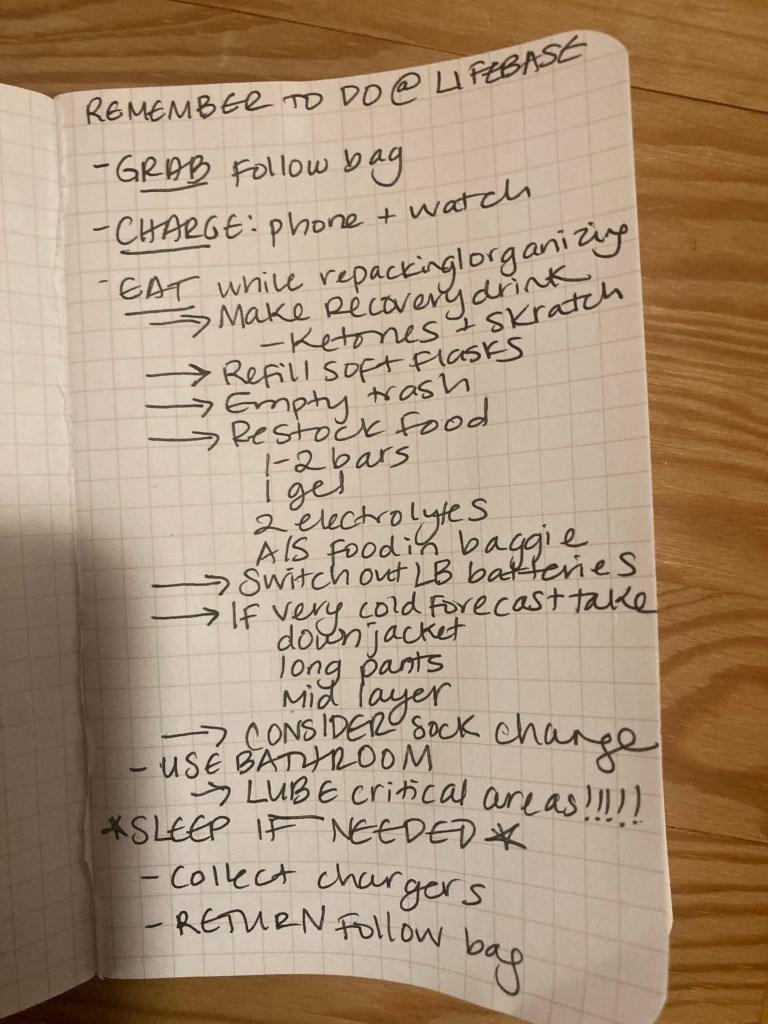
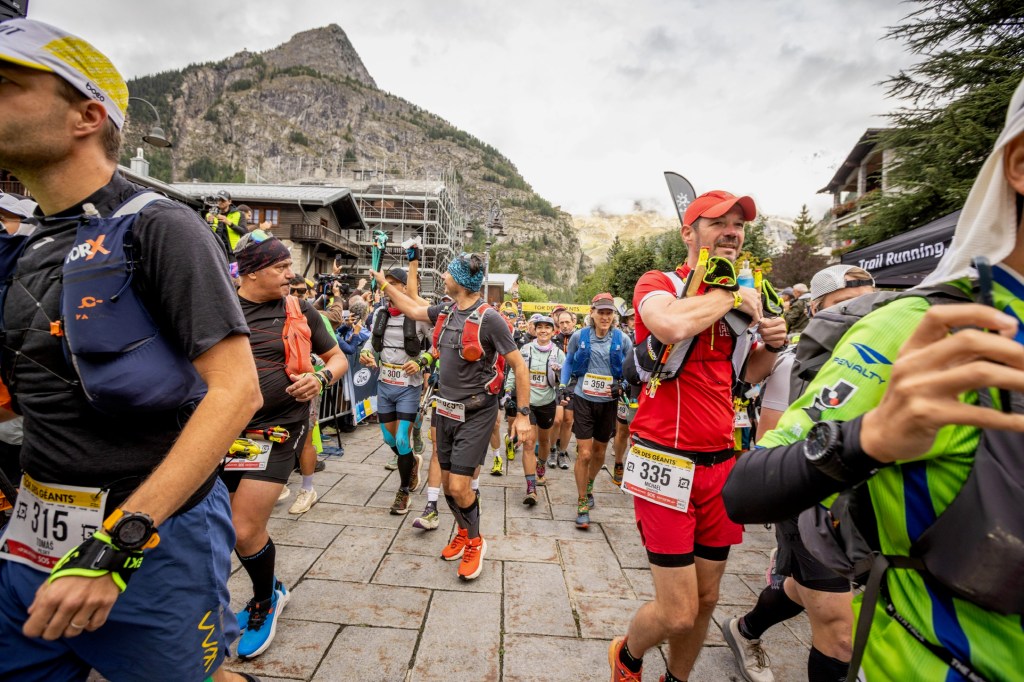
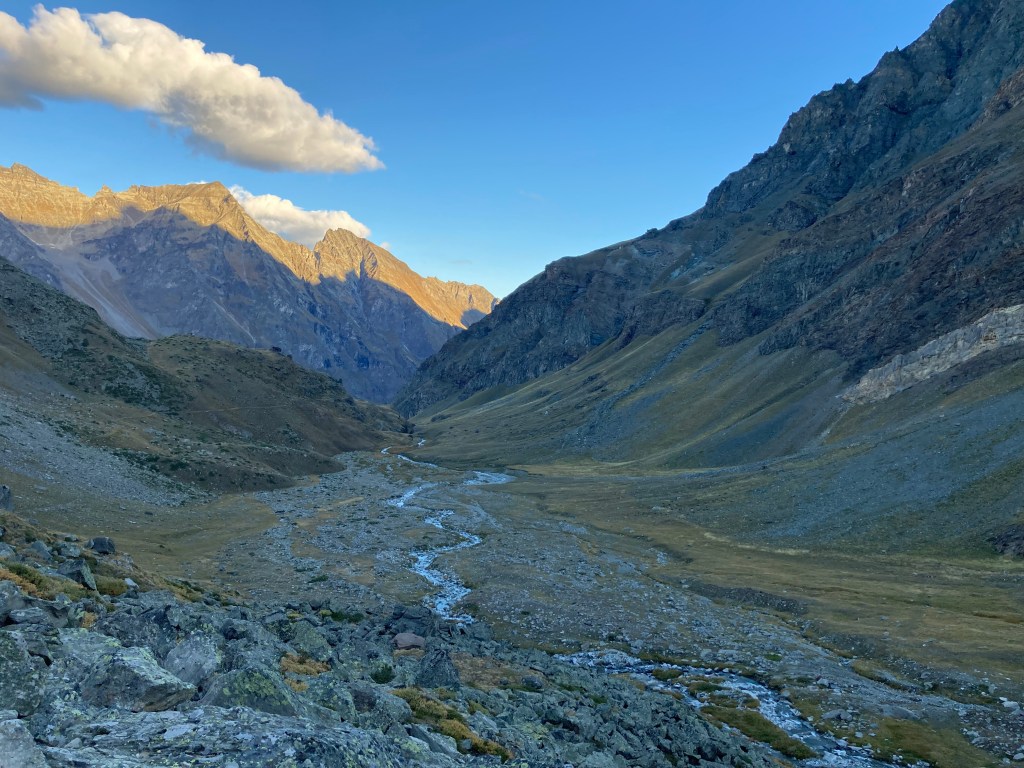
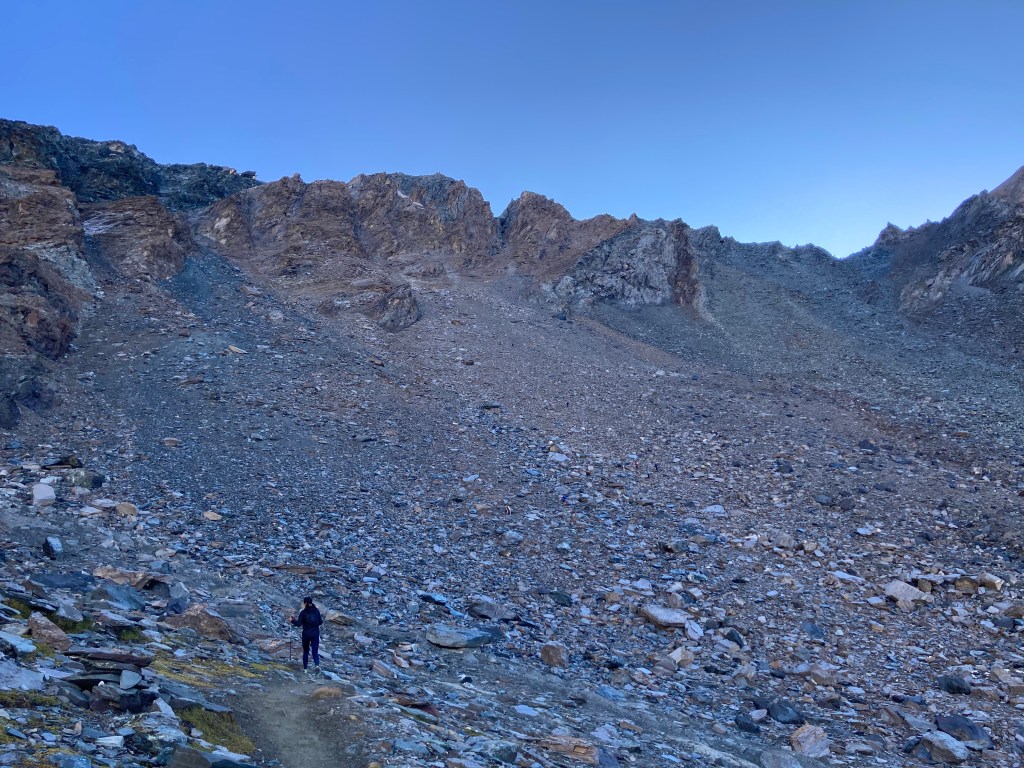
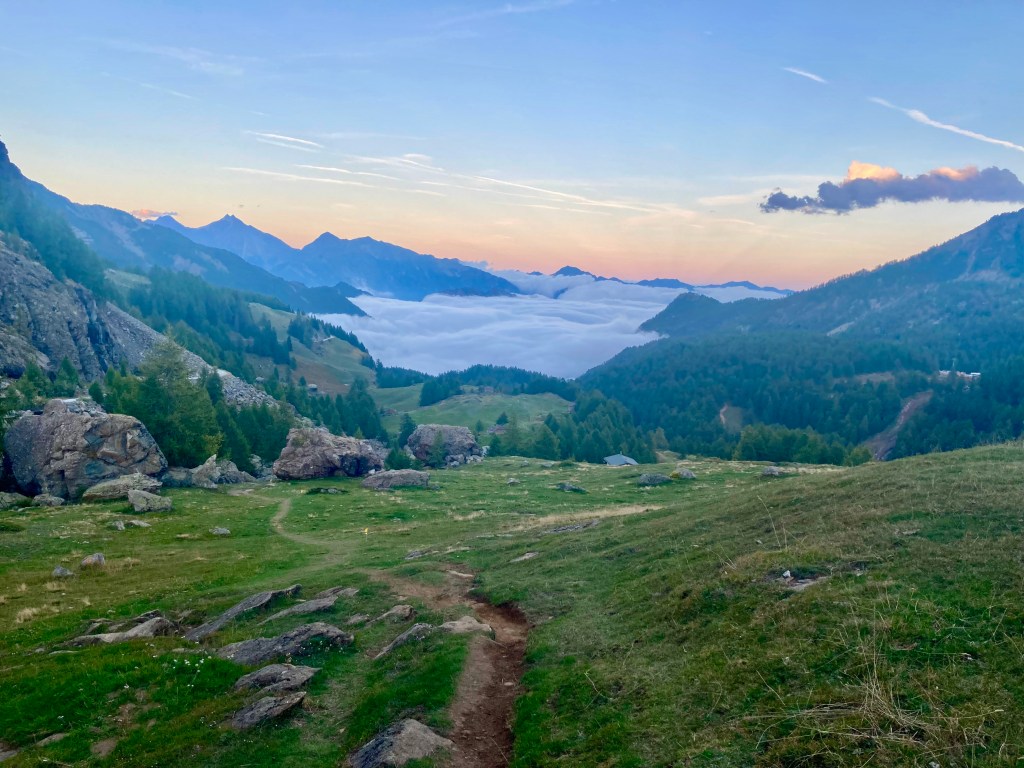
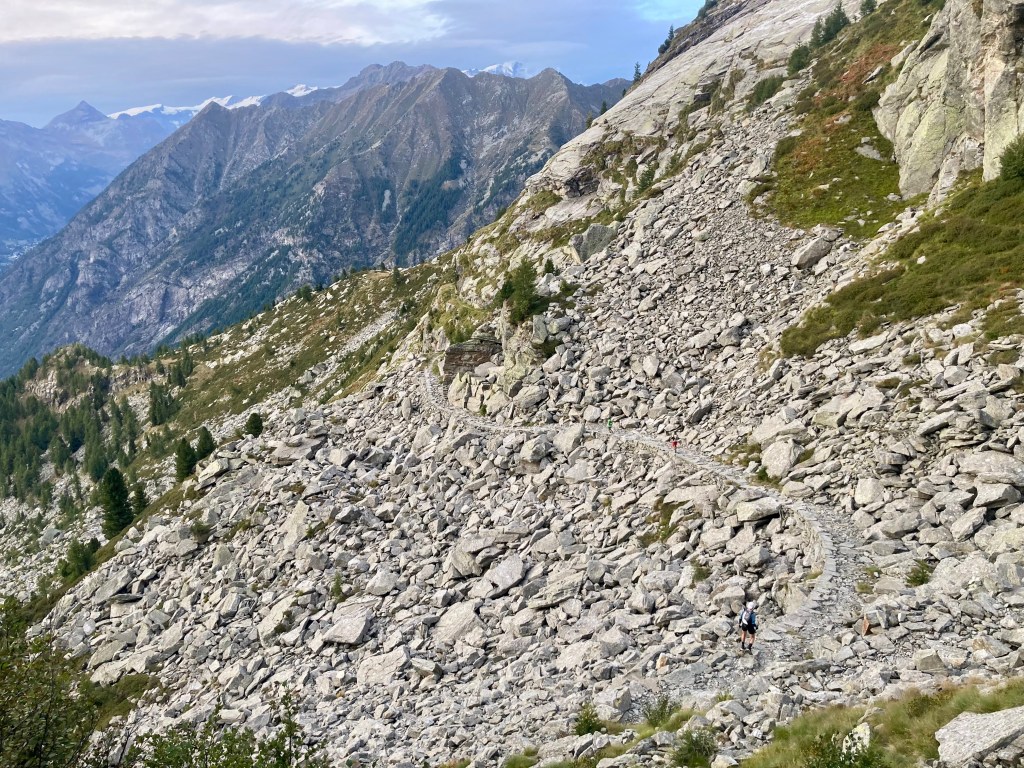


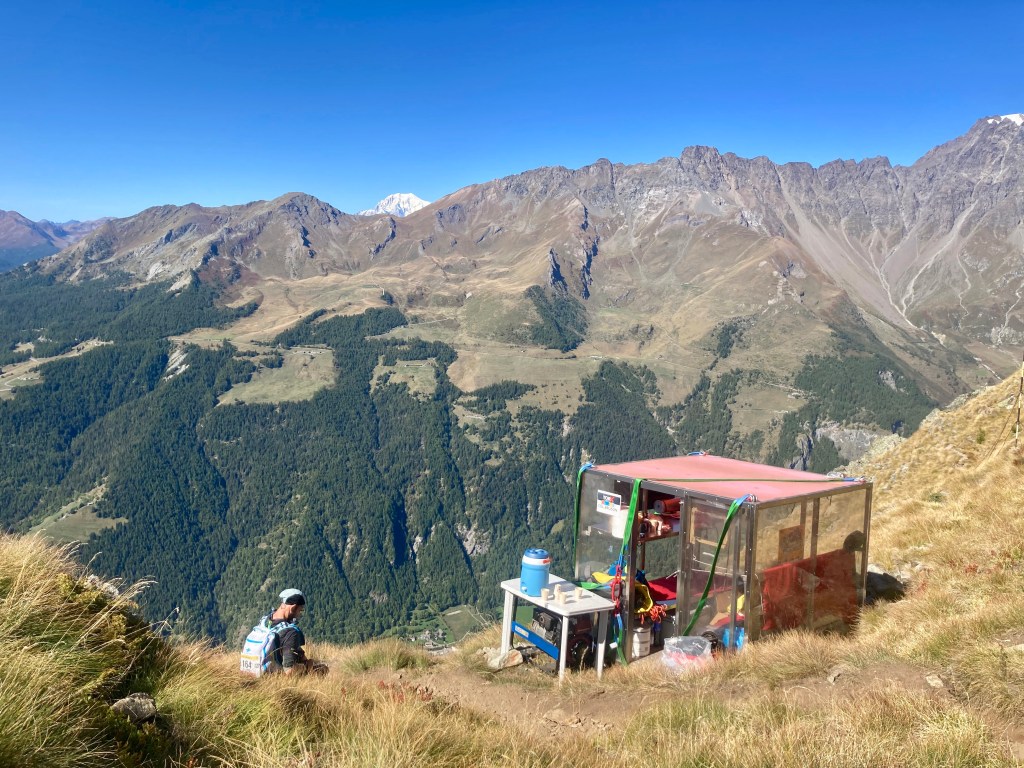


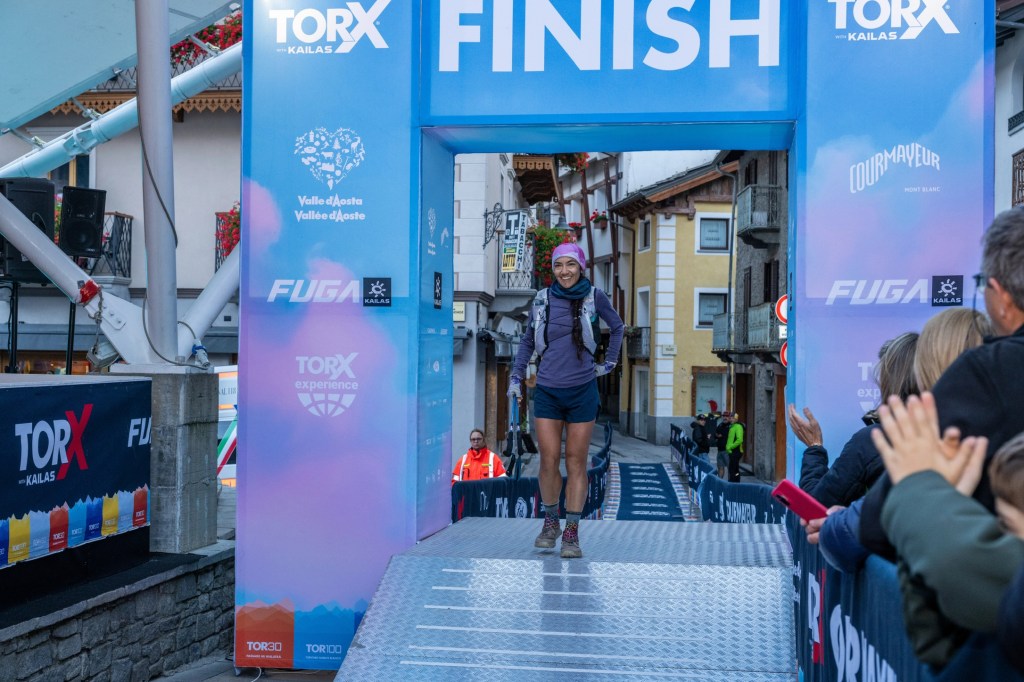
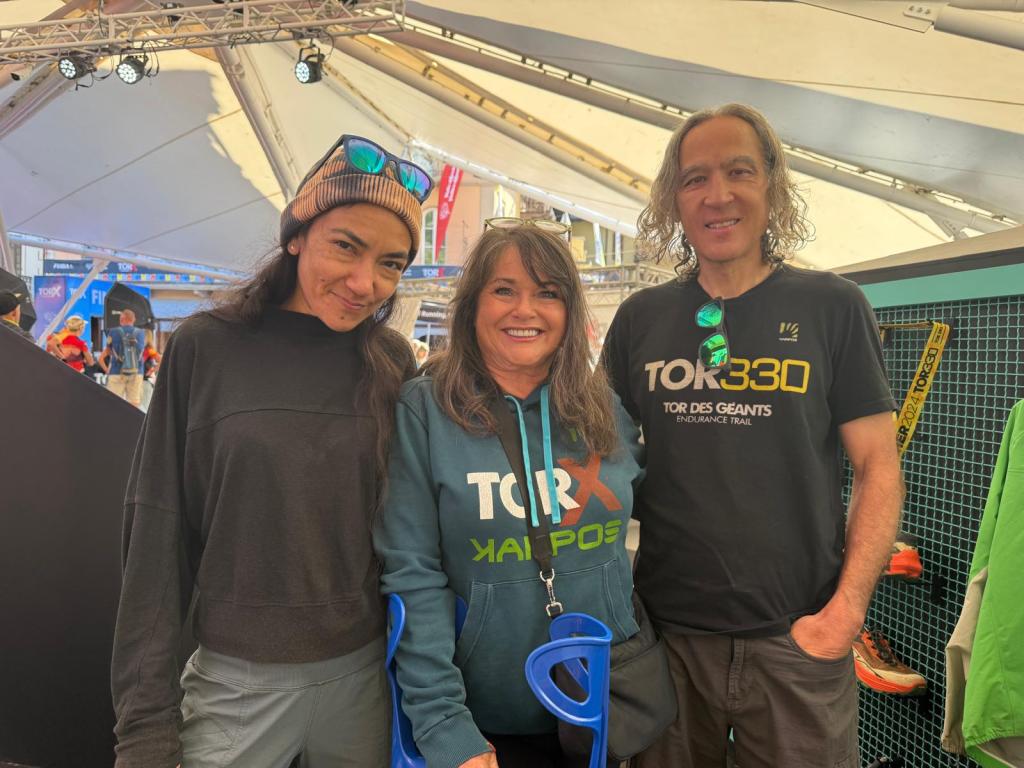

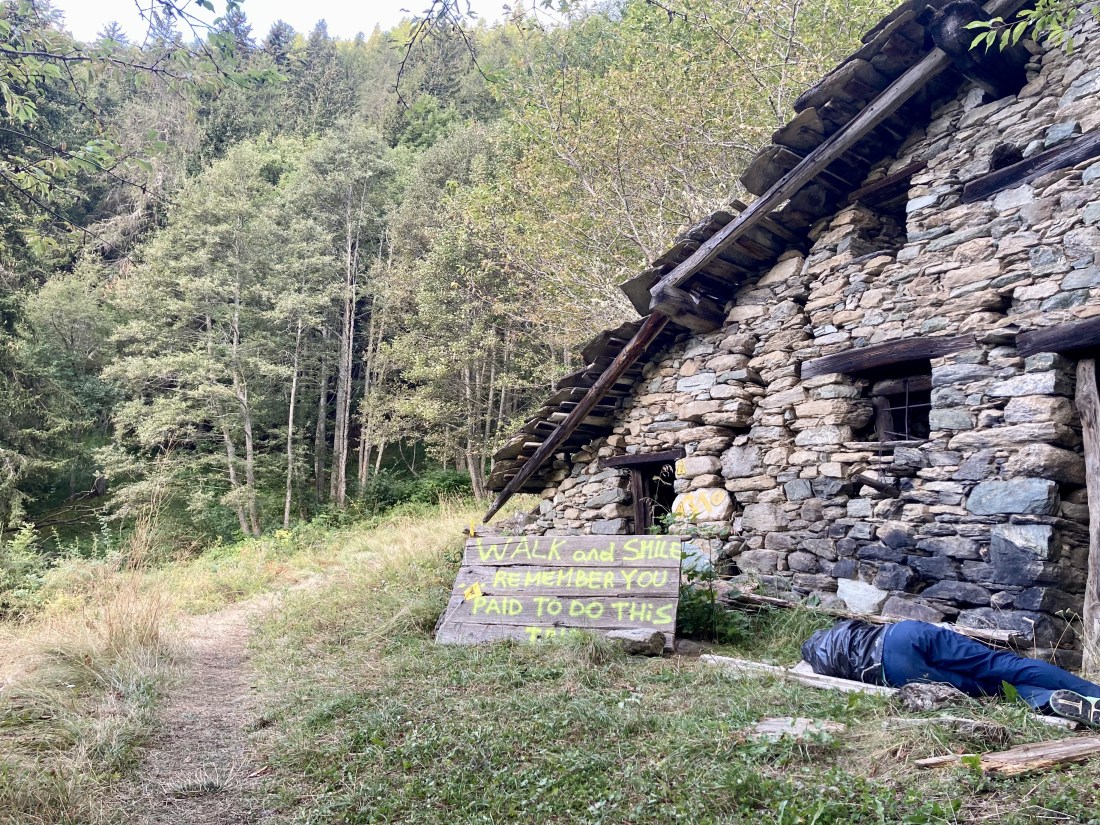

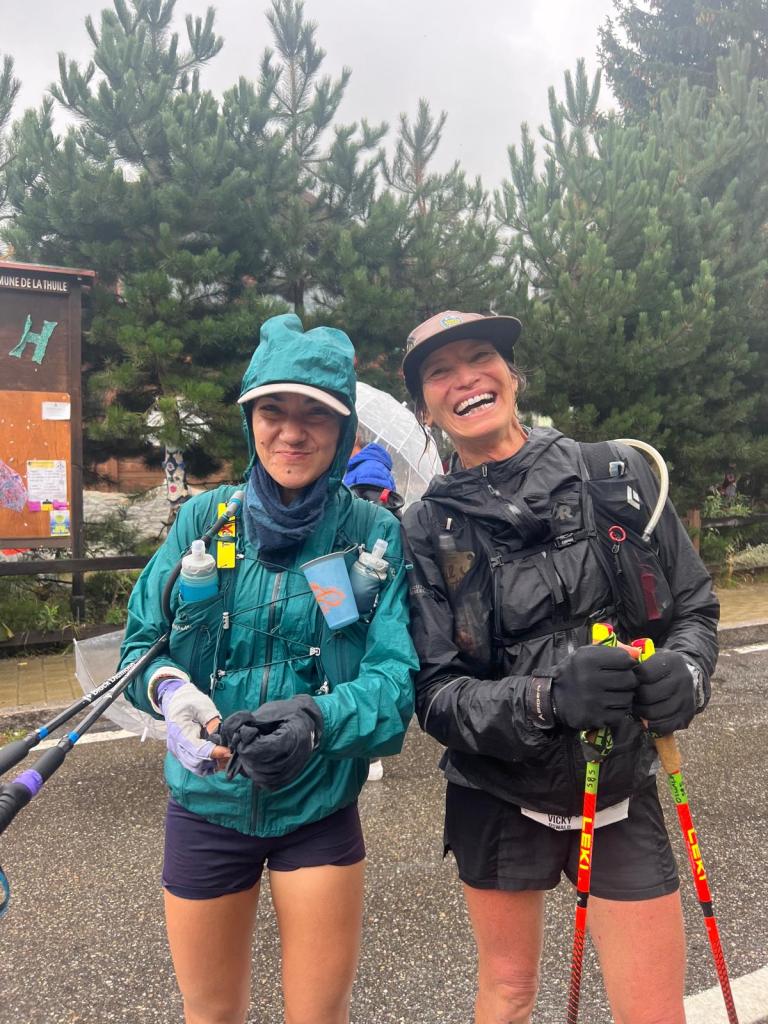

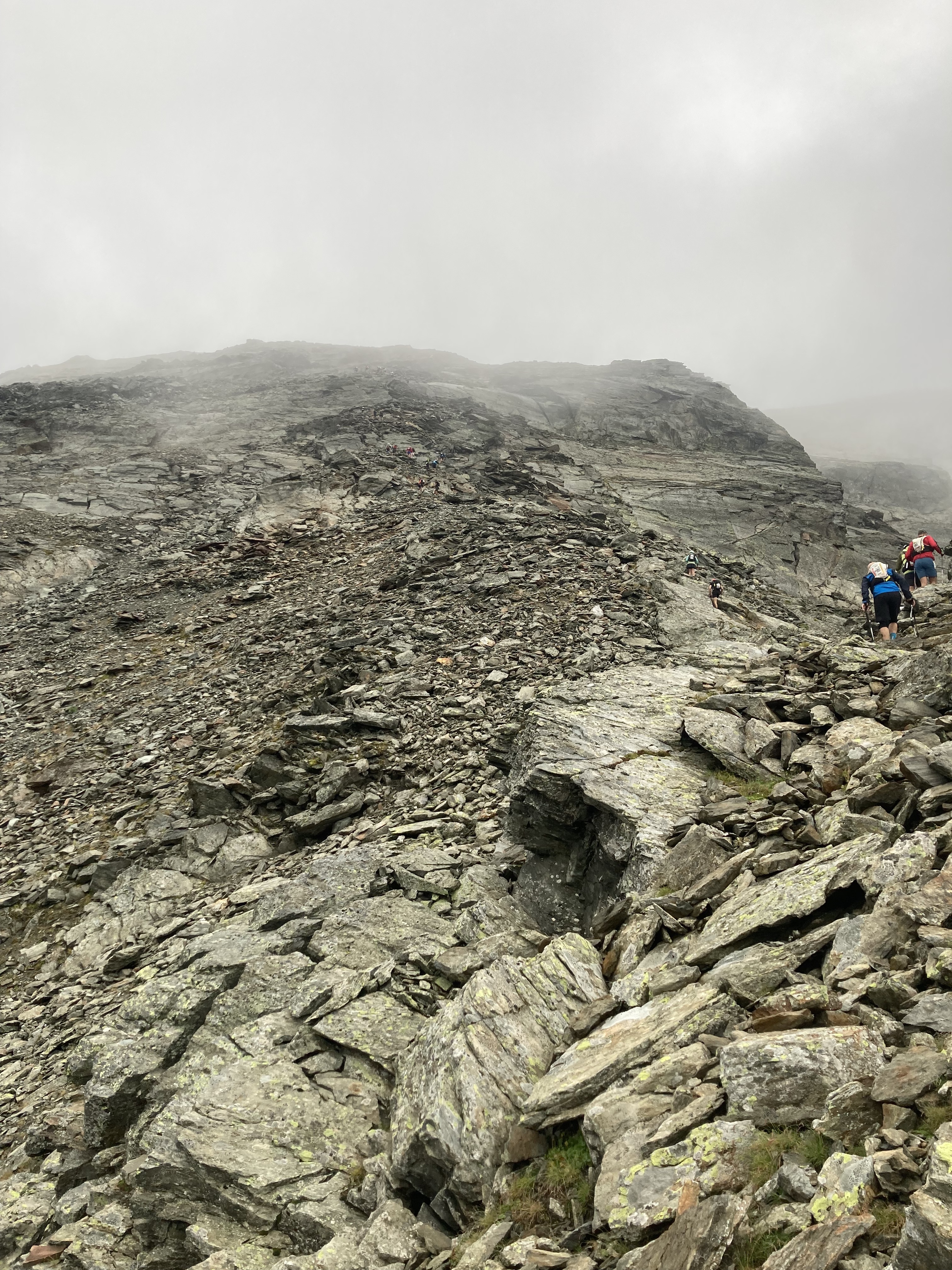

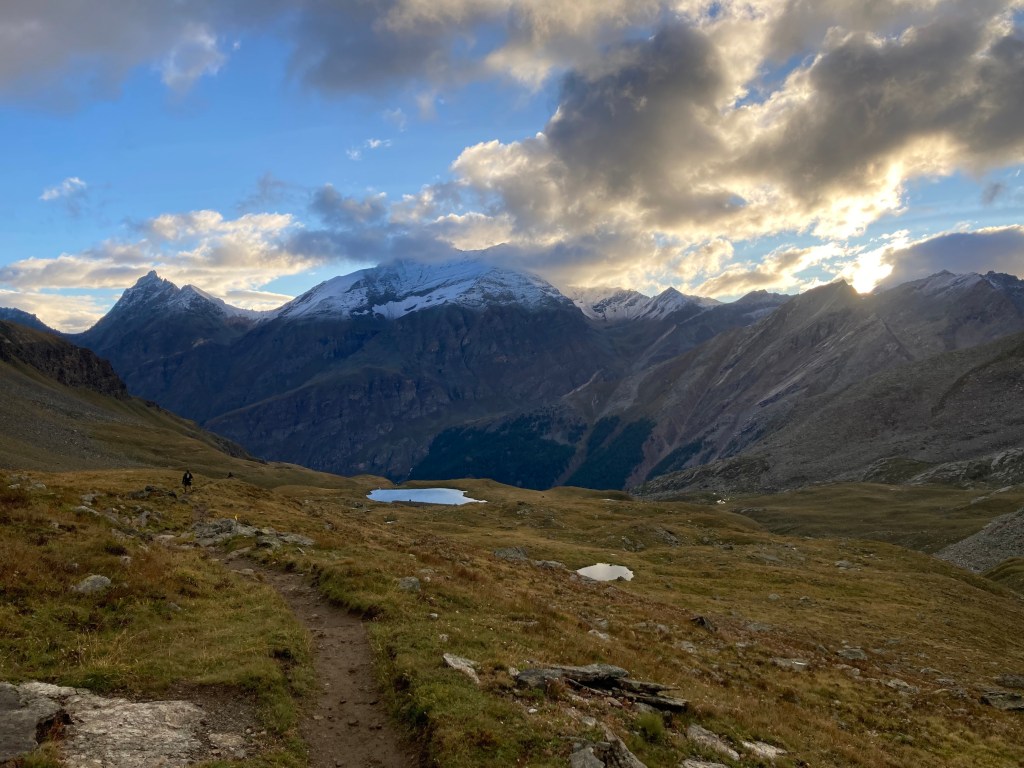

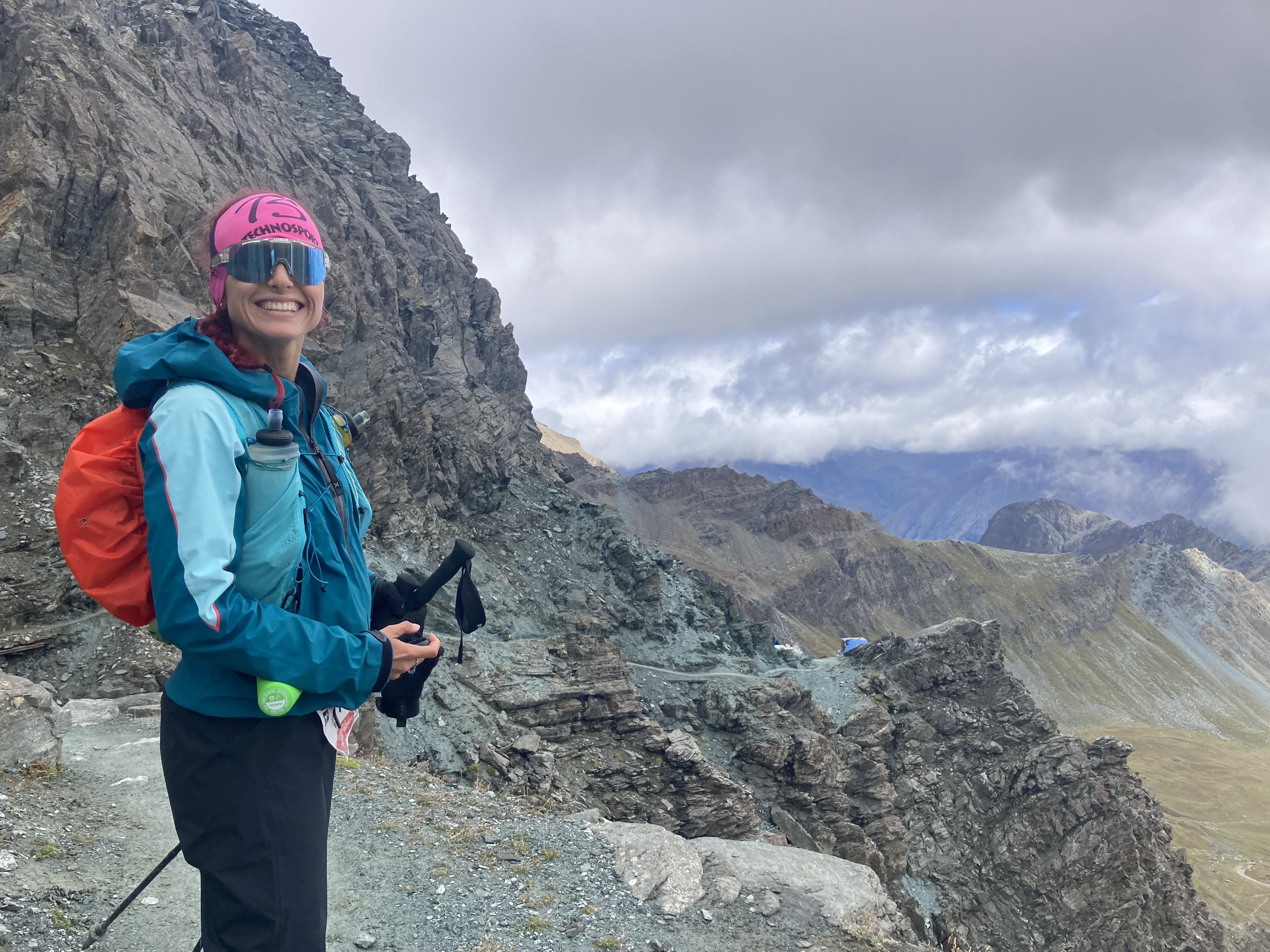
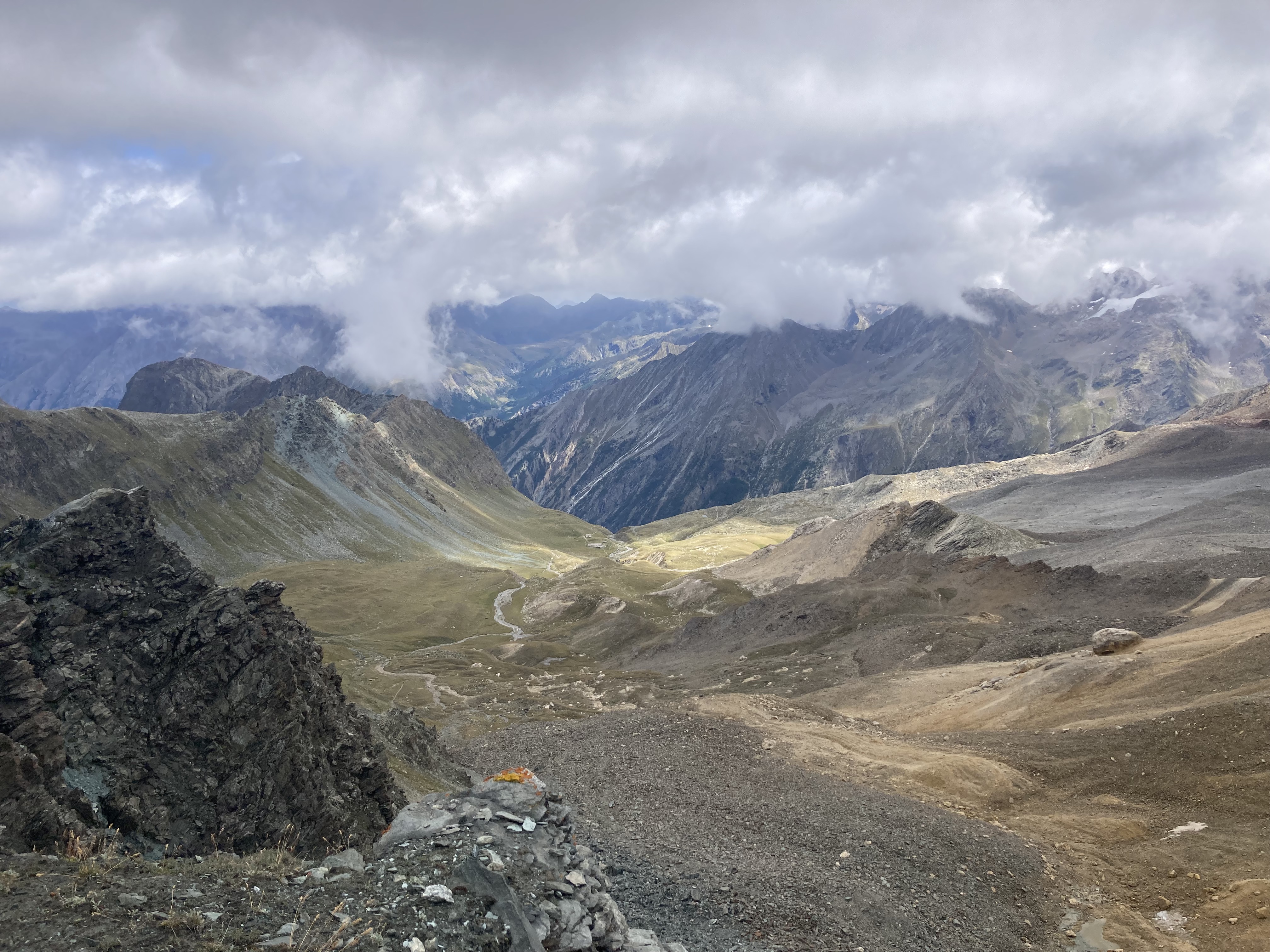

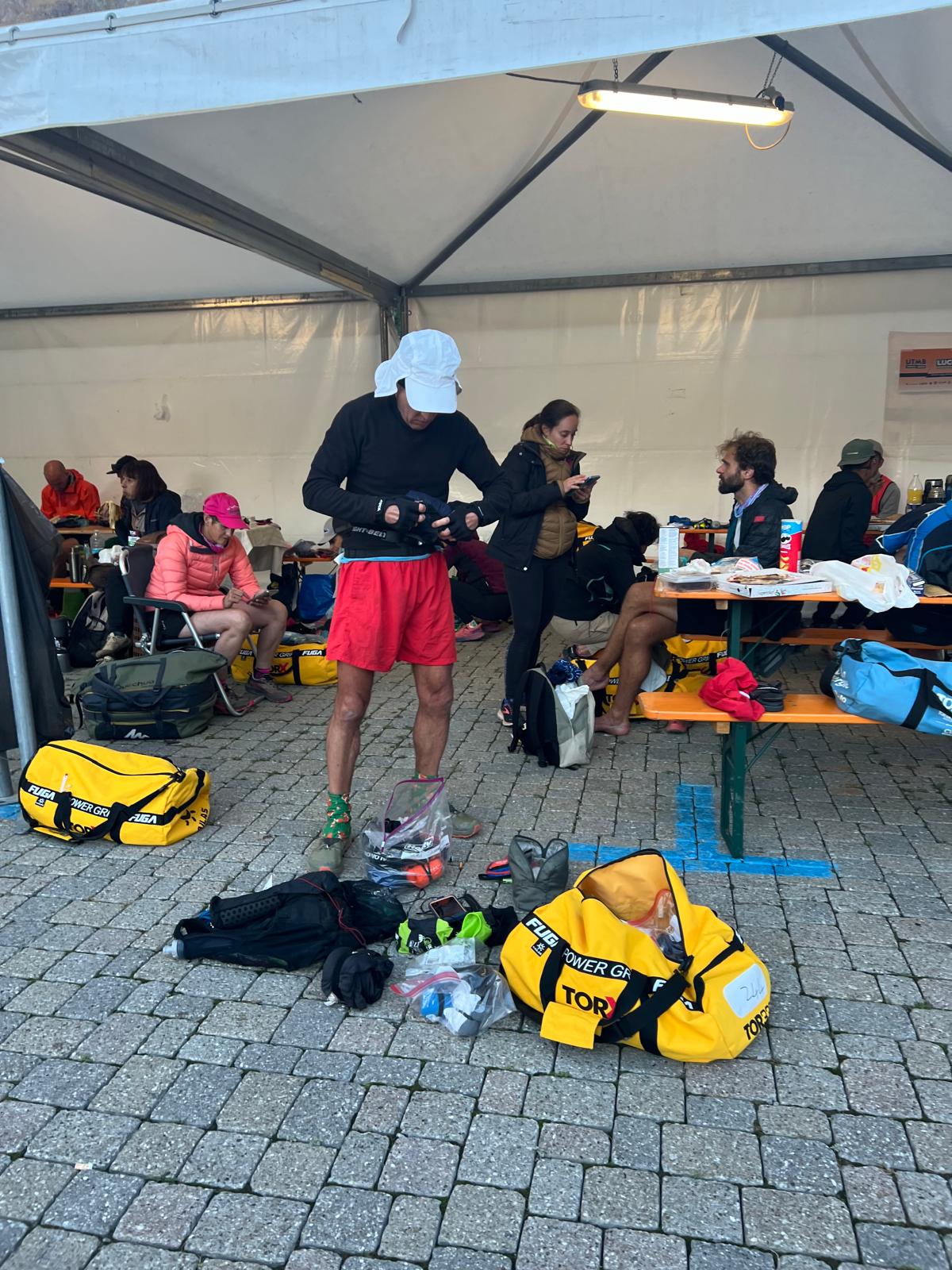

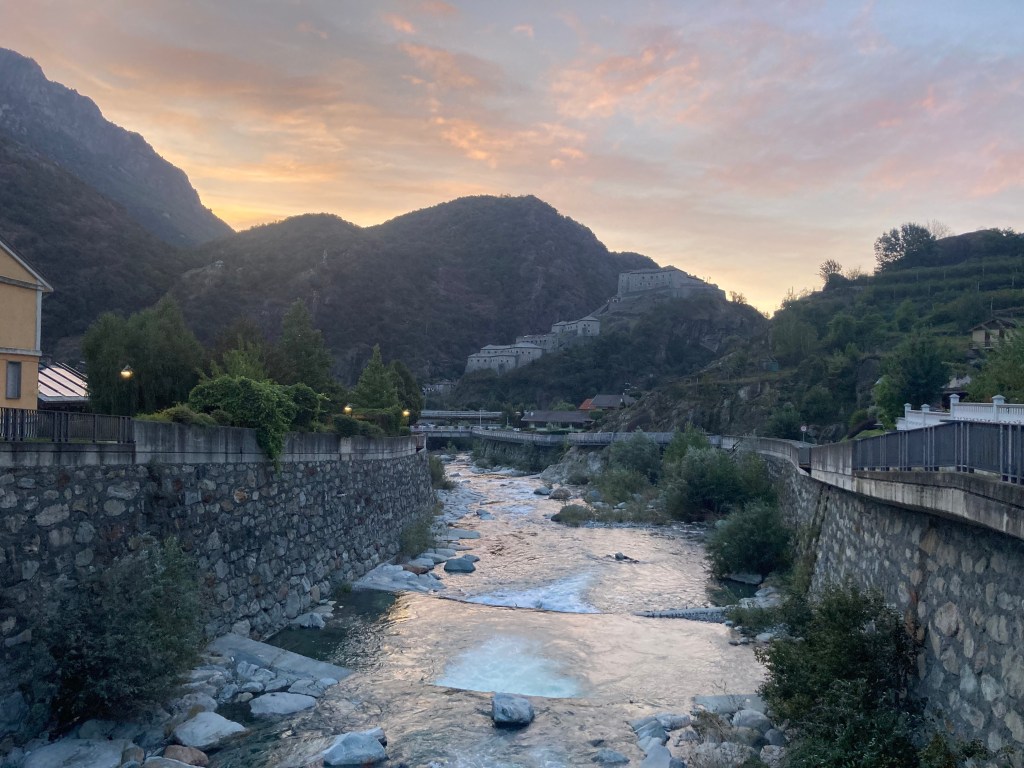


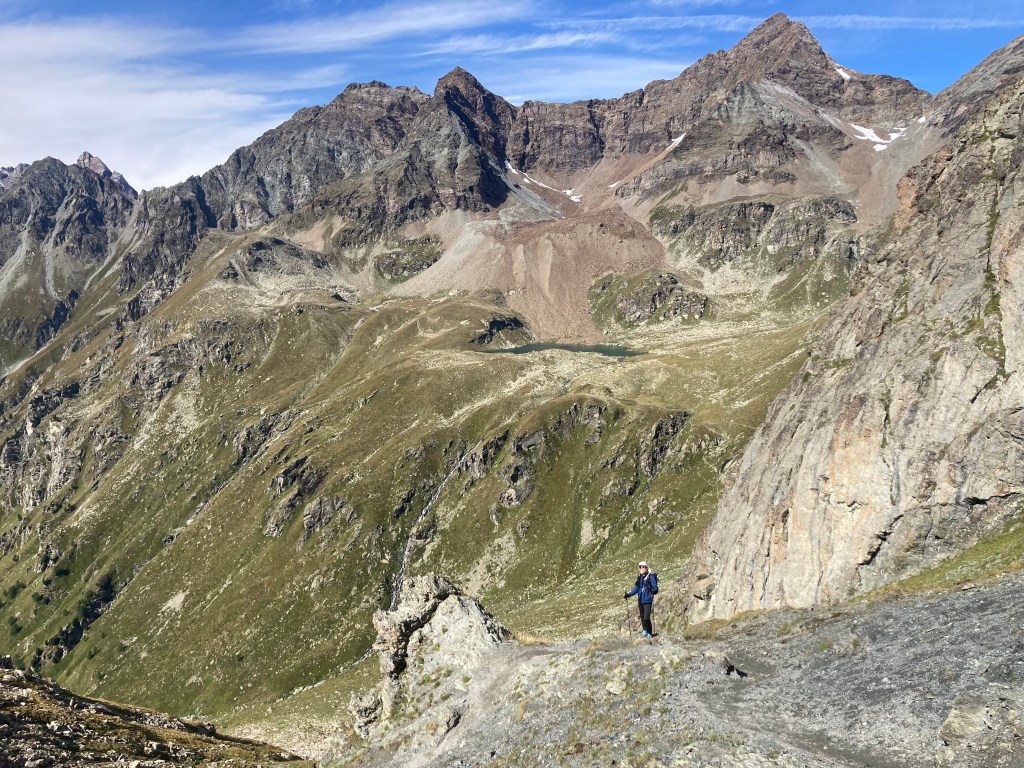
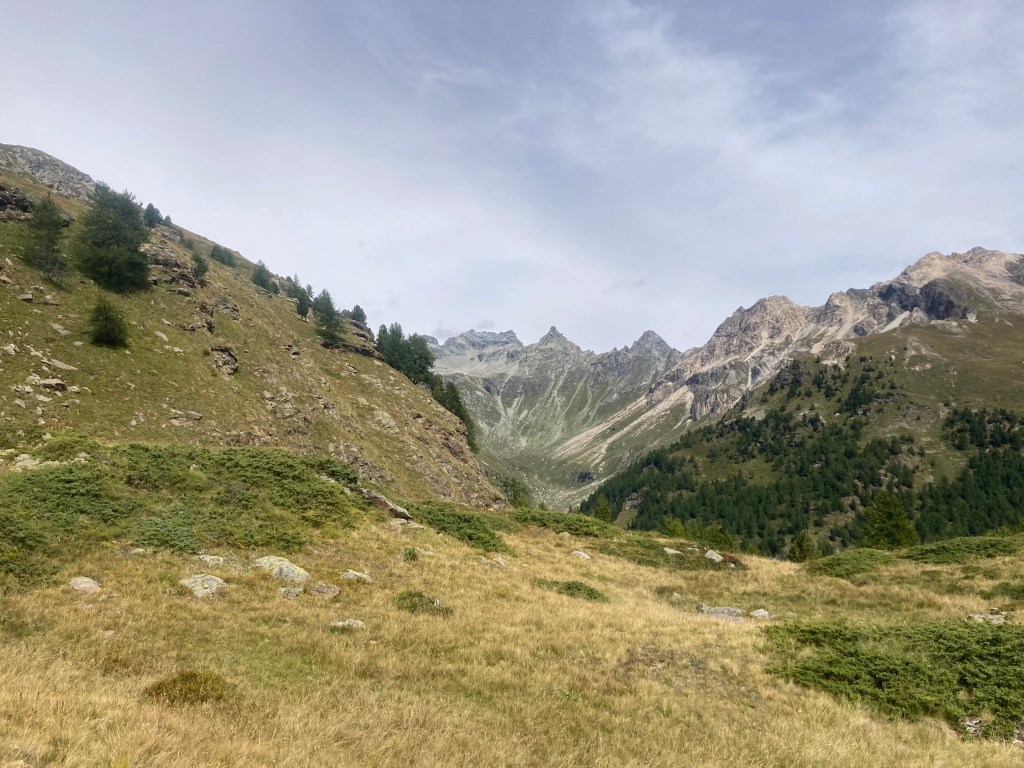
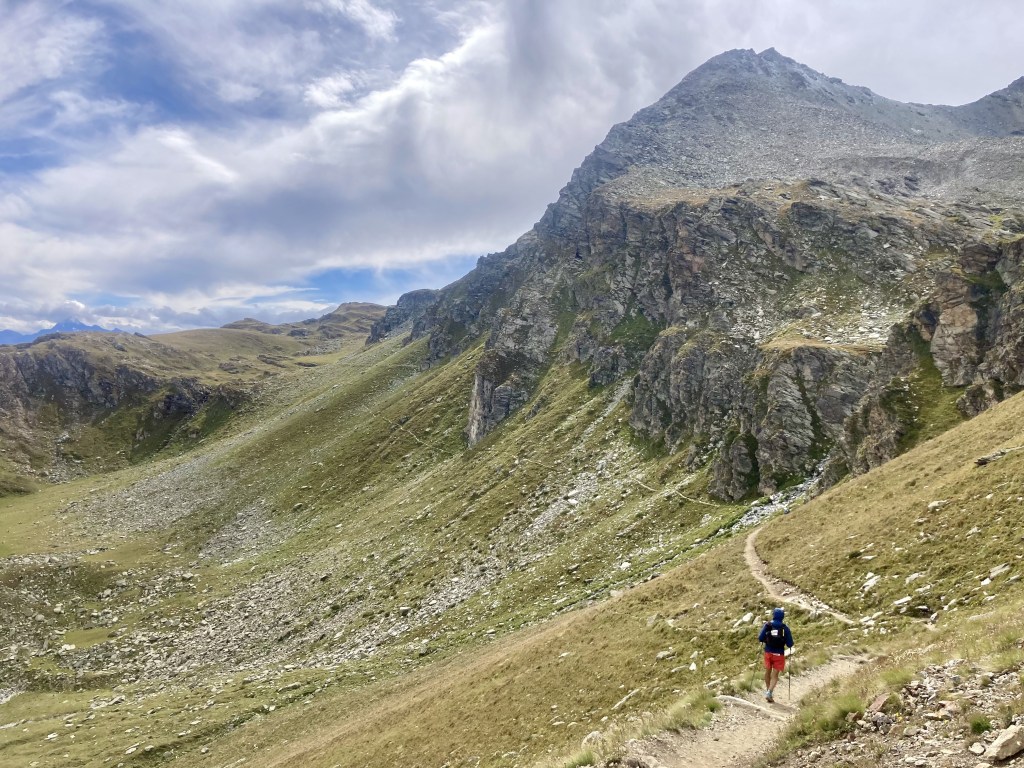
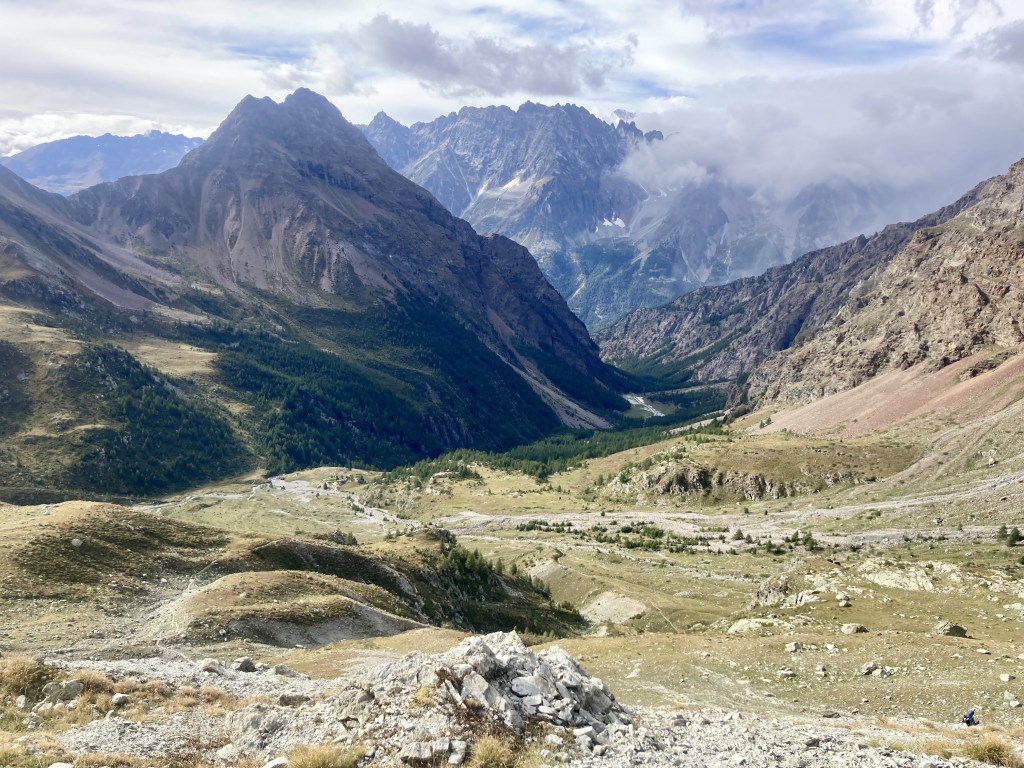


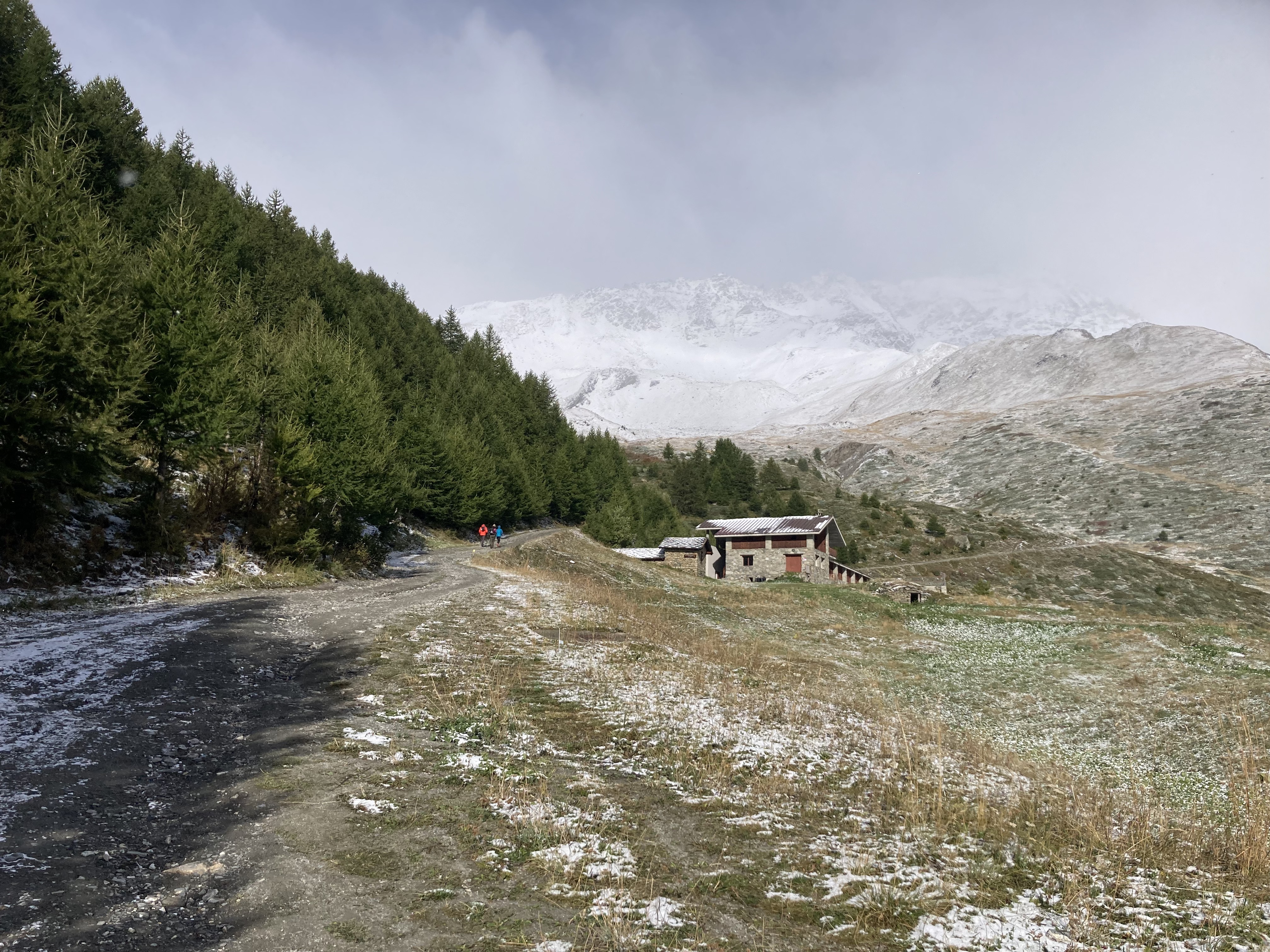

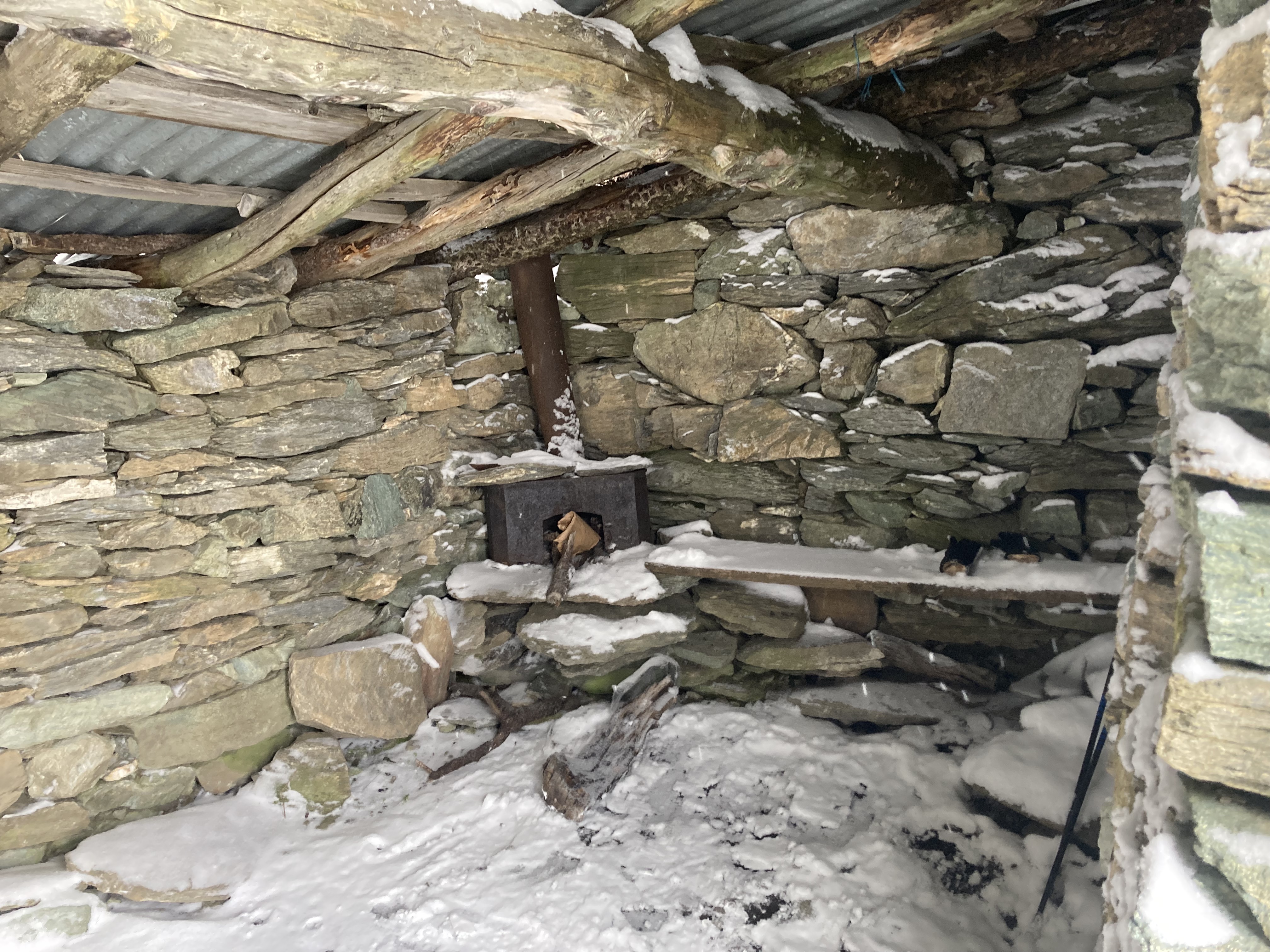


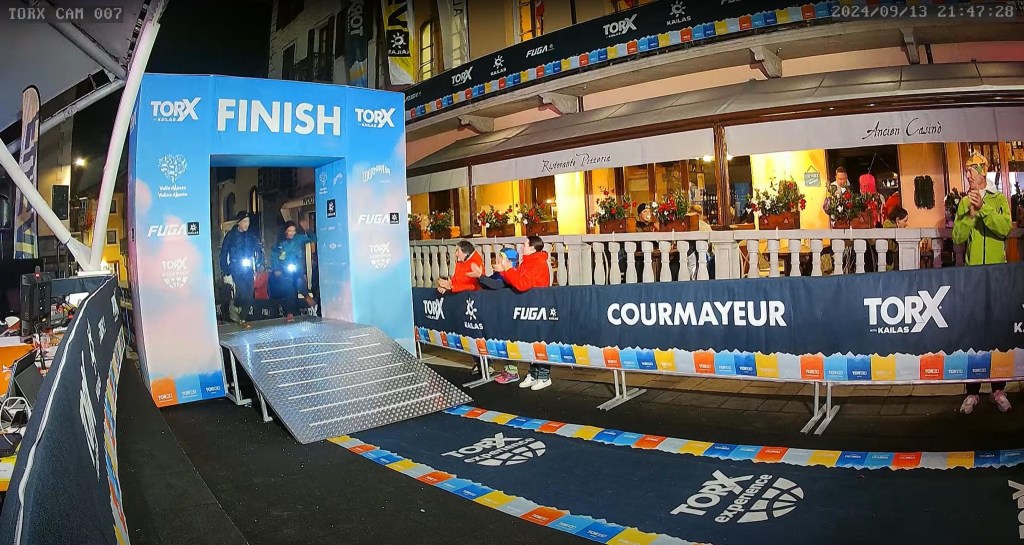


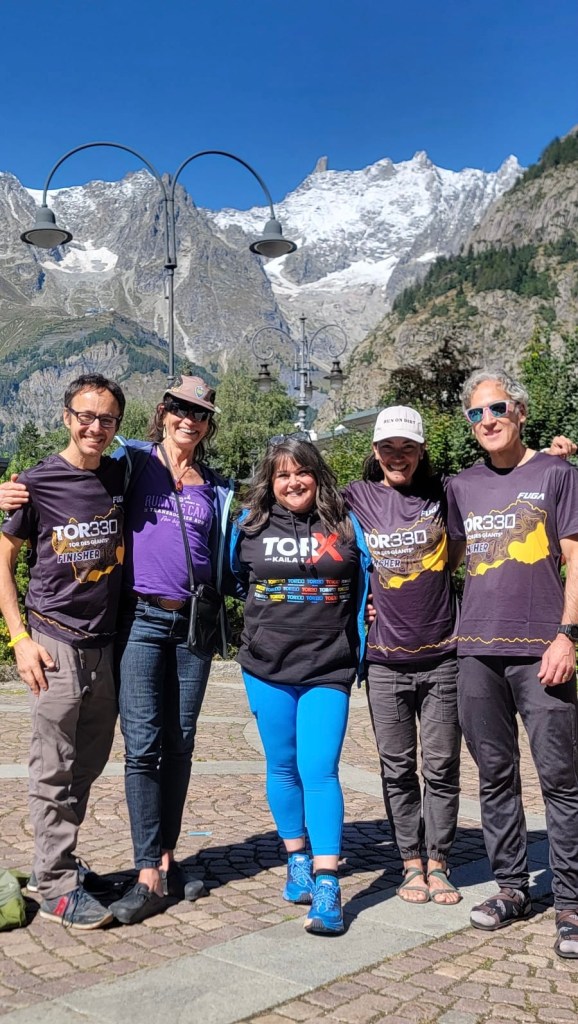
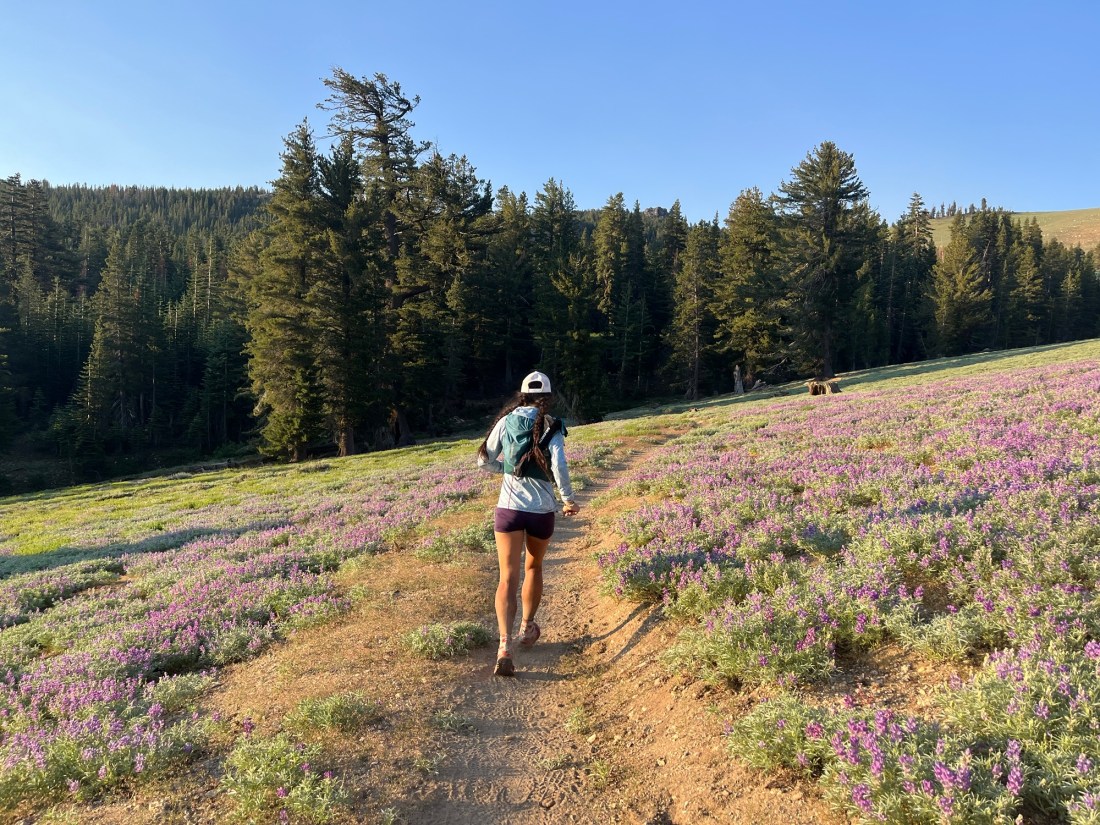
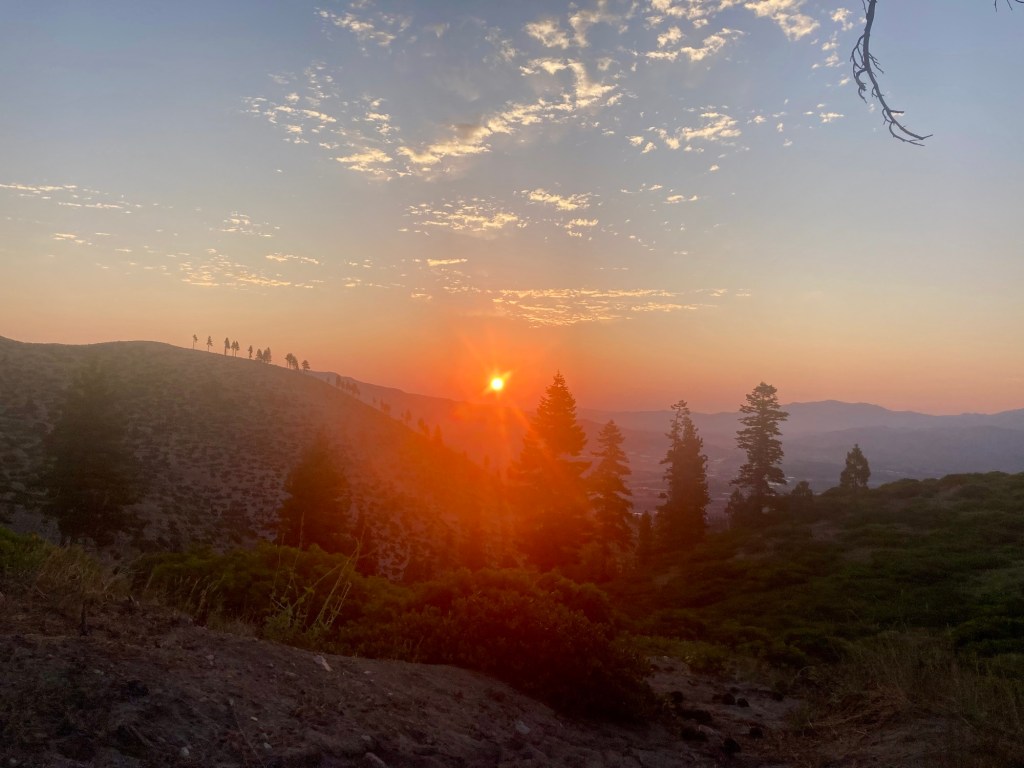
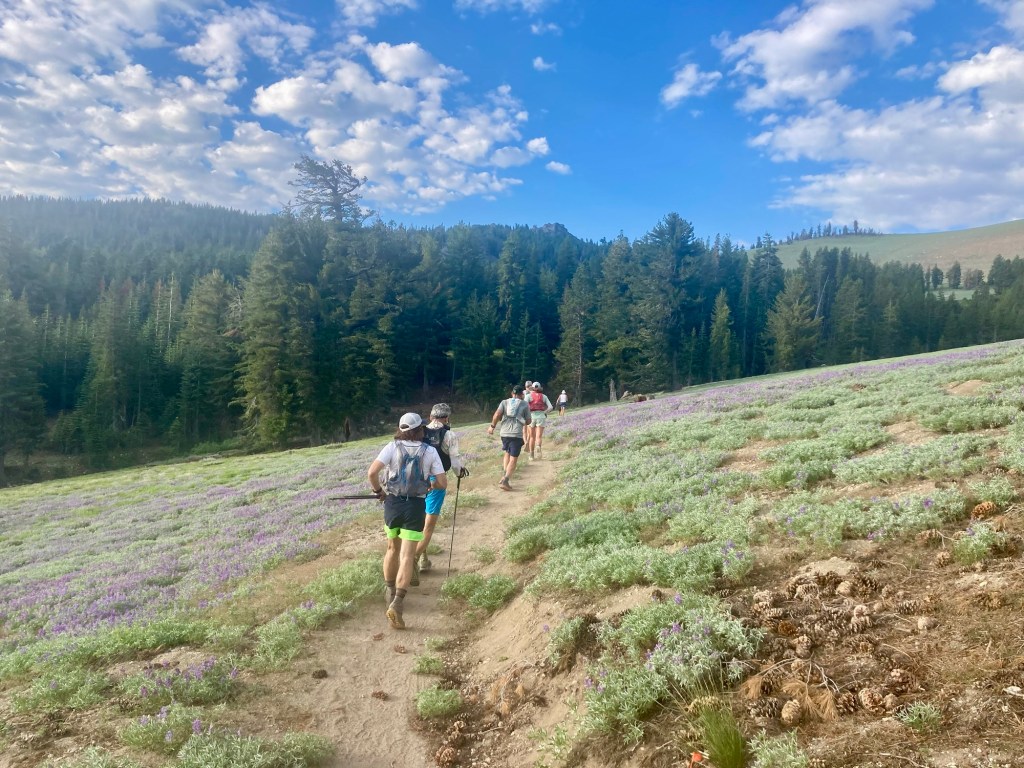
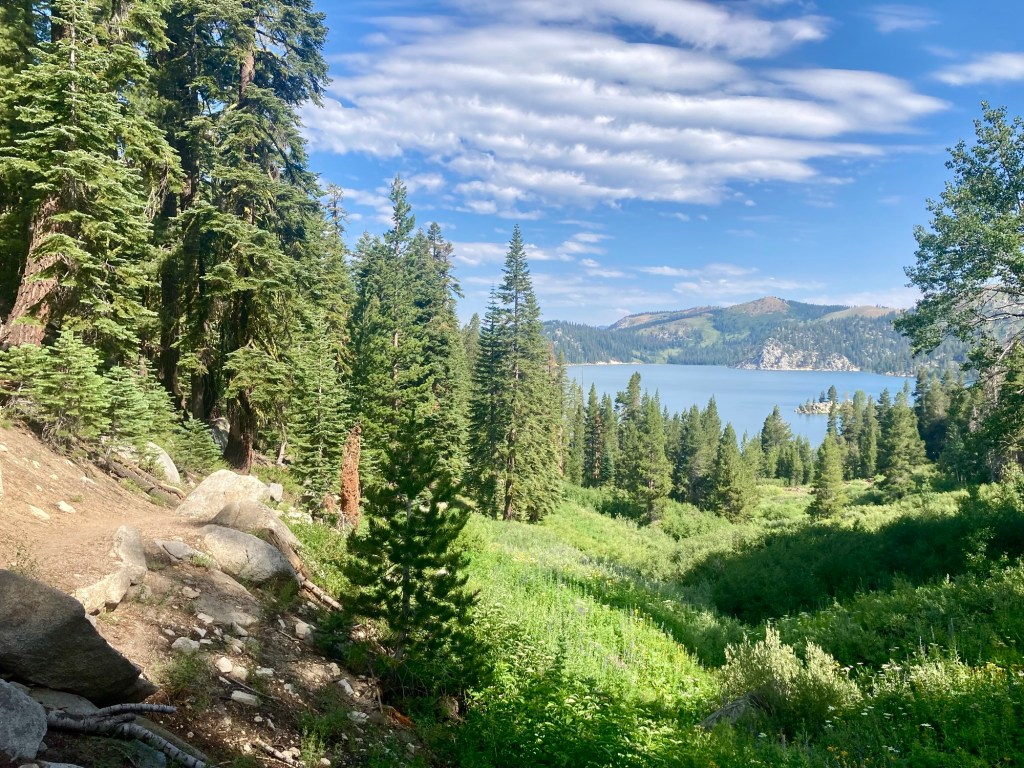

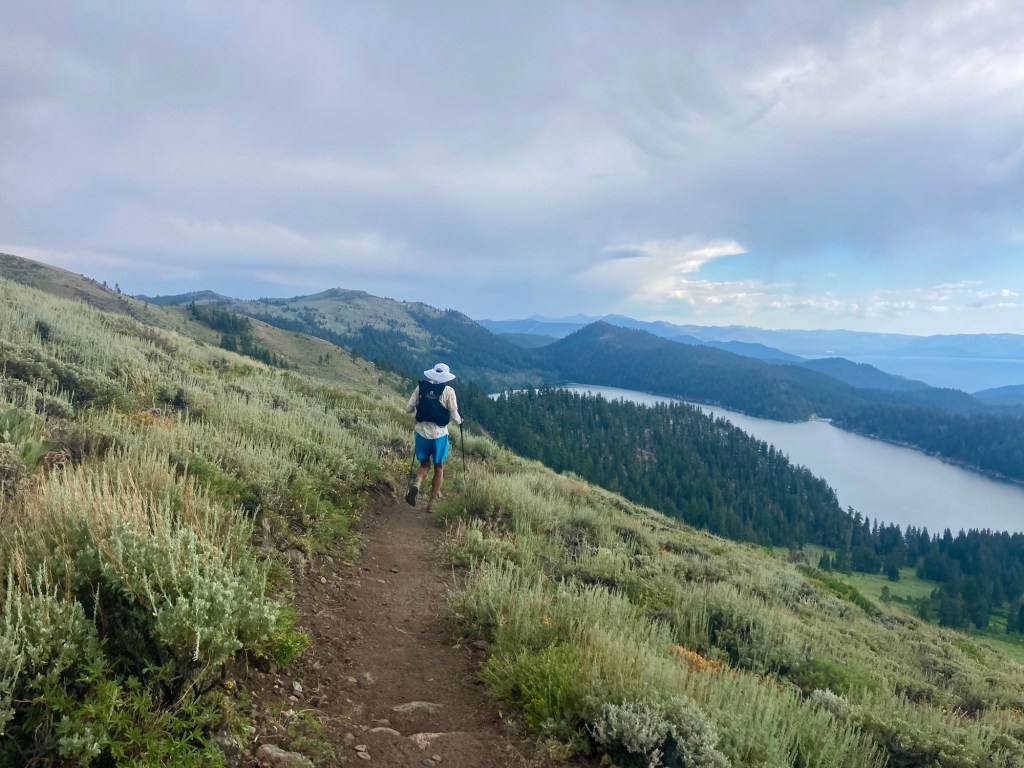


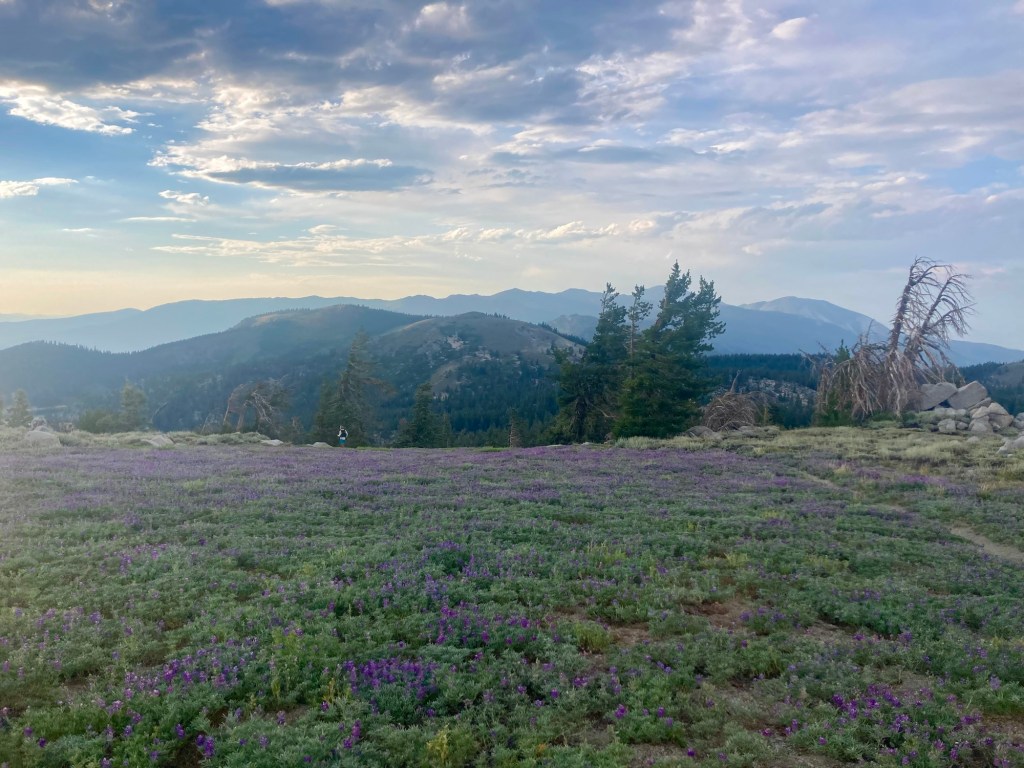


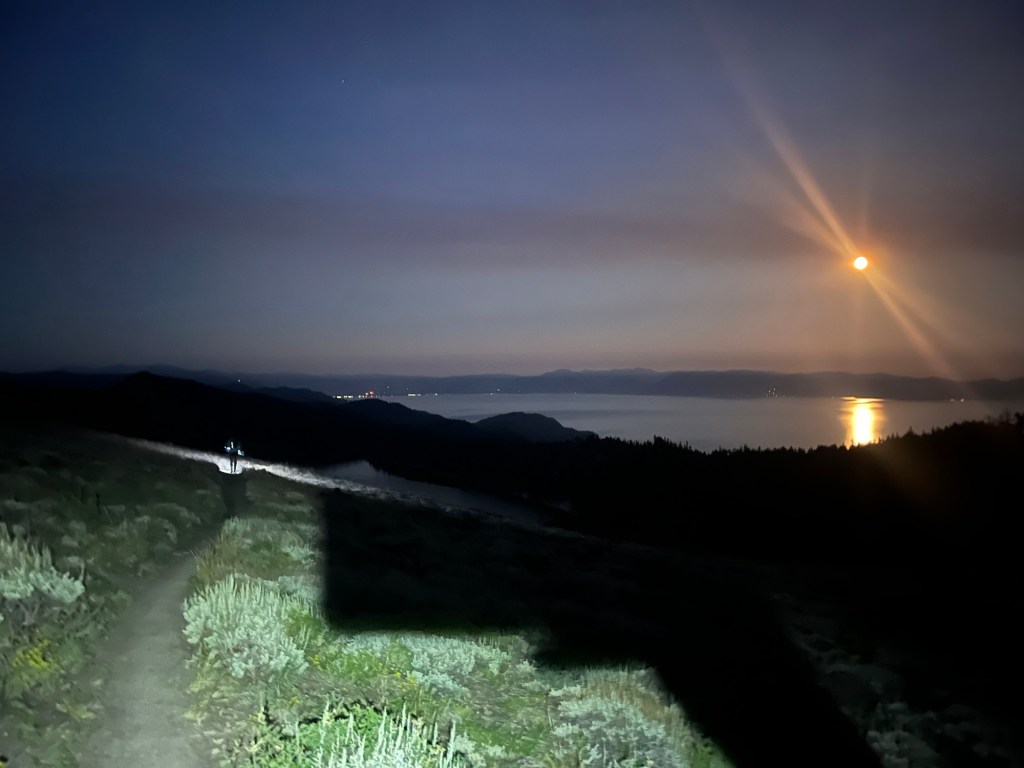


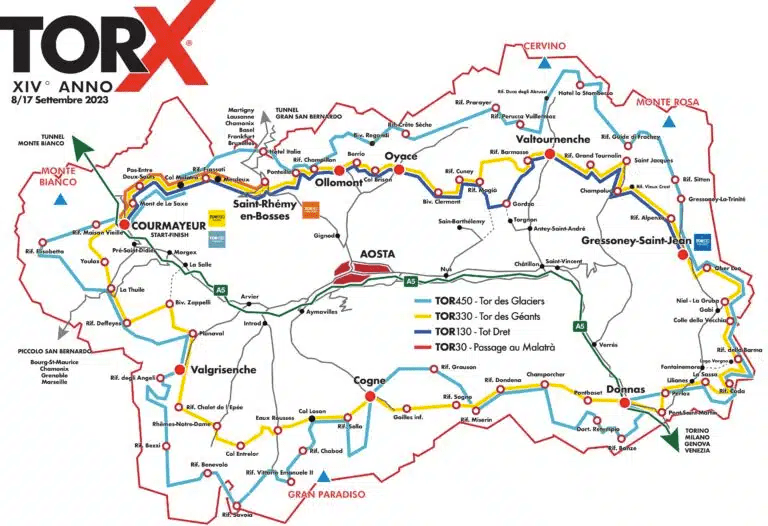


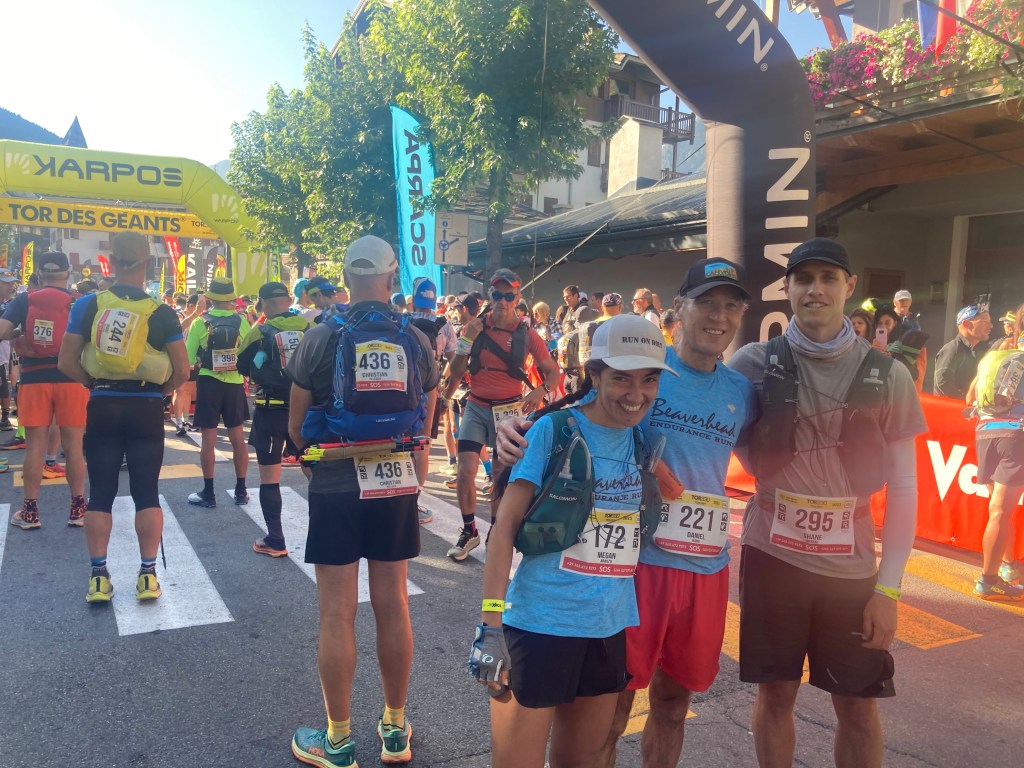
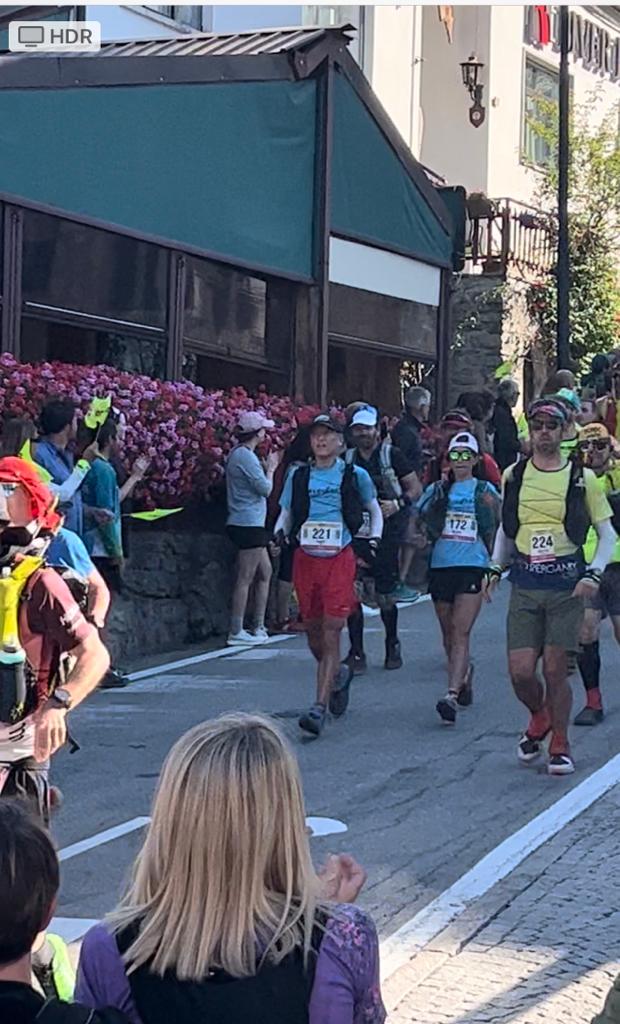
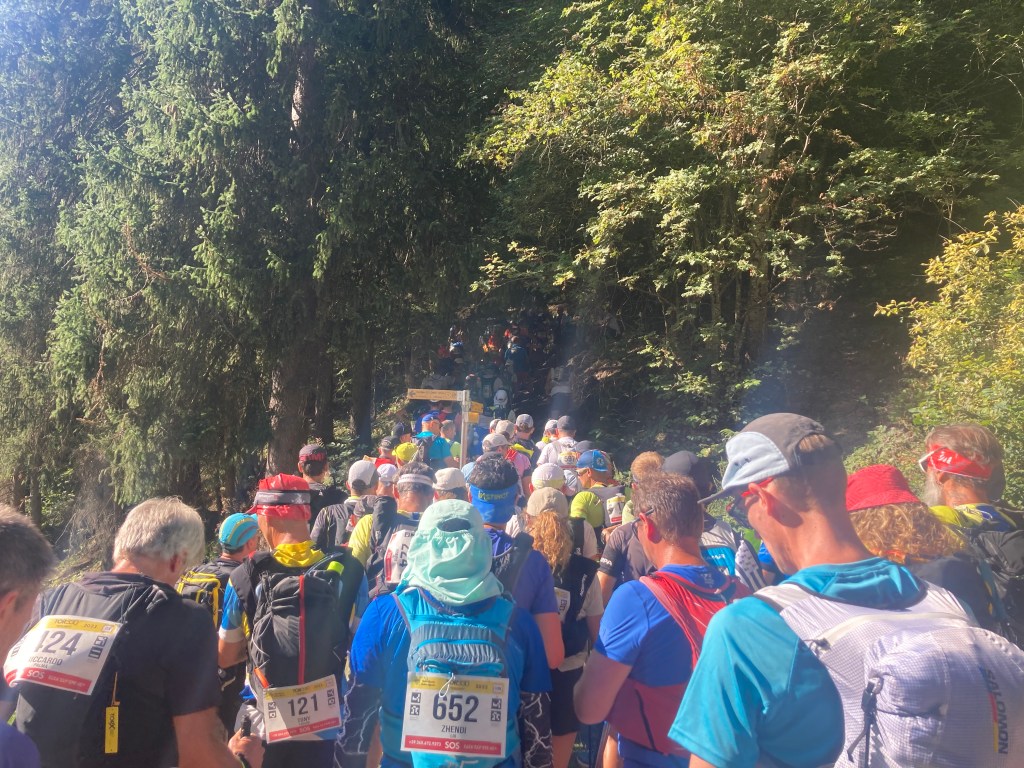


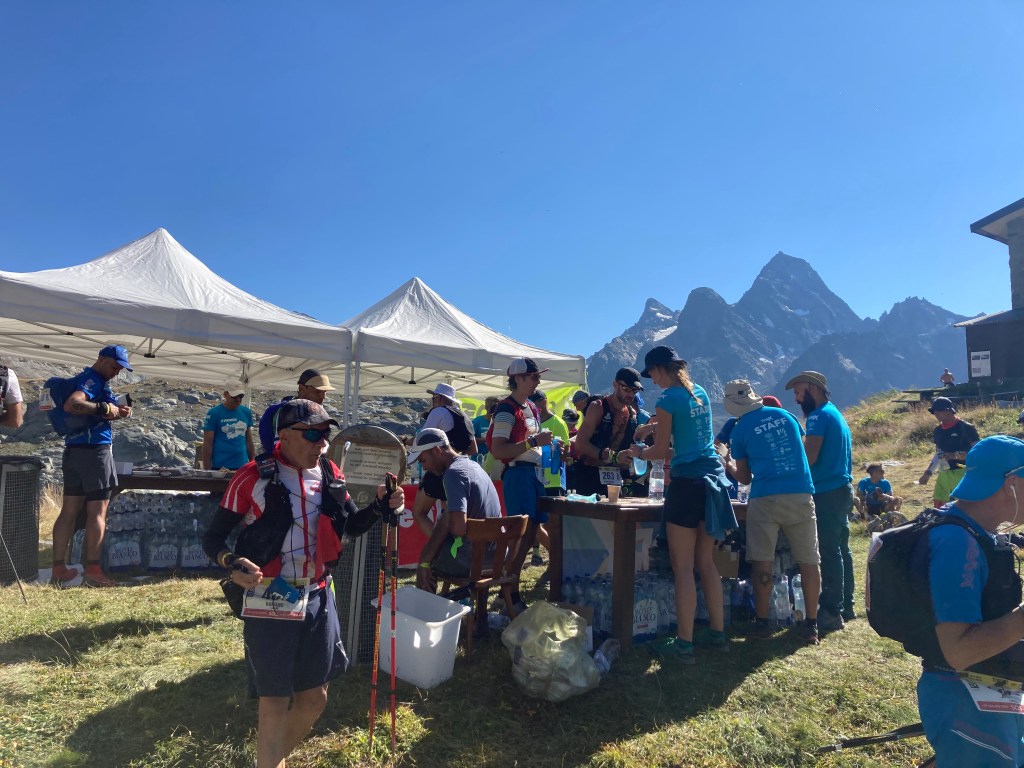


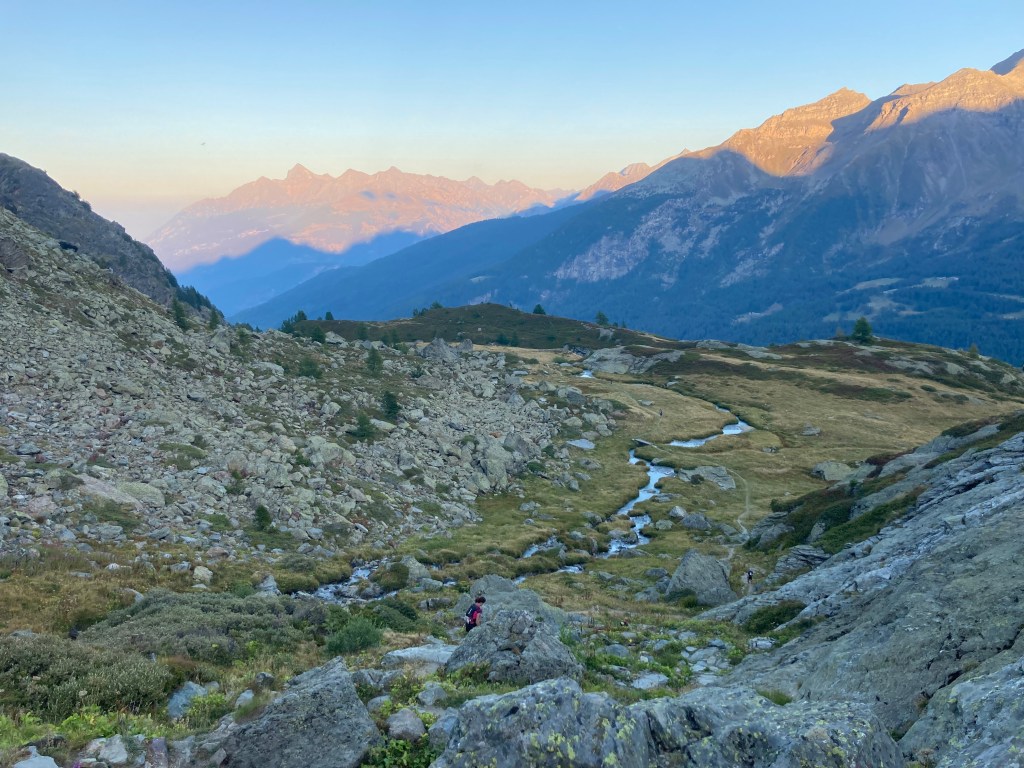

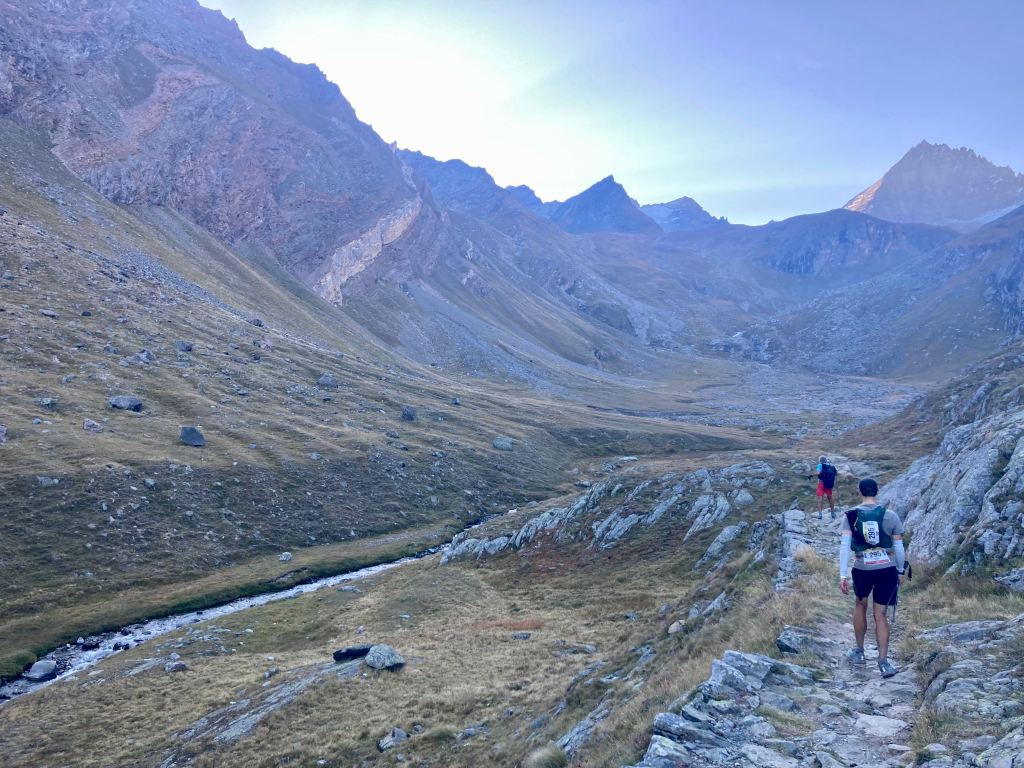
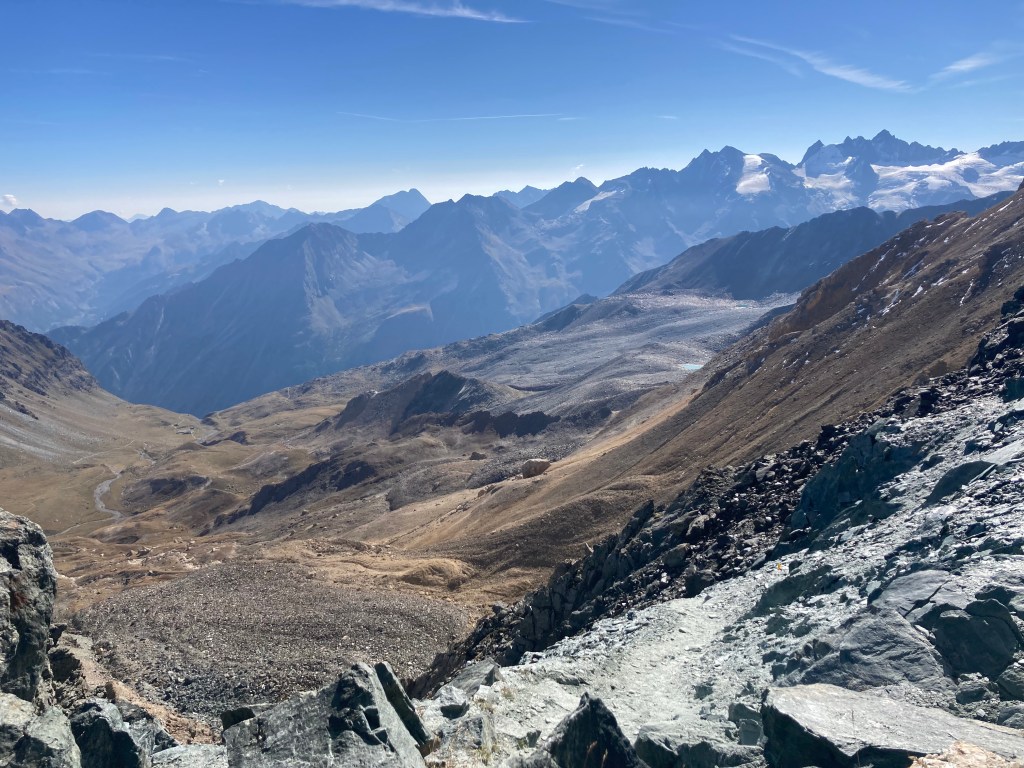
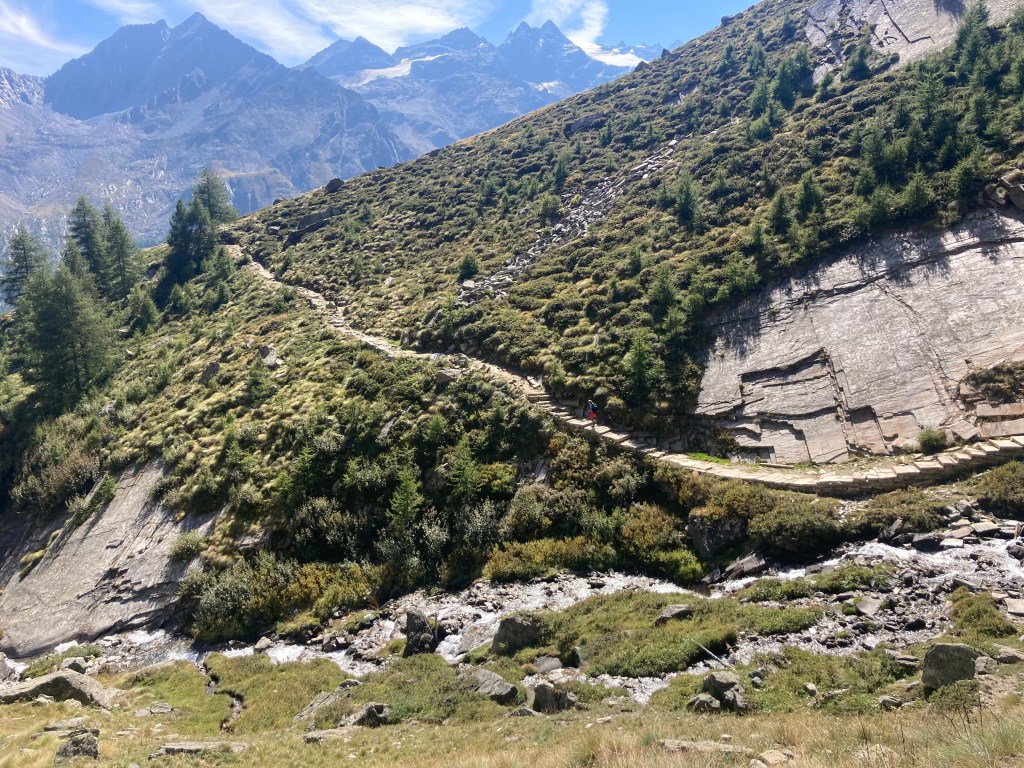


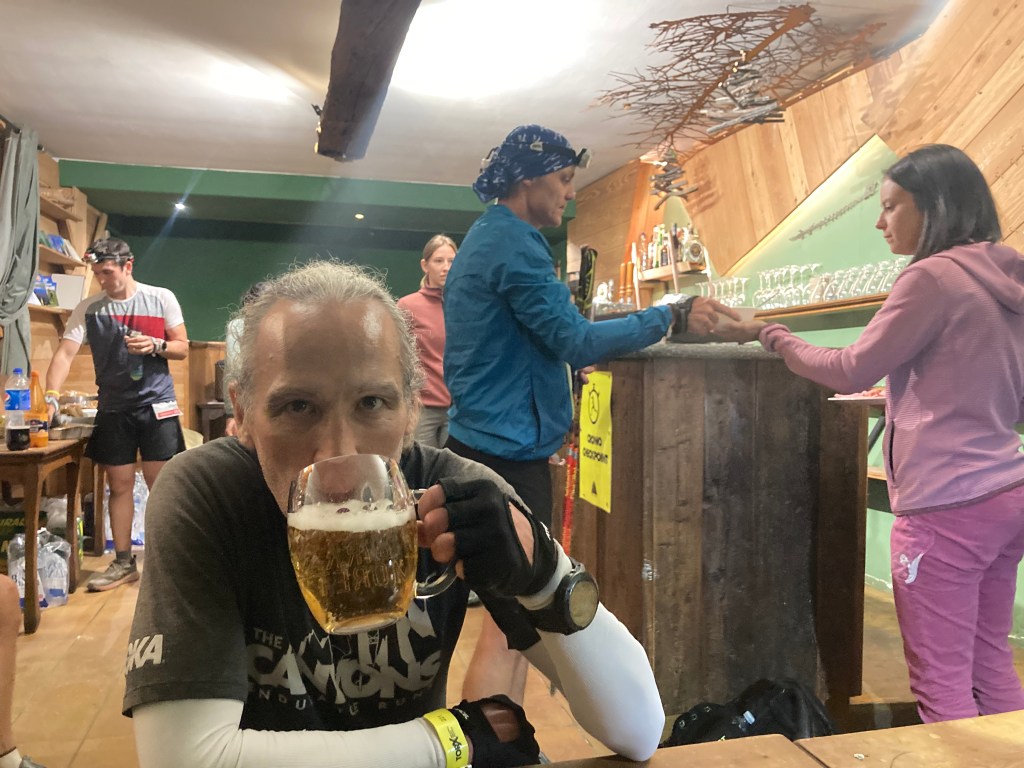


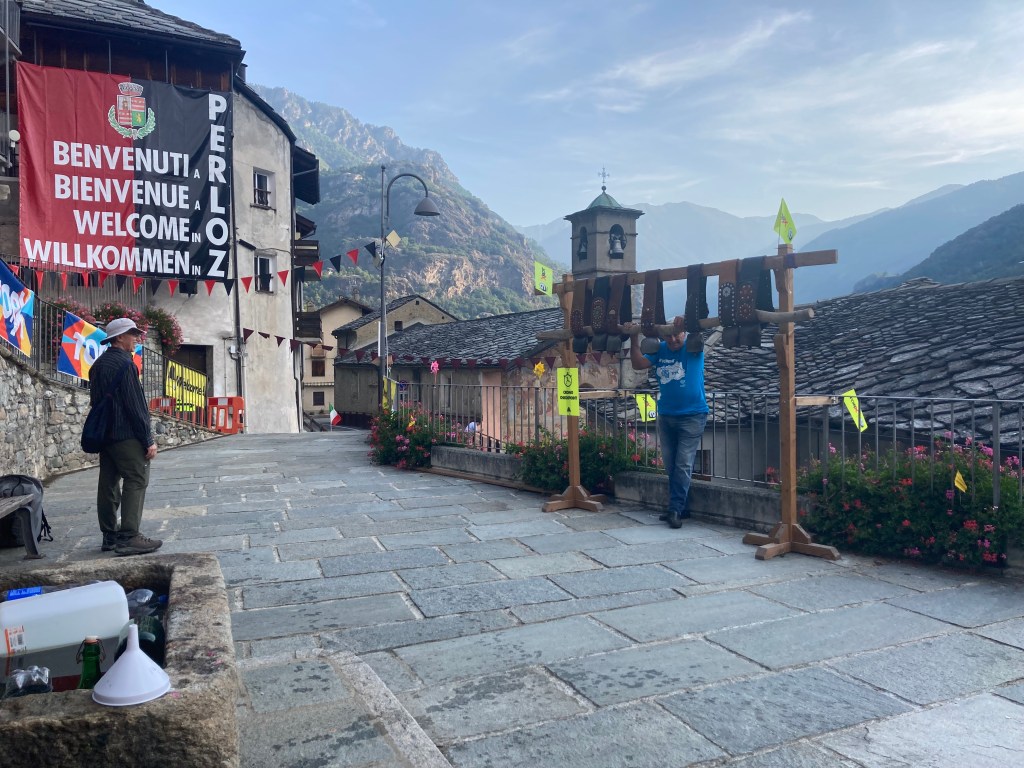
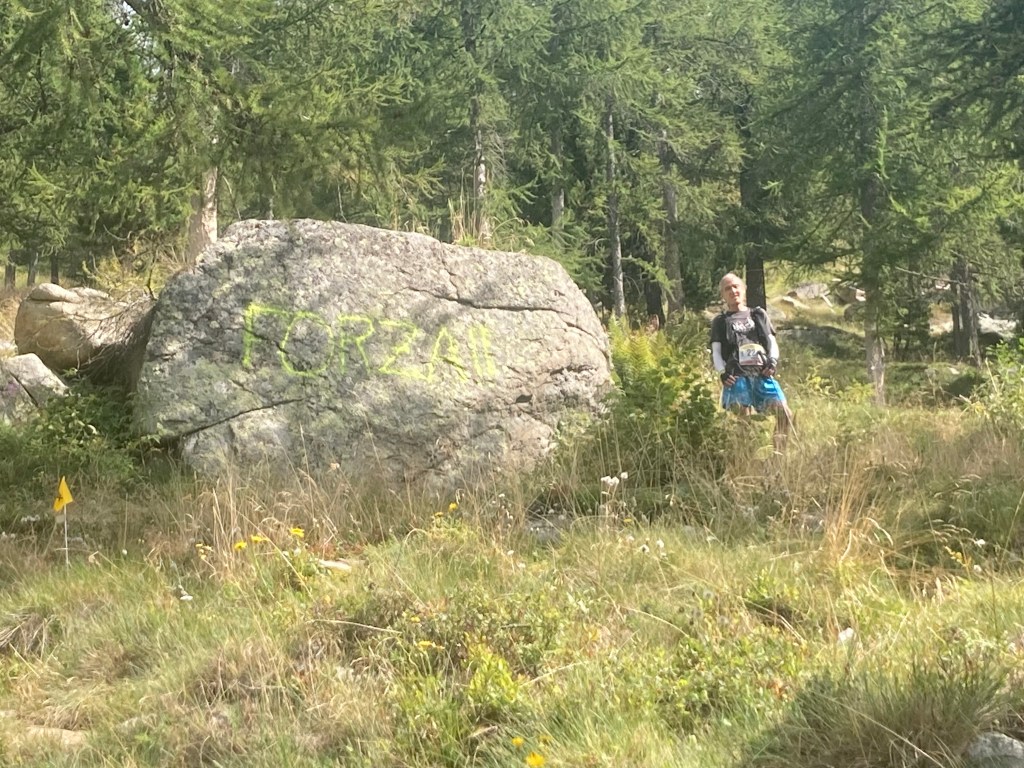

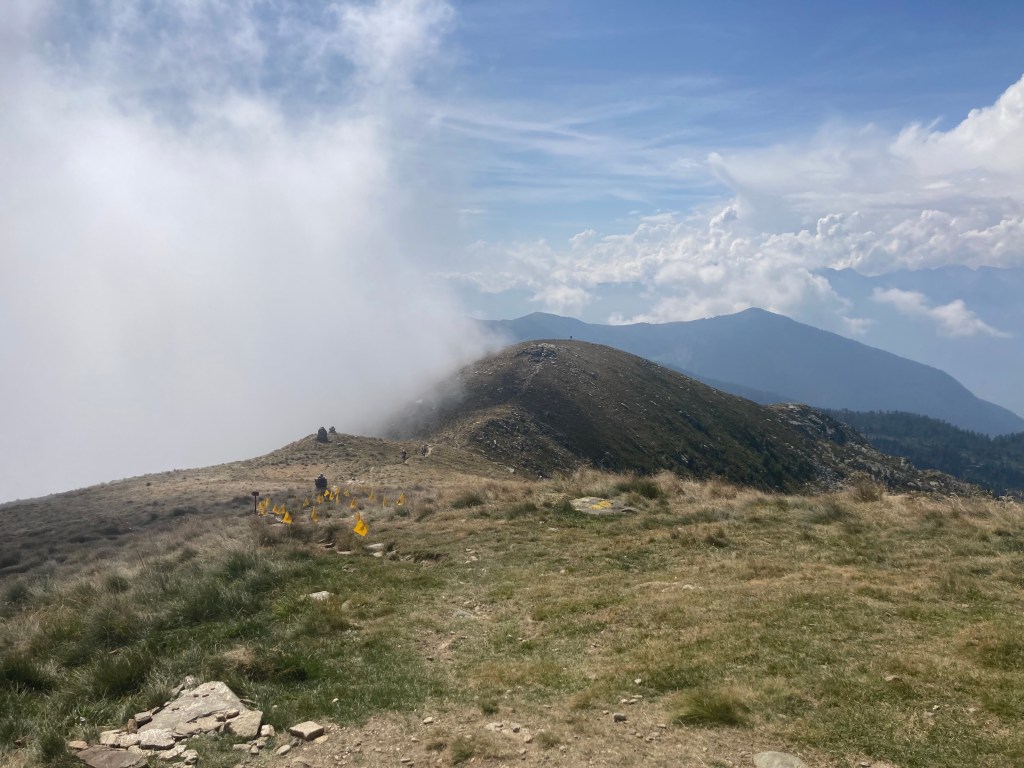


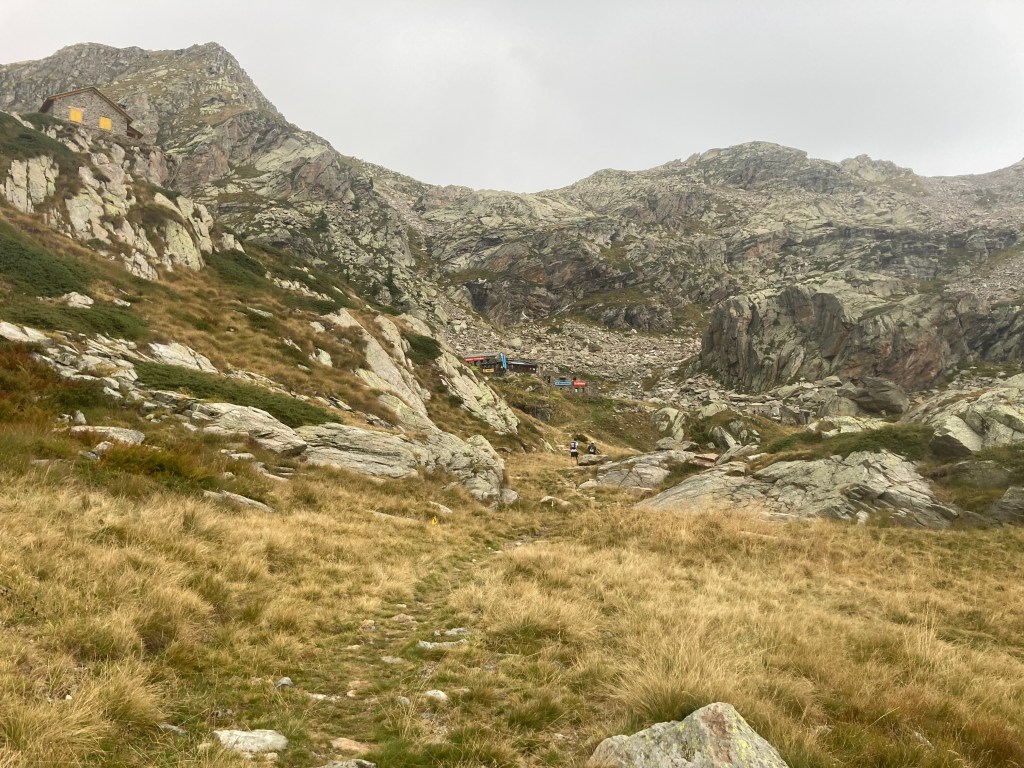



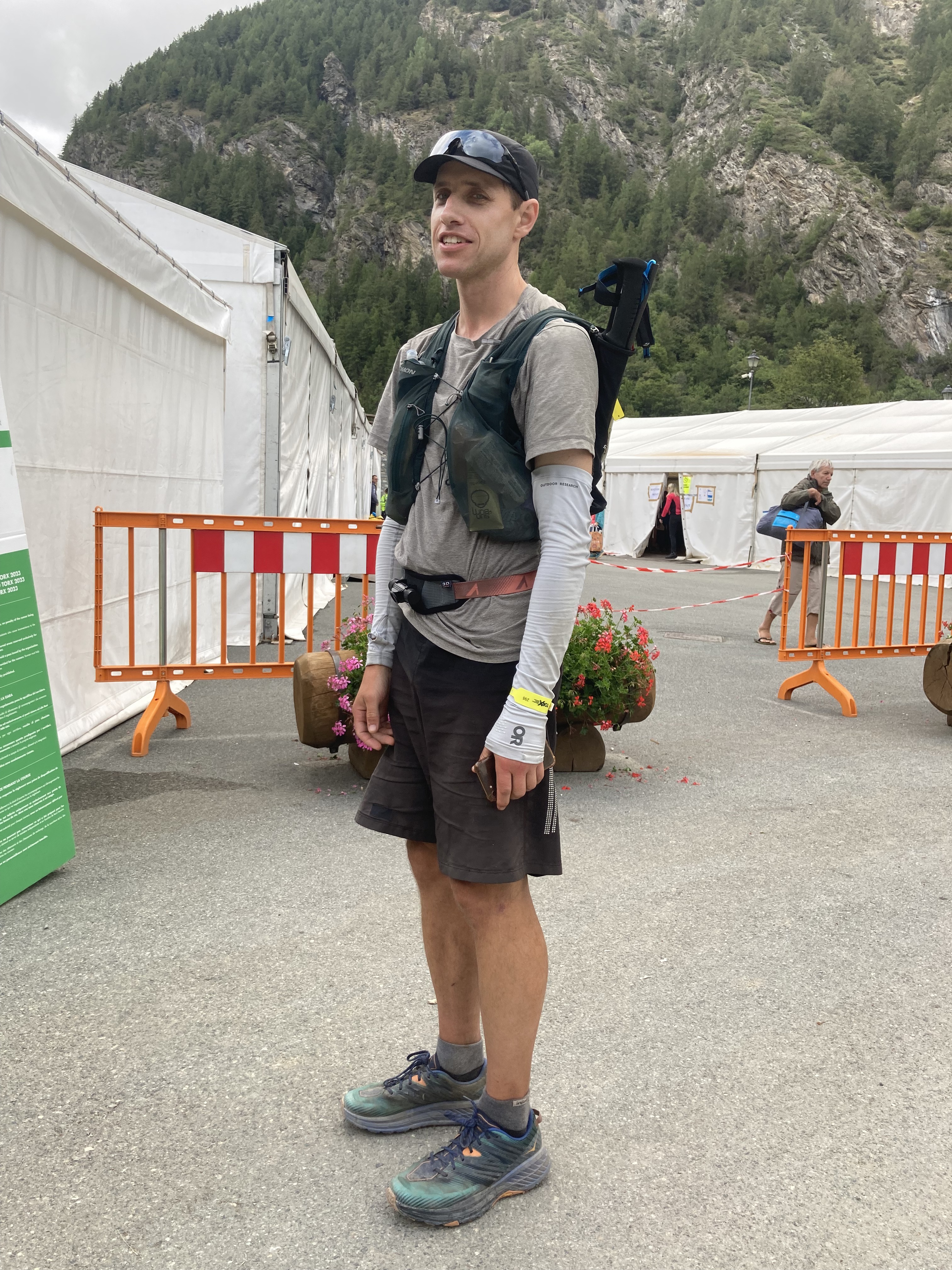


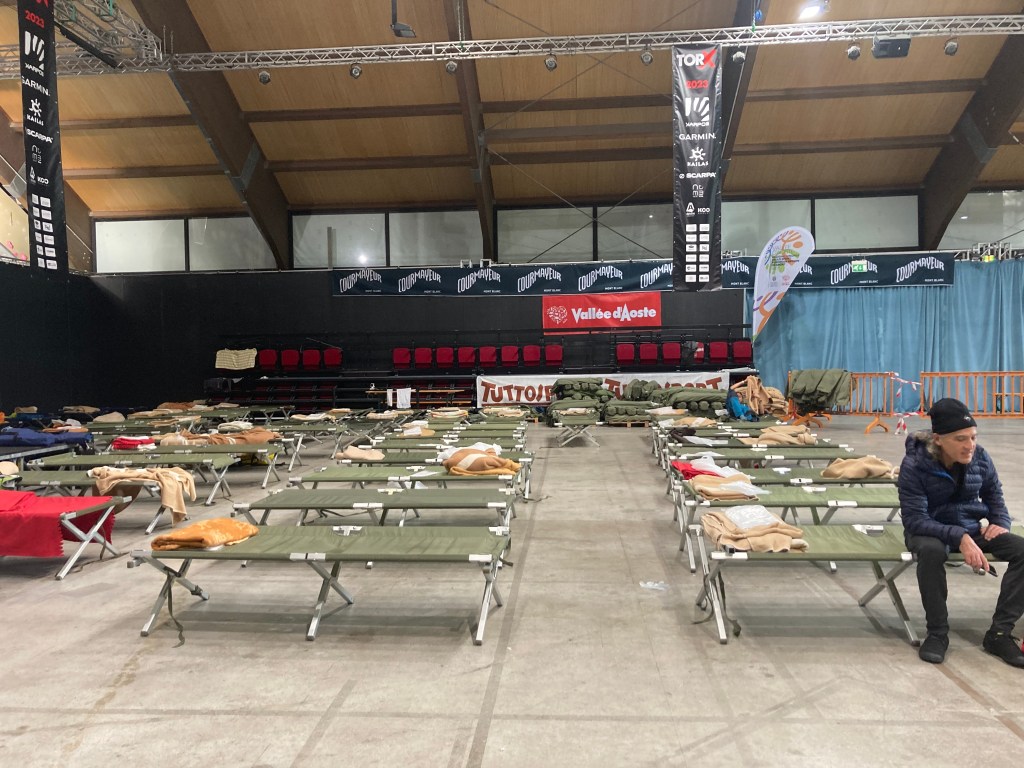
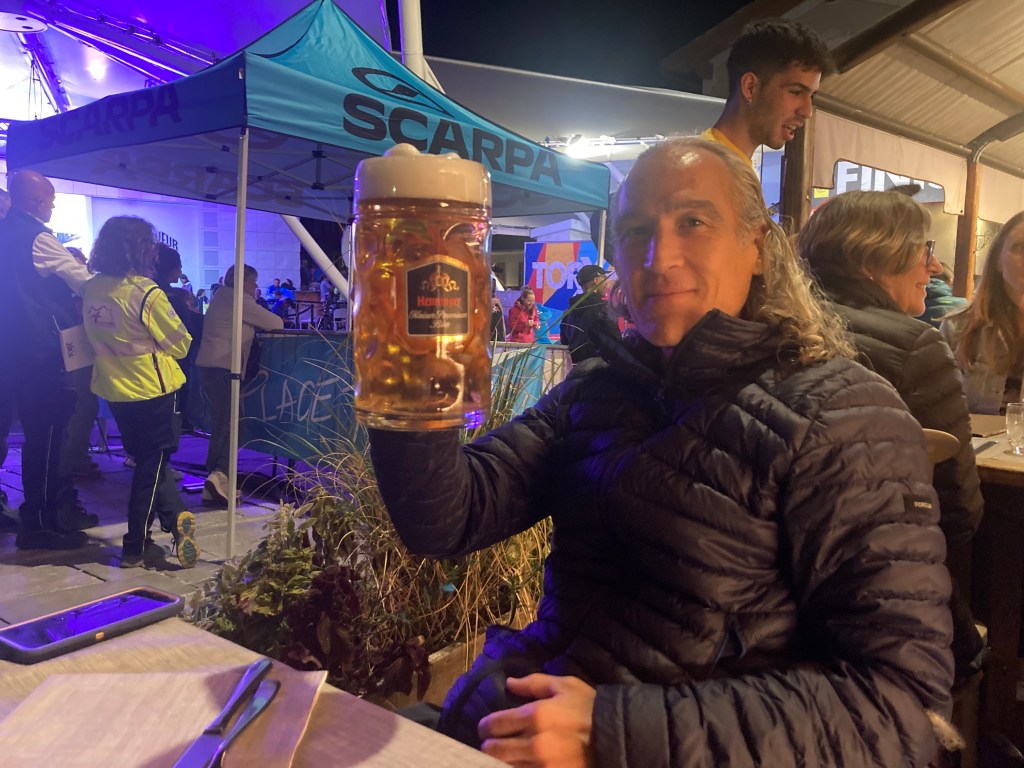


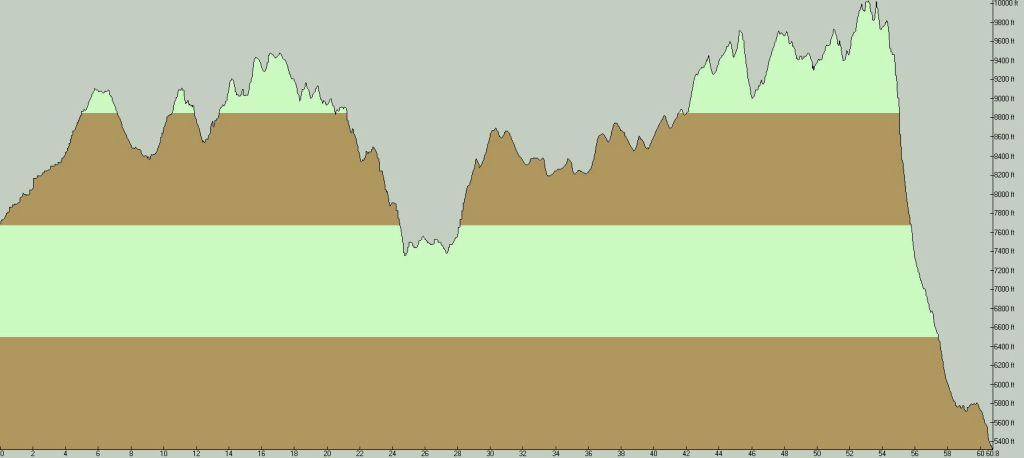

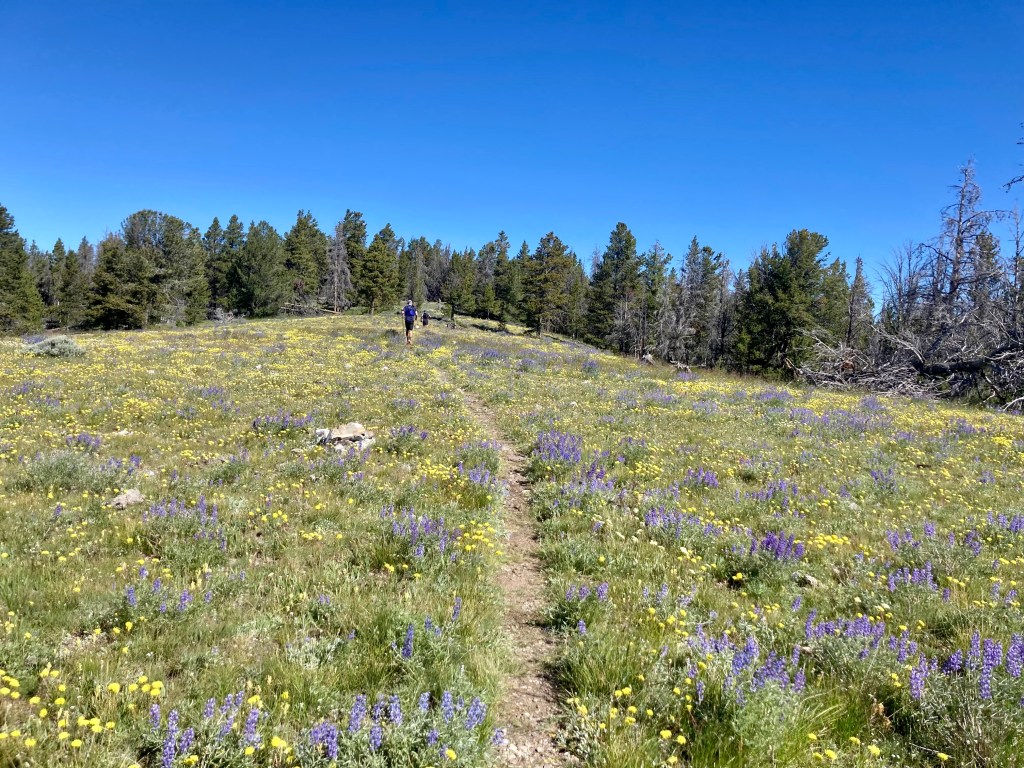


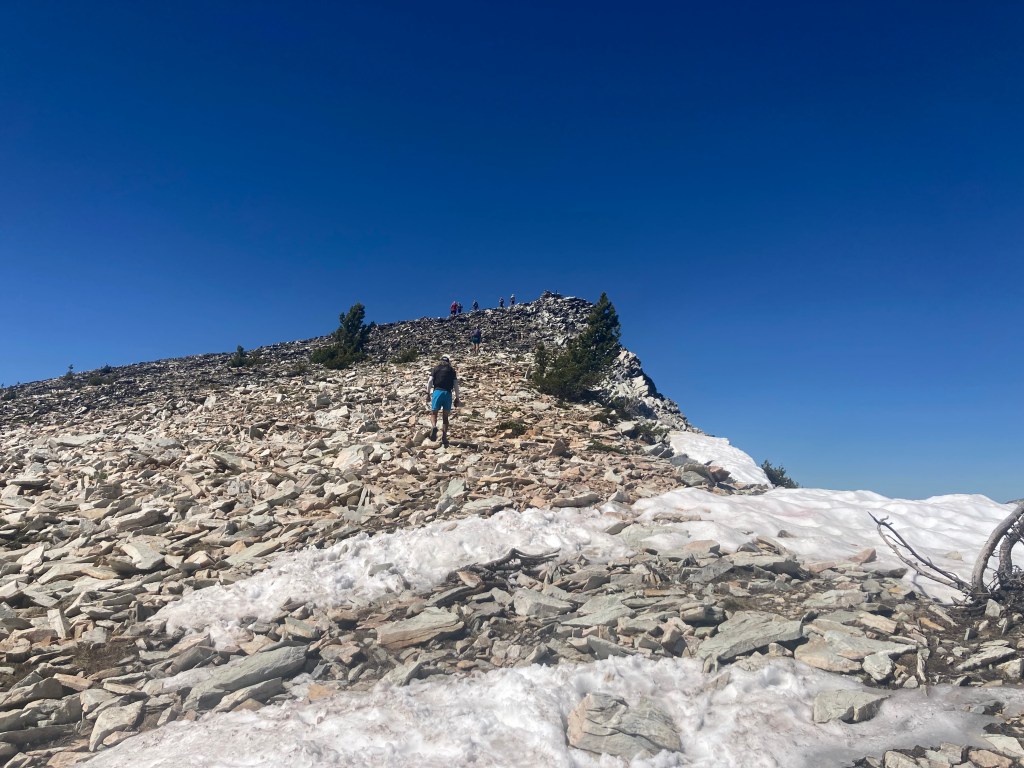


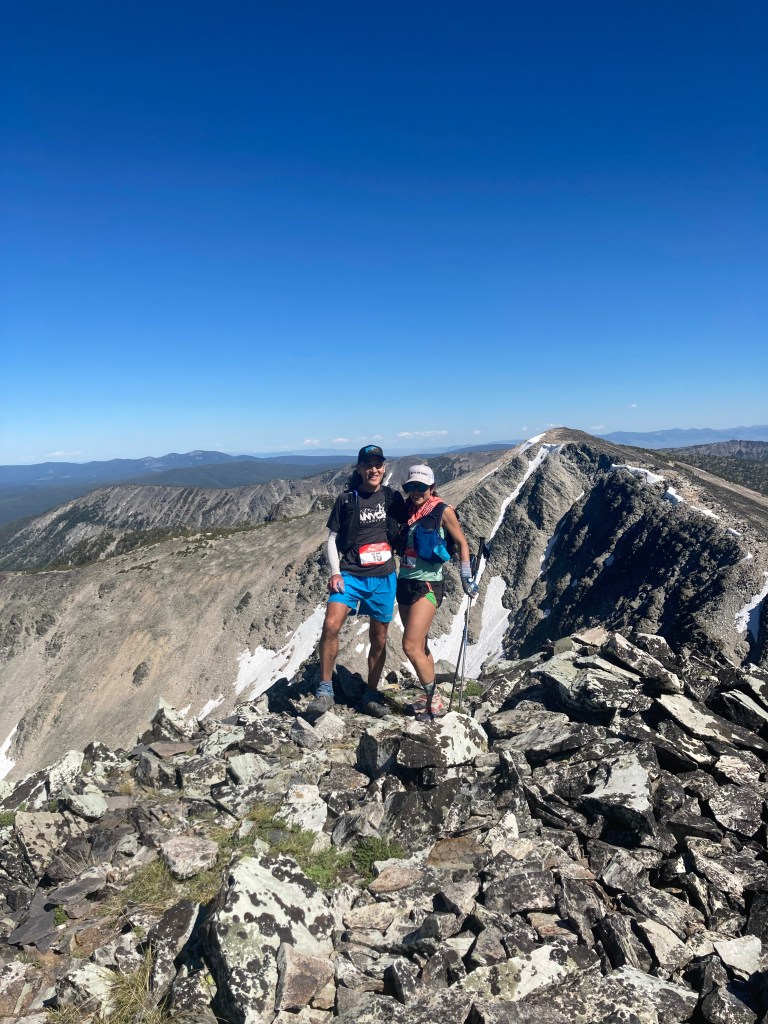

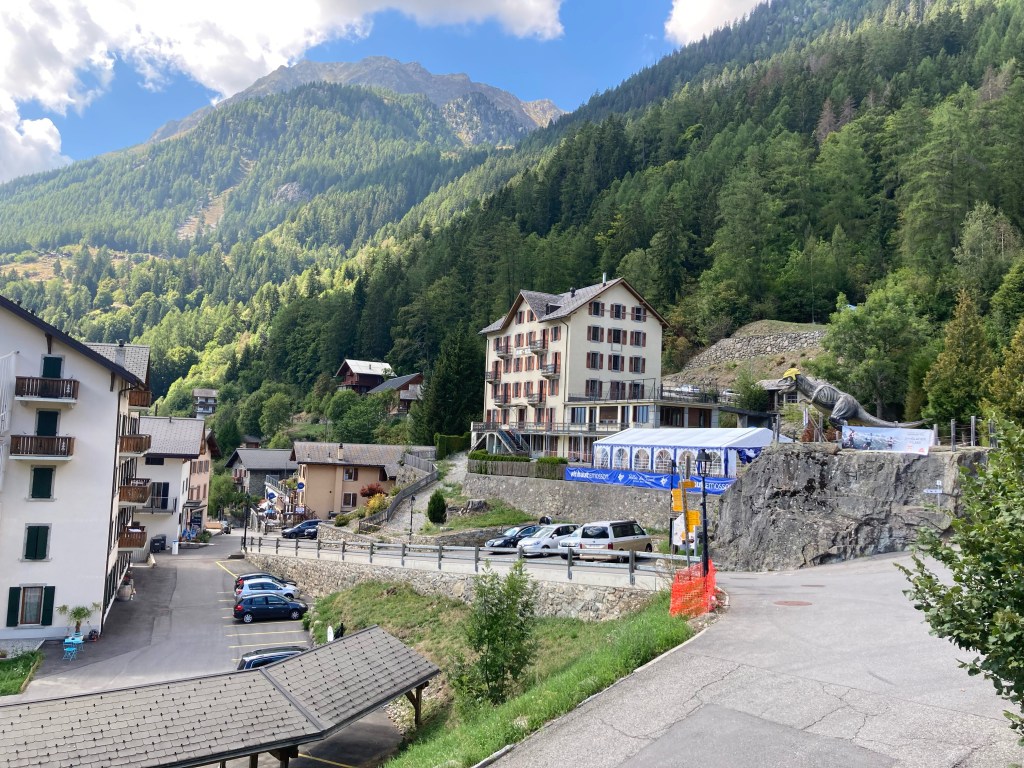
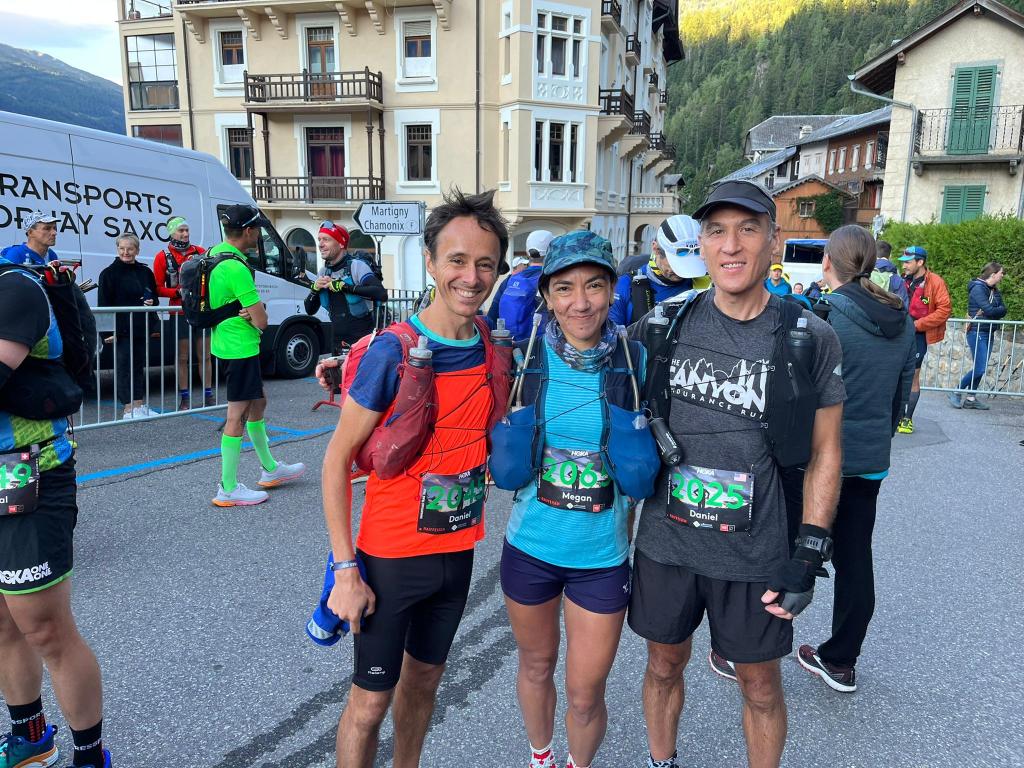


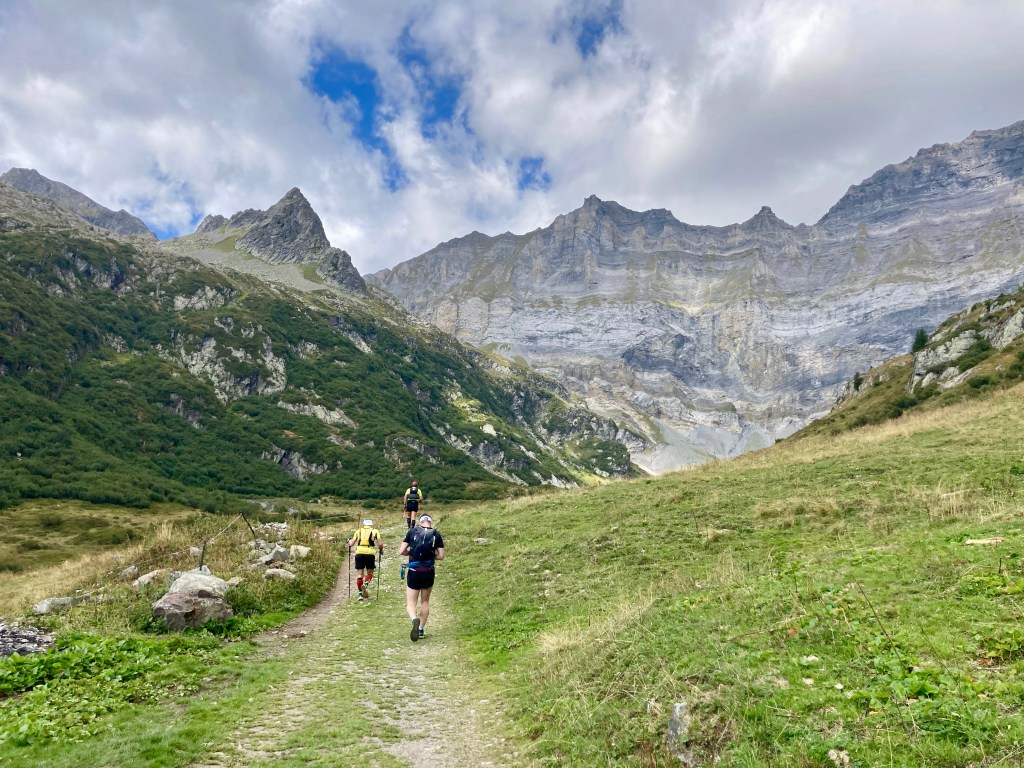


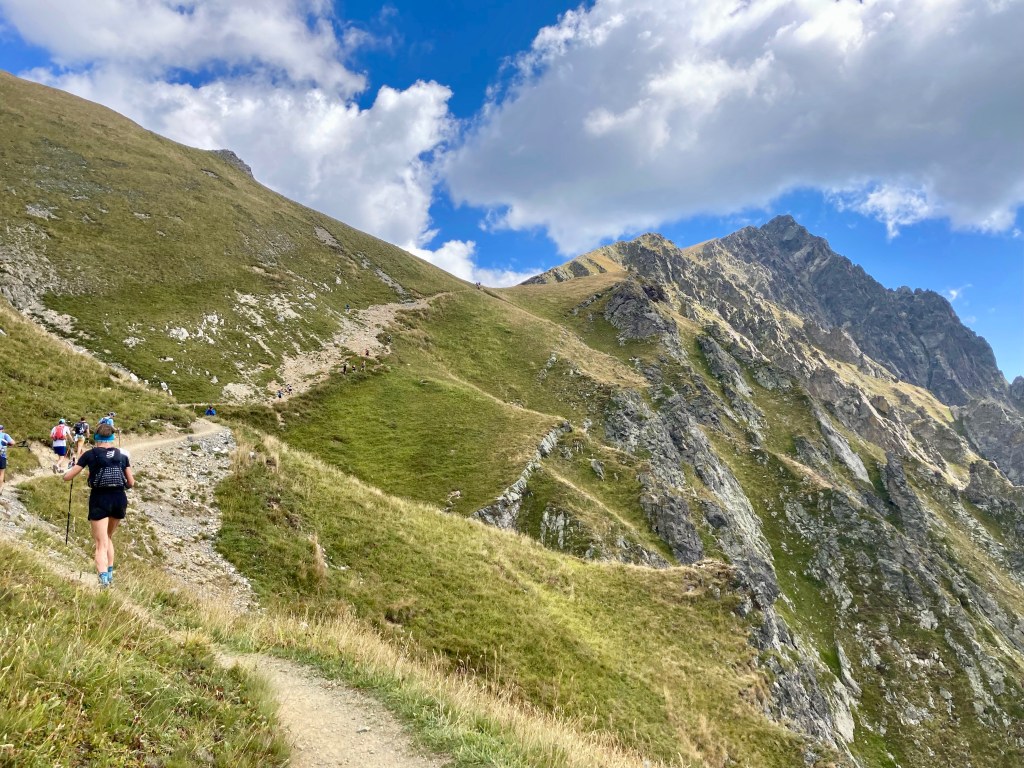
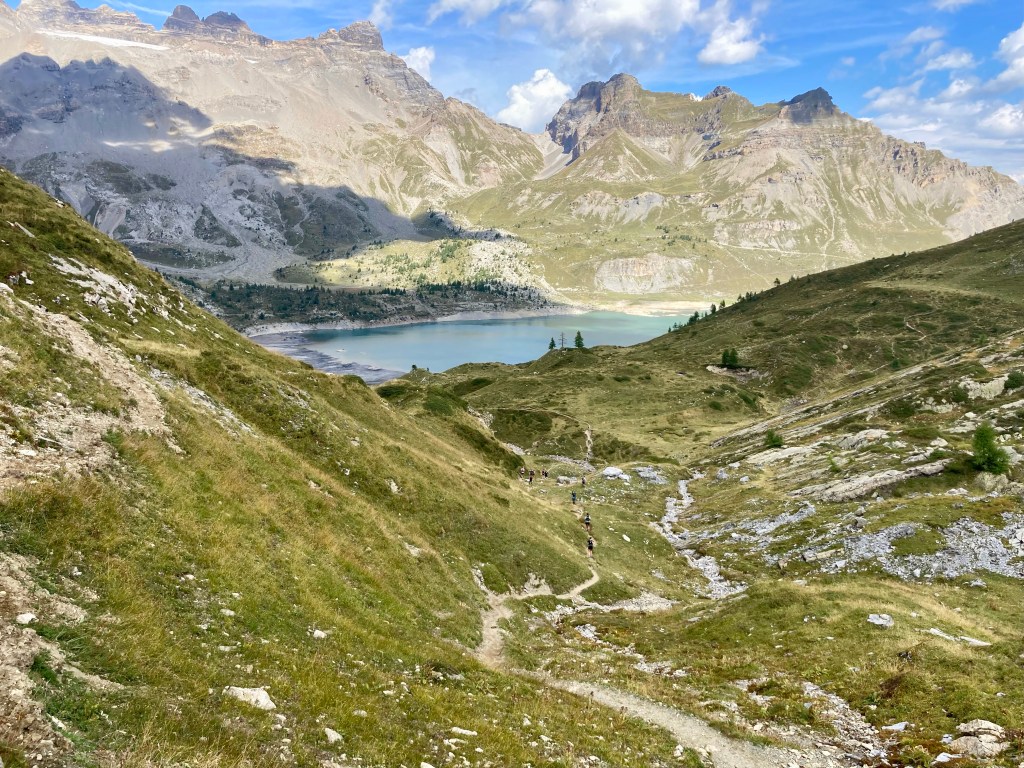
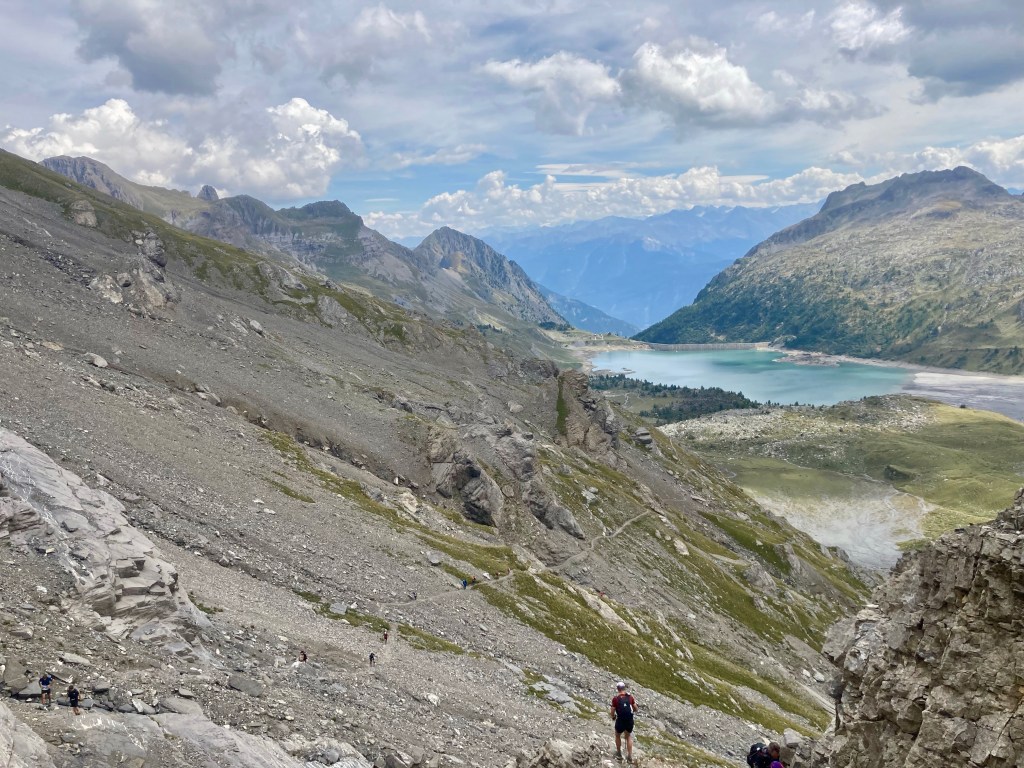
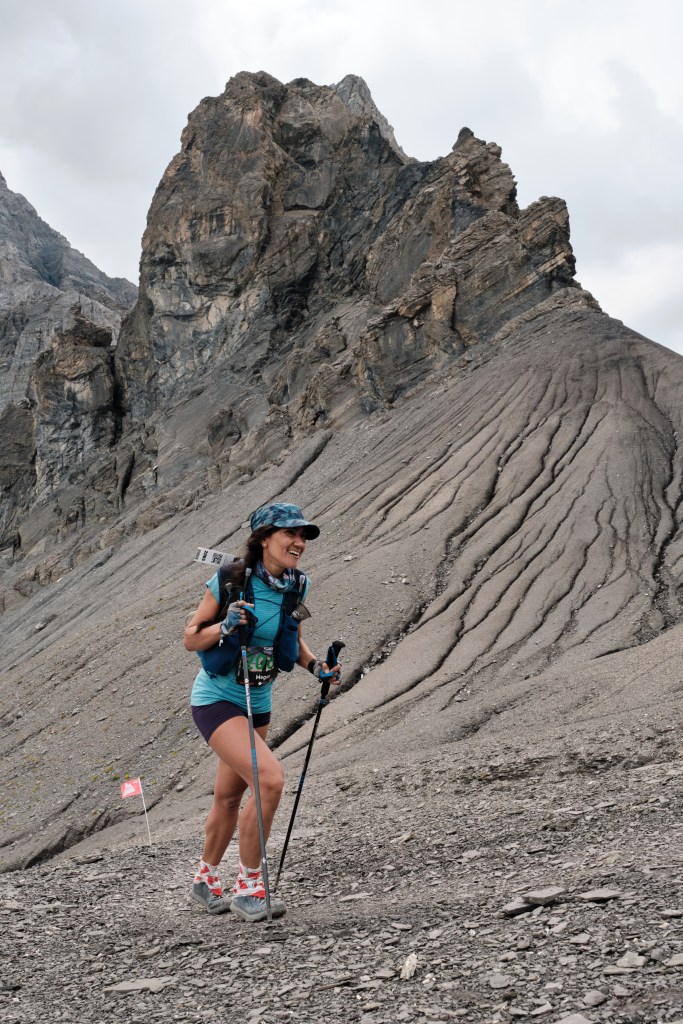
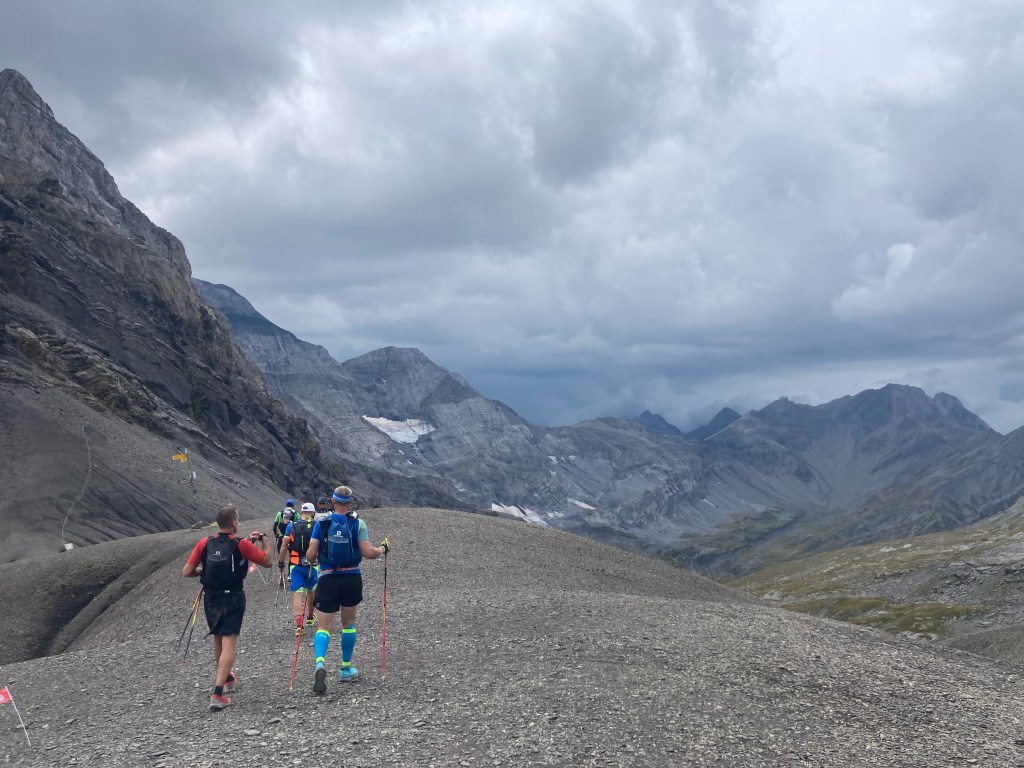

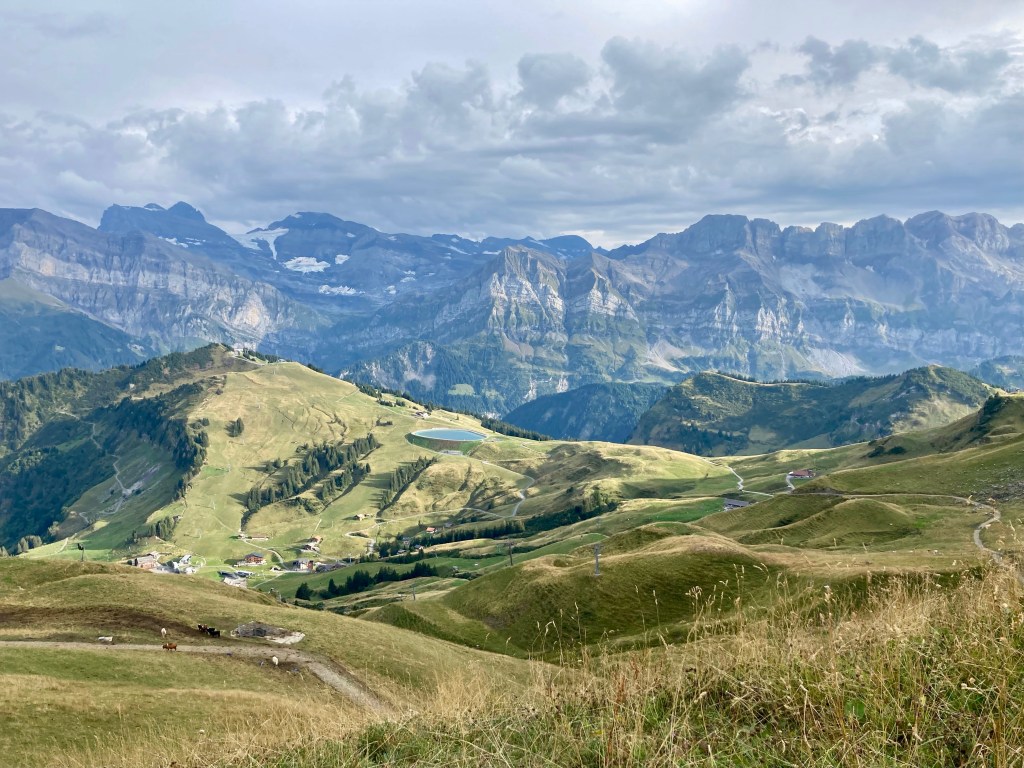


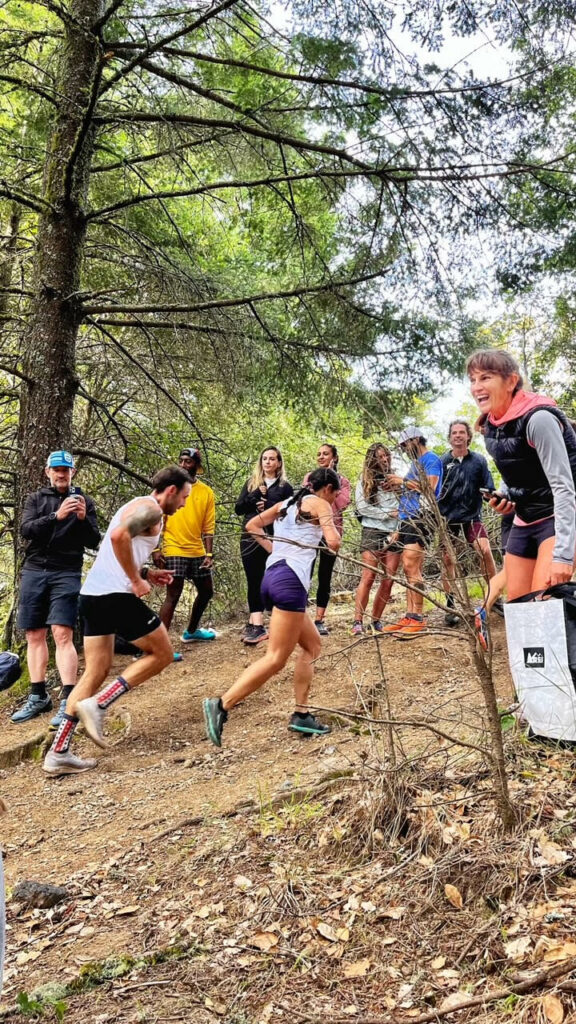


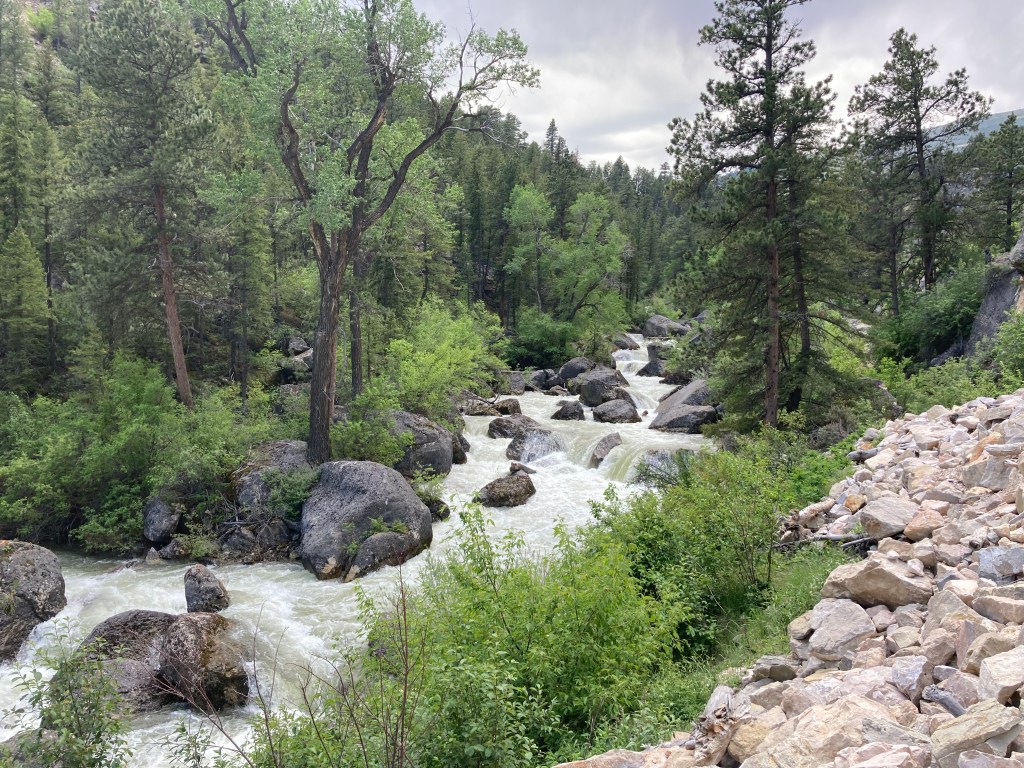


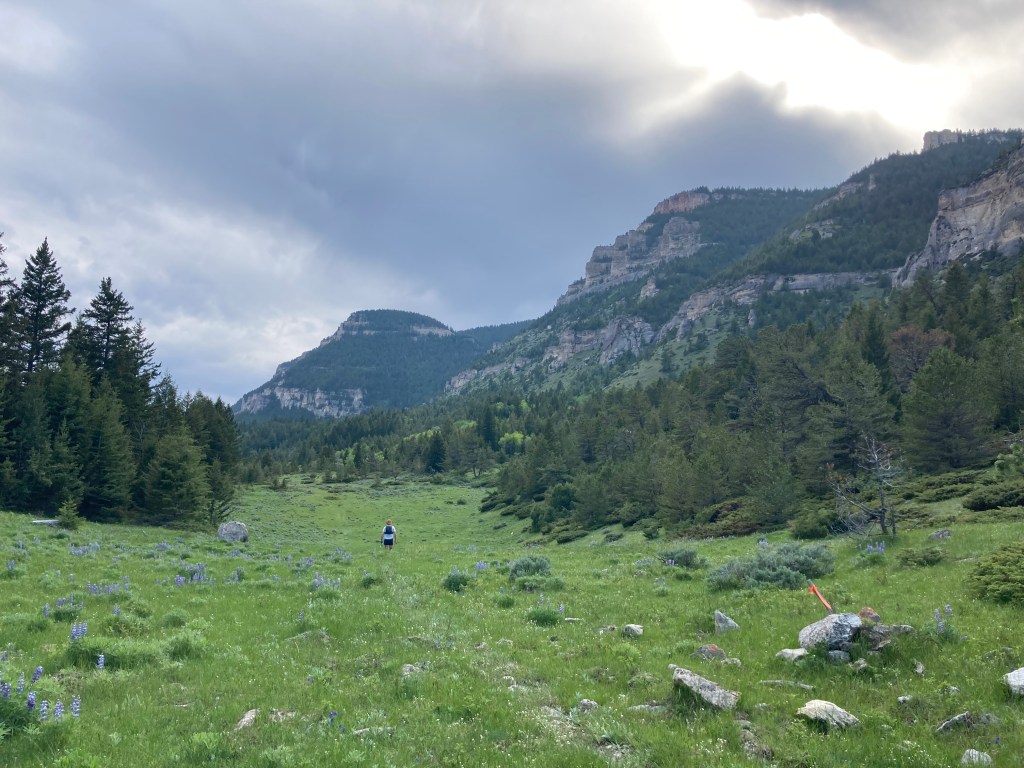
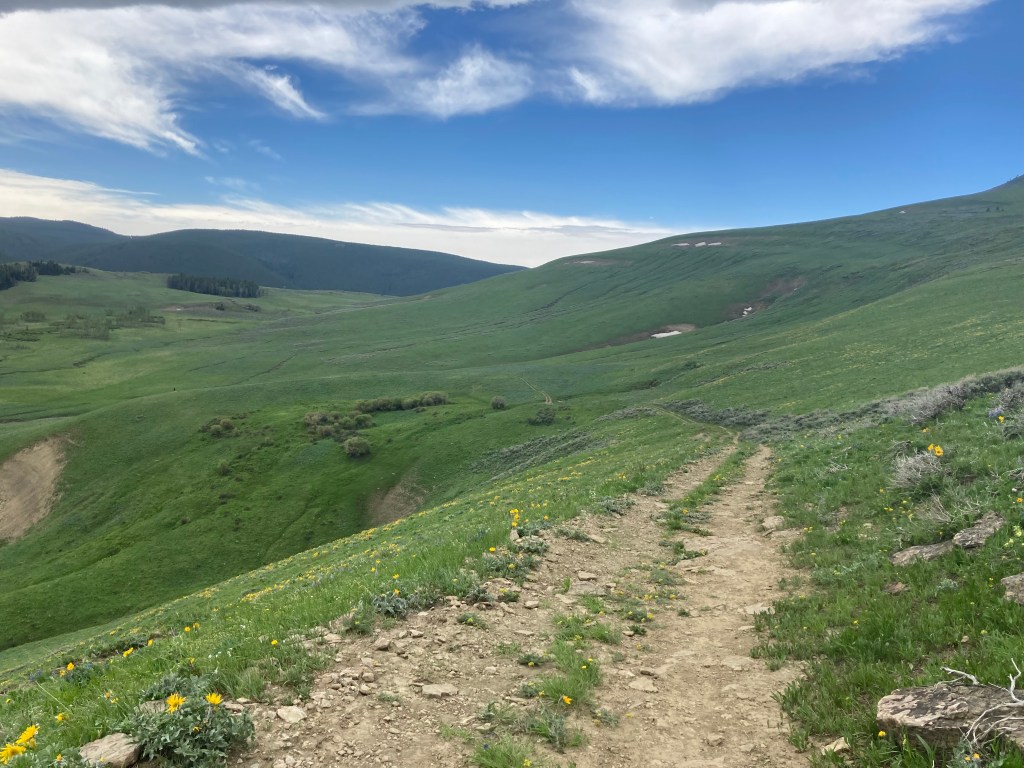
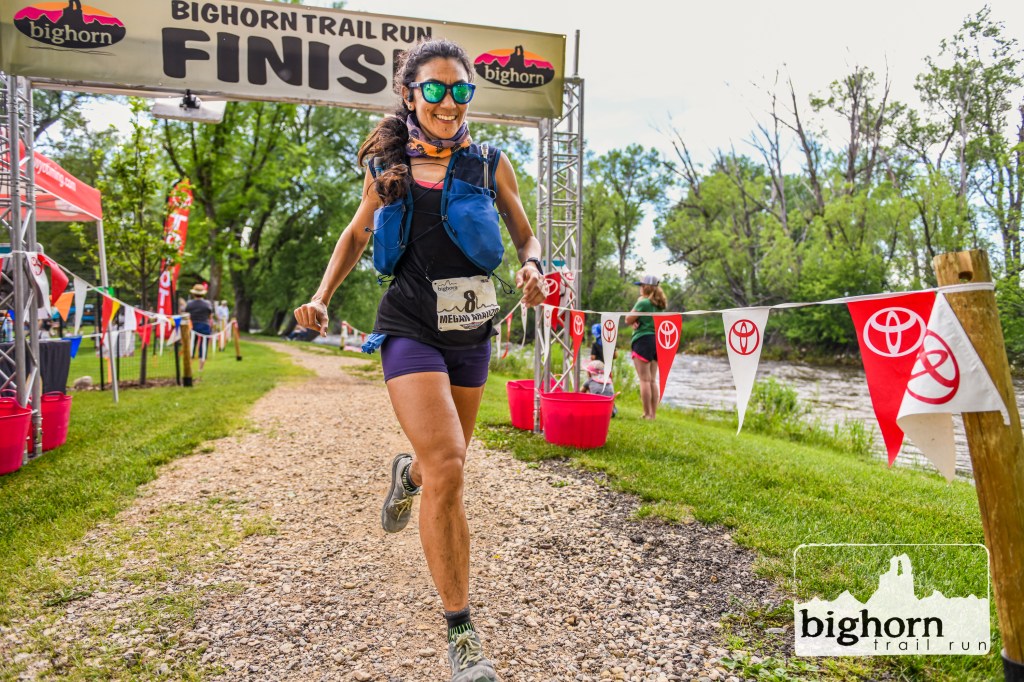


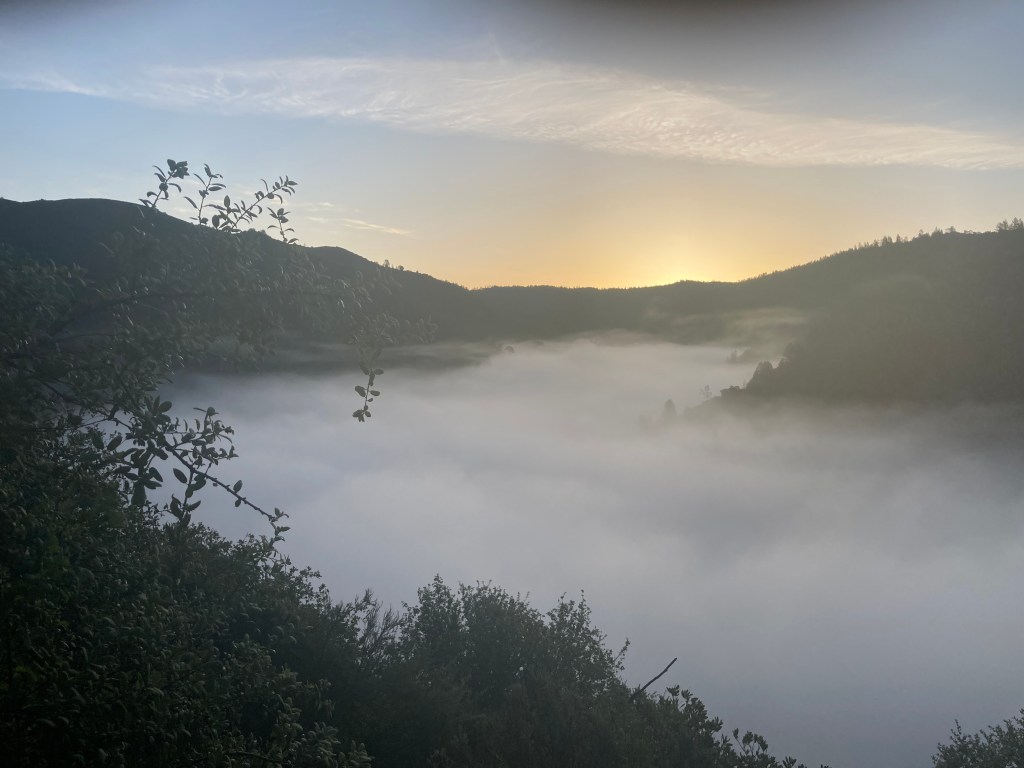


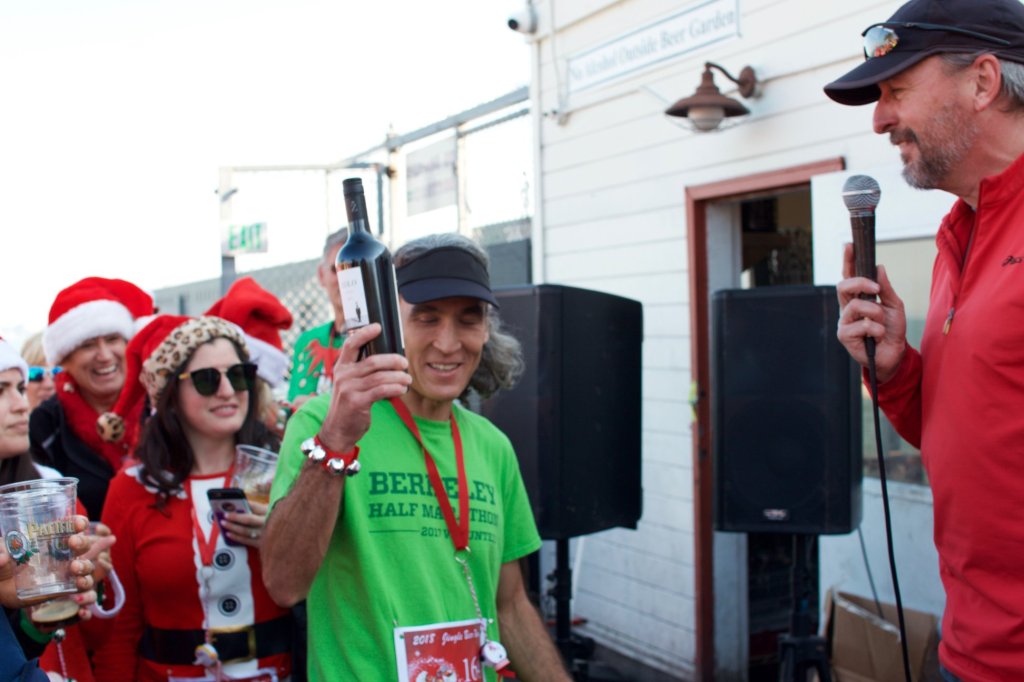
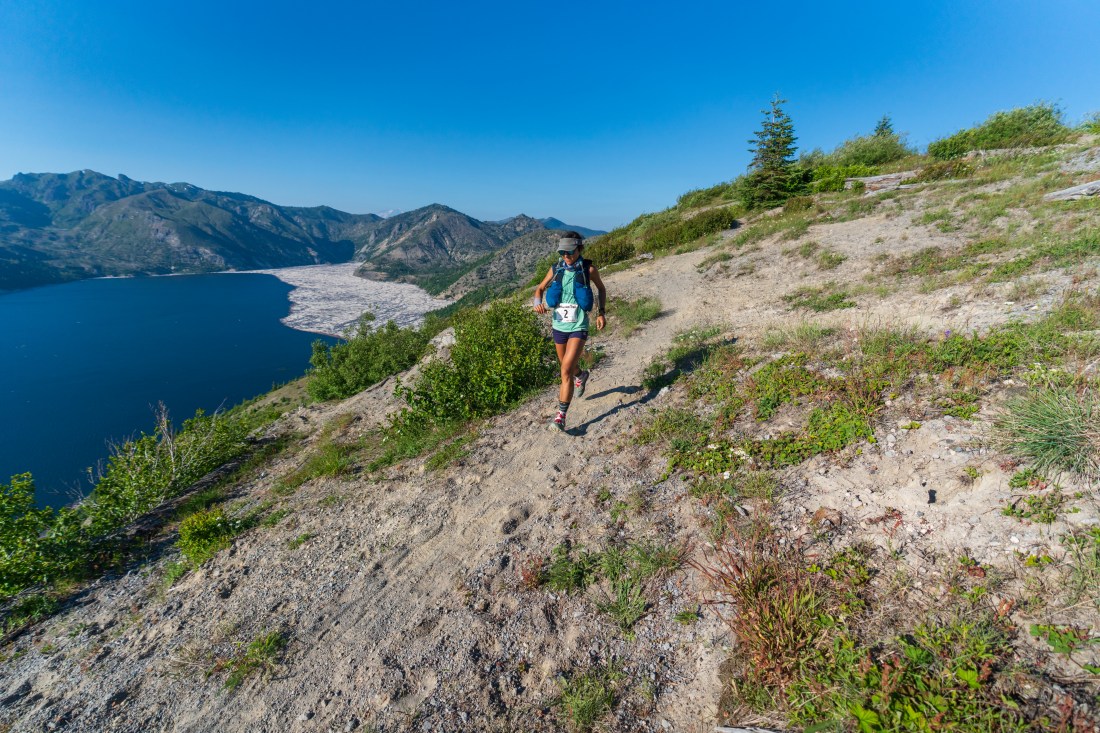
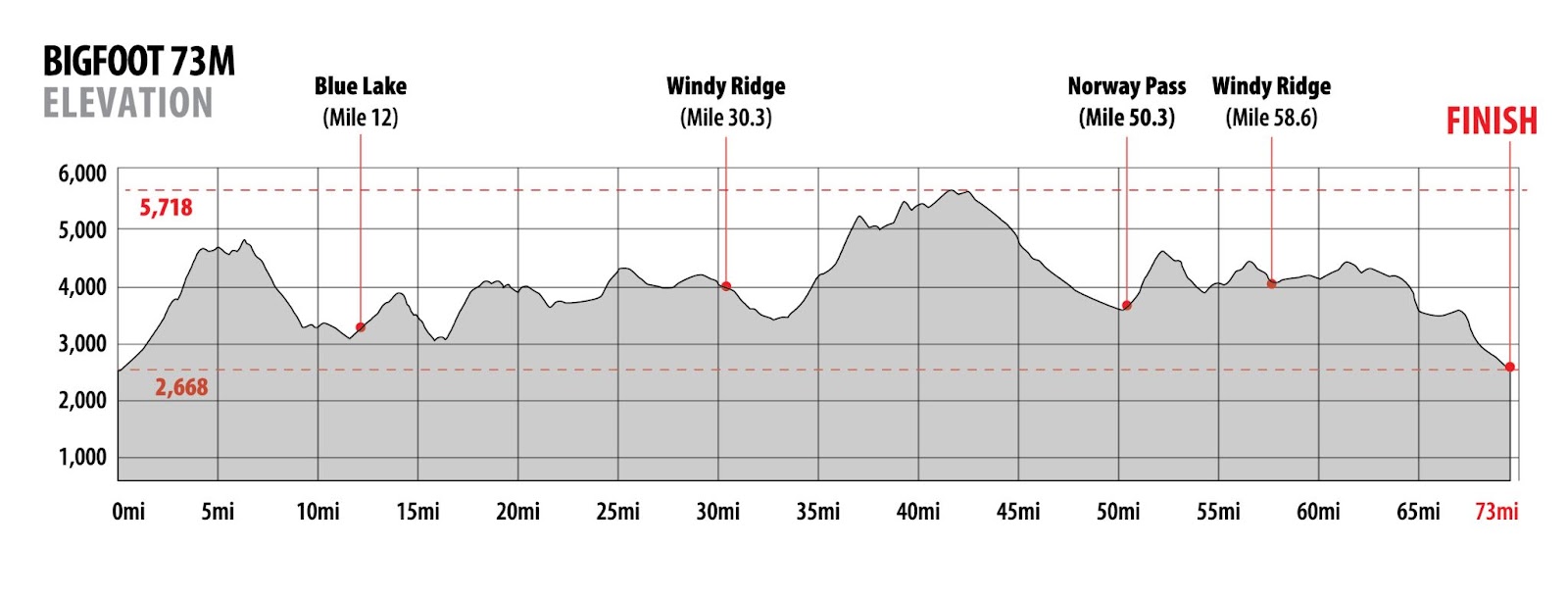

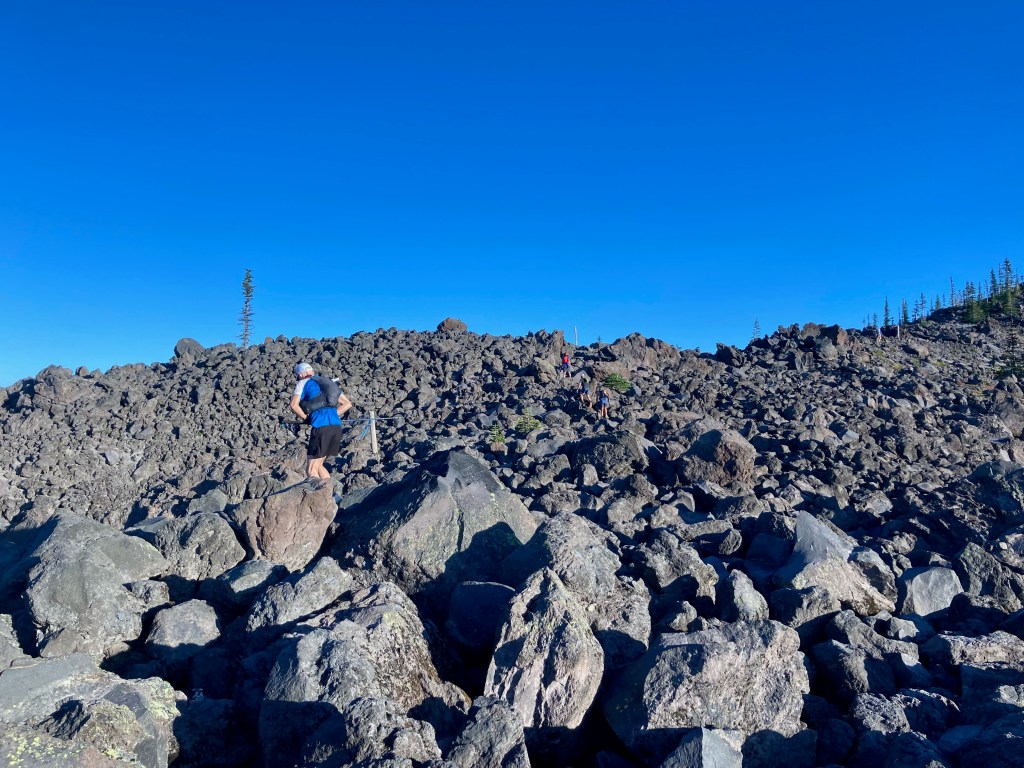

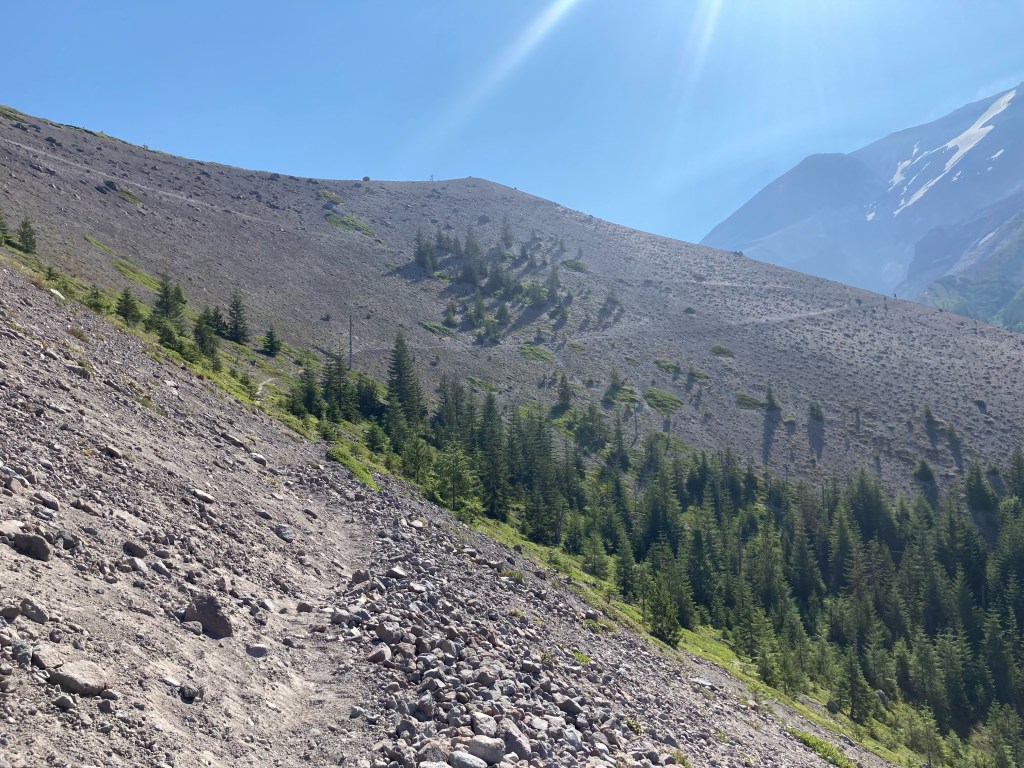
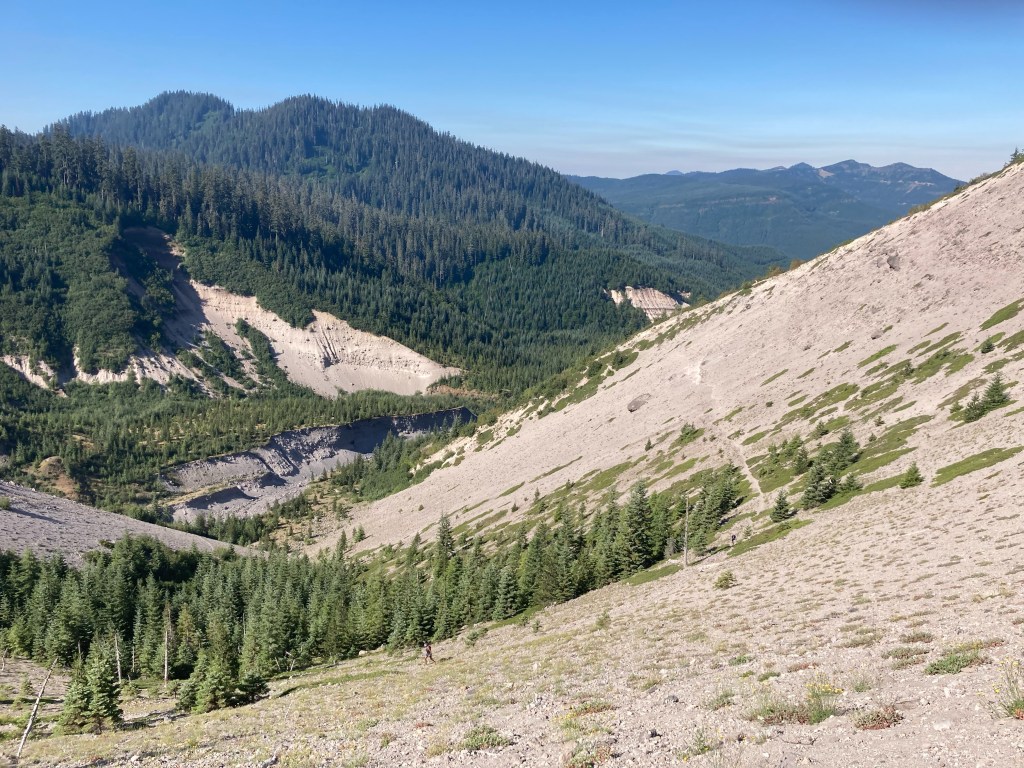


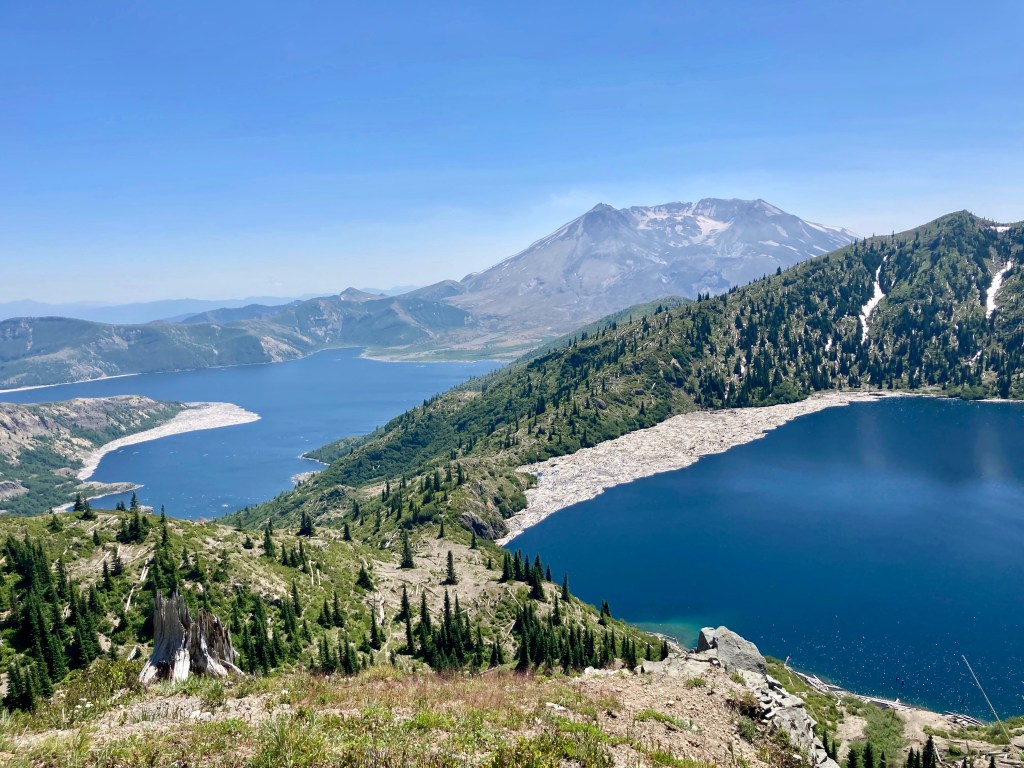


 Meg-A-Miles